
Medieval Cross of Sergeac

Sergeac is one of those magnificent villages you wish you had discovered sooner!
In the 12th century, it was the most important commanderie (command post) of the Order of the Knights Templar in Périgord, set back from the road (now D65).
A superb Hosanna cross marks the junction of the small path that leads there.
Hosanna crosses were funerary monuments that often marked mass graves or ossuaries. Most of them stood on a column and a stone base.
“Hosanne” or “Ozanne” refers to the boxwood branches placed at the foot of the cross on Palm Sunday.
However, the medieval cross of Sergeac is quite unusual because it does not mark a burial site.
It was used more to show travellers and pilgrims the way to the commanderie, as the region was then covered with a thick oak forest.
Sergeac, a former Knights Templar Commanderie
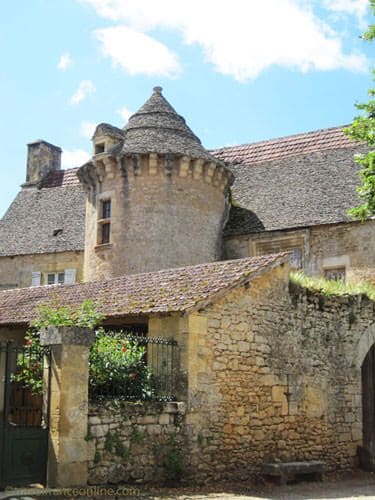
Sergeac, perched above the Vézère River, is safe from flooding, a privileged situation that has attracted populations since Gallo-Roman times. The numerous remains discovered in the village of Sergeac also show that the site was constantly inhabited from Antiquity until the end of the Middle Ages.
The construction work of the church in the 11th century indeed unearthed the foundations of Roman houses and a Visigoth necropolis.
In the 13th century, Elie Rudel, lord of Bergerac, donated the lands of Sergeac and their associated rights to Géraud Lavergne, Commander of the Order of the Templars in Périgord.
Lavergne then established a commanderie, making Sergeac the most important Templar stronghold in Périgord.
However, the fate of the Templars took a tragic turn when King Philip the Fair ordered their arrest in 1307, leading to the order’s downfall.
Accused of heresy and idolatry, the Templars underwent a seven-year trial that resulted in their death sentence and the suppression of their order in 1312.
On March 18, 1314, the Grand Master of the Templars and two other dignitaries were burned at the stake in the Square du Vert Galant in Paris.
After the dissolution of the Templar order, all their commanderies were transferred to the Order of the Hospitallers of Saint-John of Jerusalem. In 1316, Sergeac thus came under their control.
Their Commander Guillaume de Crémirac moved into the manor, which then became known as Hospitalum Cramiraco.
Faced with escalating tensions during the Hundred Years War, the Hospitallers fortified Sergeac to protect its inhabitants and livestock from English raids and brigands who were rampant in the countryside.
Sergeac, a listed village
Peace and tranquillity have returned to the region for a long time!
The village is still organised around the old Commandant’s House, known as the Manoir de Cramirat, and the church. This magnificent fortified manor, now privately owned, features remarkable architectural characteristics, including a large round tower in the courtyard and several grotesques carved on its facades.
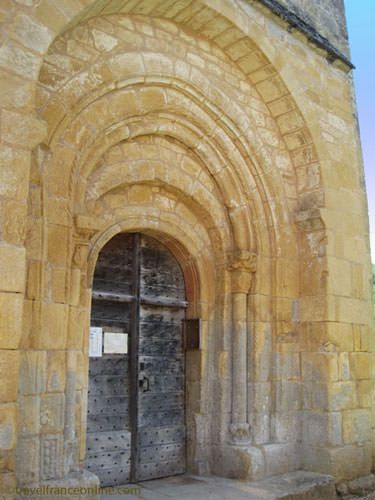
The Hospitallers not only fortified the village but also reinforced the church, transforming it into a fortress-refuge. Despite the attacks suffered during the Wars of Religion, the imposing fortified church still stands, bearing in its stones some traces of its tumultuous past.
Fortunately, the church’s magnificent Romanesque porch remained intact.

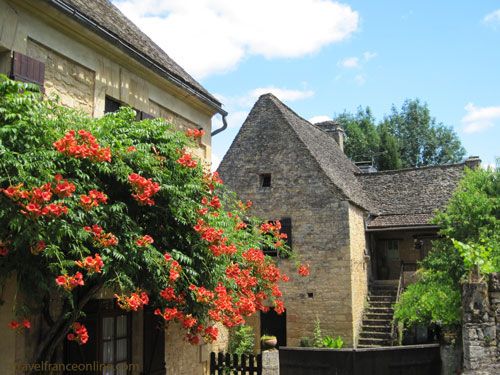
Picturesque old limestone houses, most covered with lauze (limestone slabs), line the village’s narrow streets, contributing to the Sergeac’s unique charm. It seems that time has stood still since the Middle Ages, as the entire village has being classified and protected by strict building regulations. As a result, there are no shops or tacky souvenir stores!
However, a small museum of local prehistory and archaeology has created in one of the village houses. It displays various objects unearthed in Castel-Merle, a cave located behind the village.
Sergeac is undoubtedly a must-see destination for those who wish to immerse themselves in the region’s timeless beauty and history.
Department of Dordogne
Coordinates: Lat 45.002830 – Long 1.106500
Where to stay? L’Auberge de Castel-Merle
Please note that Travel France Online is not responsible for the contents or services offered by the websites listed on its site


