
Saint-Léonard-de-Noblat, a village named after a holy man

Saint-Léonard-de-Noblat is located approximately 20 kilometres east of Limoges.
The village developed at a strategic point, along the Roman road connecting Avaricum ((Bourges) to Burdigala (Bordeaux) and by the ford across the Vienne River.
This road later became part of the Voie Limousine or Voie Lemovicensis, one of the pilgrimage routes to Santiago de Compostela in Spain. The village was named in honour of Saint Leonard de Noblac, a revered figure of the 6th century. Also known as Léonard de Limoges and Léonard de Noblet, he came from a Frankish aristocratic family and served at the court of King Clovis.
Saint Leonard became the patron saint of prisoners because of his reputed ability to visit them and set them free. However, despite his high rank, he refused any reward or privilege for his acts of compassion and mercy.
The legend of Saint-Léonard
Saint Leonard joined the religious orders, and withdrew to a hermitage in the Forest of Pauvain, on a hill overlooking the Vienne River.
It was during this time that he also became the patron saint of pregnant women.
Legend indeed recounts that Saint Leonard implored God when the Queen of Aquitaine was experiencing a difficult childbirth. The queen gave birth to a healthy son, and both mother and child recovered quickly. In gratitude for this miracle, the king gifted Saint Leonard the lands of Noblac and the forest of Pauvain.
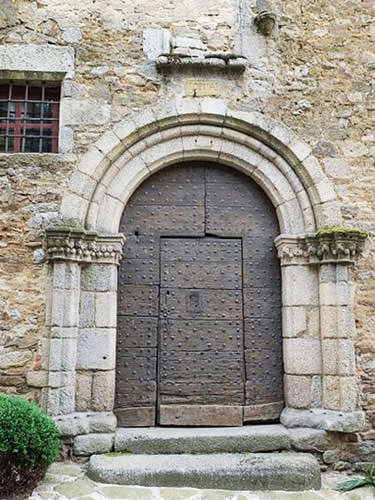
Upon his return, Saint Leonard had the Chapel of Our Lady Under the Trees built, which he dedicated to the Virgin Mary and to Saint Remigius of Reims.
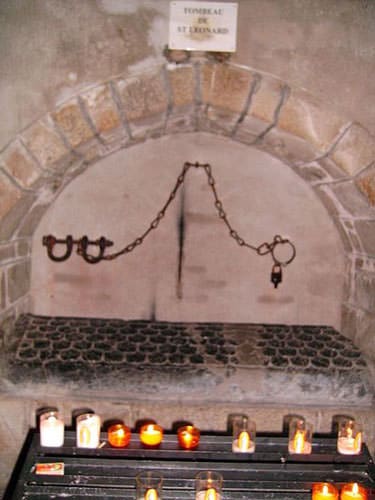
The chapel became a refuge for many prisoners who were freed thanks to Saint Leonard’s diplomatic efforts. Saint Leonard died in 559 AD and was buried in the chapel. His tomb quickly became a place of pilgrimage, attracting devout Christians from France and beyond
Abbey of Saint-Léonard-de-Noblat
The Abbey of Saint-Léonard-de-Noblat was built in the early 11th century on the site of his tomb.
Over the centuries, pilgrims from all walks of life came to the abbey to invoke the saint, including women struggling to conceive and families of prisoners. Kings and queens, such as Richard the Lionheart, Charles VII and Anne of Austria, also made pilgrimage to the abbey.
The pilgrimage’s popularity endured through the ages thanks to the holy man’s renown, but also the abbey’s prime location and access along the Via Lemovicensis.
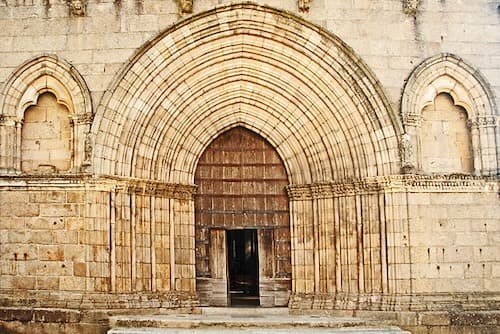
The Collegiate Church of Saint-Léonard-de-Noblat is a listed historic monument and a UNESCO World Heritage Site of the Routes of Santiago de Compostela for its oustanding Romanesque architecture.
The church’s bell tower, in the Limousin architectural style, is open on two sides and consists of two square floors topped by two octagonal floors. The tomb of Saint Leonard, protected by a prisoner’s chain, is located on the ground floor of this tower. According to tradition, women who are barren or who wish to conceive must touch the lock to receive the saint’s blessing.
Town of Saint-Léonard-de-Noblat
Saint-Léonard-de-Noblat boasts numerous religious and medieval buildings, including the 13th-century inn, the priory, the Maison des Consuls (House of the Consuls), and the Pont de Noblat (Noblat Bridge).
The Gay-Lussac Museum, housed in a former convent, pays tribute to the renowned chemist born in Saint-Léonard-de-Noblat.
Cycling enthusiasts will surely know that Raymond Poulidor, one of the most celebrated French cyclists of the 20th century, spent his retirement in the village.
Let’s not forget the Moulin de Got, built in 1522, which once produced rag paper from hemp, flax, and cotton. After a period of disuse, the mill was restored and reopened in 2003.
Finally, Saint-Léonard-de-Noblat is also famous for its Limoges porcelain factories,and for being the birthplace of the famous Limousin cattle breed, renowned for the quality of its meat.
Department of Haute-Vienne – Limousin region
Coordinates: Lat 45.836700- Long 1.486205
Photos via Wikimedia Commons: Collegiate Church St-Leonard and Church portal and Header by Jochen Jahnke CC BY-SA 3.0 – St-Leonard’s tomb by Sjwells53 CC BY-SA 3.0 – Pilgrims hospital by Reinhardhauke CC BY-SA 3.0


