
Château Gaillard, the Castle of the Dukes of Normandy
Perched on a rocky spur, Château Gaillard, although now in ruins, remains imposing and offers a breathtaking view of the meandering Seine at Les Andelys.

In the Middle Ages, the Seine was a vital transport route, linking Paris to the Normandy coast. Les Andelys had a strategic location, commanding one of the largest meandres of the river. It was also situated on the lands of Richard the Lionheart, King of England and Duke of Normandy!
Richard was the son of Eleanor of Aquitaine and Henry II of England, a descendant of William the Conqueror. He thus found himself caught in the complex power struggles between England and France.
In December 1195, Richard the Lionheart and Philip-Augustus, King of France, signed a treaty aimed at maintaining the neutrality of Les Andelys, a territory within the diocese of Rouen. According to this agreement, the Andeli were to remain unfortified, but Richard had other plans.
Disregarding the terms of the treaty, Richard had Château Gaillard built to protect Rouen from attacks by Philip Augustus, who, of course, sought to reconquer the Duchy of Normandy. This, naturally, reignited the latent conflict between the French and English, plunging the region back into war.
Château Gaillard, an almost impregnable fortress
Château Gaillard was built in just two years, from 1196 to 1198, a feat of engineering and logistics that astonished its contemporaries!
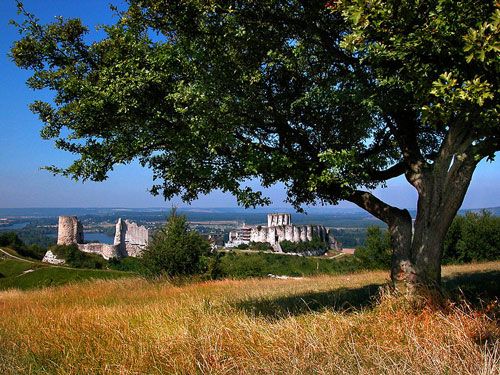
Indeed, this fortress was not only one of the first with machicolations, but also the first to construct concentric fortifications, which included three enclosures protected by dry moats surrounding a central keep.
Legend has it that upon seeing the imposing fortress, Richard the Lionheart exclaimed: “Que voilà un château gaillard – “What a sturdy castle!”
However, its seemingly impregnable defences did not deter Philip-Augustus, who managed to capture it in 1204 after a long siege during which many defenders perished.
Château Gaillard changed hands numerous times during the Hundred Years War before finally being incorporated into the Kingdom of France in 1449.
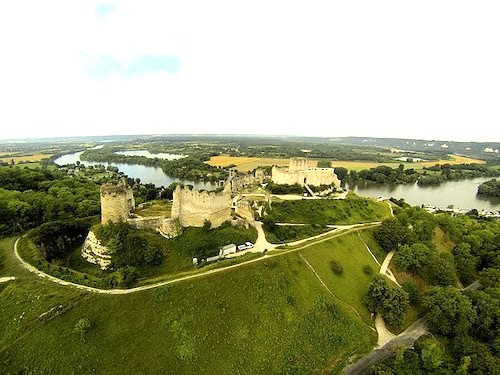
Abandoned and neglected, it became a haven for outlaws and bandits until King Henry IV ordered its demolition in 1599.
Fortunately, what remained of the ruined fortress was listed as a historical monument in 1862.
Today, the imposing ruins of Château Gaillard continue to attract visitors. Located just 85 kilometres west of Paris, the fortress is easily accessible and can be found along the scenic Seine Valley route.
Department of Eure
Coordinates: Lat 49.237690 – Long 1.402538
Photos via Wikimedia Commons: Header by ChritopheB CC BY-SA 3.0 – Fortress by Oliver Cambus CC BY-SA 3.0 – Seen from top of the hill by Michel Chéron CC BY-SA 3.0


