
Palm Sunday – Dimanche des Rameaux, the Sunday before Easter
Palm Sunday marks the beginning of Holy Week and commemorates two contrasting events: Jesus’ triumphant entry into Jerusalem (marking the fulfillment of the Messiah’s prophecy), where he was welcomed as a king, and his passion and crucifixion.
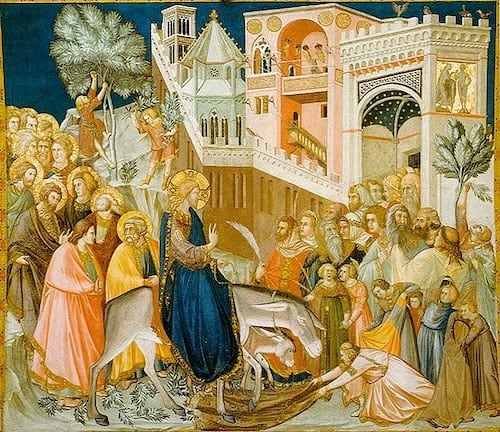
Jesus arrived in Jerusalem six days before the Jewish Passover festival and was acclaimed by the crowds who waved palm branches and laid cloaks beneath the hooves of the donkey that carried him, as they would have done for a king. As a sign of humility and peace, Jesus indeed entered the city riding on a donkey.
The four Gospels (John 12:12) recount this entry into the holy city. “When the large crowd that had come for the festival heard that Jesus was coming to Jerusalem, they took palm branches and went out to meet him, shouting, ‘Hosanna! Blessed is he who comes in the name of the Lord!“
Thus, at the beginning of Palm Sunday Mass, the priest addresses the congregation gathered outside the church, repeating these words during the opening liturgical hymn. He then blesses the palm branches and reads the Gospel account of Jesus’ messianic entry into Jerusalem. The congregation then processes to the church for the celebration of Mass, which includes the reading of the Passion of Christ.
Christian tradition dictates that after Mass, the blessed palm branches are taken home to adorn crosses and religious images, but also placed above the front door to protect the household in the coming year. Once dry, palms and boxwood branches are traditionally burned, not discarded.

The ashes are collected, and on Ash Wednesday, a day of penance that takes place the day after Mardi Gras, and marks the first day of Lent. During the Mass, the priest traces a cross on the forehead of each parishioner with ashes from the palms blessed on Palm Sunday of the previous year, as a sign of hope in God’s mercy. Around the year 591, Pope Gregory I established the beginning of Lent as the Wednesday preceding the first Sunday of the Easter season. Ash Wednesday, Dies cinerum – day of ashes in Latin, falls 46 days before Easter. For Christians, it is a day of penance and fervent prayer that leads to a 40-day period of abstinence and fasting.
In the south of France, where the climate is milder, people traditionally use palm branches, and the Dimanche des Rameaux is called Dimanche des Palmes (as in English Palm Sunday). In Corsica, olive branches are often mixed with palm branches, as the olive tree symbolises peace and abundance.
In Northern France, where palm trees are scarce, boxwood branches are traditionally used to commemorate Palm Sunday. Boxwood, with its hardy, dark green leaves, was considered a symbol of life; thus, after Palm Sunday Mass, people would also place some blessed boxwood branches on graves as a sign of remembrance. Today, while boxwood is primarily valued for its ornamental qualities and its suitability for topiary.
Although the celebration of Palm Sunday is less frequent in urban areas, many rural communities in France continue to perpetuate this religious tradition.
Wikimedia Commons: Cross of ashes by Oxh973 Public domain – Jesus entering Jerusalem by Pietro Lorenzetti (1280–1348) Basilica di San Francesco d’Assisi public domain


