
Palais Royal, the seat of the Conseil d’Etat
In the 17th century, Armand Jean du Plessis, Cardinal Richelieu, built the Palais Cardinal, which was renamed Palais Royal after he bequeathed it to the King of France in 1642.

This U-shaped mansion has changed hands several times over the centuries and today houses the Constitutional Council and the Ministry of Culture.
Although it is only open to the public during Heritage Days in September, certain areas, such as the Cour d’Honneur (where the Colonnes de Buren and Fontaines de Pol Bury are located), the garden, and the galleries, are open to visitors.
The Galerie des Proues (prows), in the east gallery bordering the Cour d’Honneur, is named after the maritime-themed sculptures that adorn it, commissioned by Richelieu when he was Minister of the Navy.
The Galerie d’Orléans, an elegant double colonnade which separates the Cour d’Honneur from the gardens, was built during the Restoration (1814-1830).
Palais Royal Gardens

The Palais Royal Garden is one of the capital’s most beloved public parks.
The Parisians indeed flock there at lunchtime or on Sundays, seeking tranquillity in this oasis. Adorned with a rich array of flowers, shrubs, trees, and expansive lawns, this 5-hectare garden is centered around a reflecting pool and its elegant fountain.
The elegant arcades that frame it house a variety of upscale boutiques, primarily specialising in antiques.
To the west, the Galerie de Montpensier features shops offering secondhand medals and decorative objects, as well as tea rooms and cafés.

To the east, the Galerie de Valois attracts engravers and decorators.
To the north, the Galerie de Beaujolais is renowned for being home to the restaurant Le Grand Véfour.
Several small passageways crisscross these galleries, offering shortcuts.
The Passage Vérité thus connects the small Place de Valois to the Rue de Montesquieu; the Passage-des-Deux-Pavillons offers a picturesque route from the Rue de Beaujolais to the Rue des Petits-Champs, and the discreet Passages Hulot and Potier link the Rue de Montpensier to the Rue de Richelieu.
Palais Cardinal
It’s impossible to stroll through the elegant garden without wondering about the palace’s history!

In 1634, Cardinal Richelieu commissioned the architect Mercier to build a grand private mansion to the north of the Louvre Palace.
However, the cardinal died shortly after completing his ambitious project and, in his will, bequeathed the palace to Louis XIII and his descendants.
Unfortunately, the king also died soon after inheriting the estate.
Thus, it fell to the young Louis XIV and his mother, Anne of Austria, to take up residence in the palace, which then became known as the Palais Royal.
Palais Royal’s bad and good fortunes
At the end of the 18th century, the Palais-Royal underwent radical transformations under its new owner, Louis-Philippe d’Orléans.
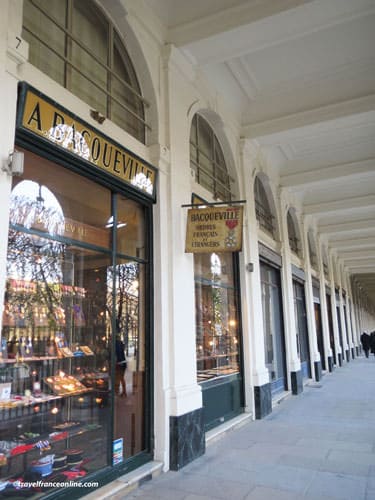
Faced with financial difficulties, he devised an unusual solution: the construction of buildings with arcaded galleries around the gardens to generate income and settle his debts.
However, these galleries immediately attracted disreputable businesses to their arcades, and by extension, a whole host of unsavoury clientele, thus tarnishing the palace’s reputation.
The Palais-Royal escaped destruction in 1793, during the French Revolution, when it was declared state property!
In the mid-19th century, Napoleon III undertook extensive restoration work and made it his official residence after the Revolution of 1848.
The Palais-Royal was restored after the damage it suffered during the Paris Commune of 1871 and has remained undamaged ever since.
Today, it is considered one of the most elegant architectural ensembles in Paris!
Directions: 1st district
Metro: Palais Royal-Musée du Louvre on Line 1
Coordinates: Lat 48.863620 – Long 2.336810


