Palais Galliera, a duchess’ palace
The lavish Palais Galliera, on the Avenue du Trocadéro, has housed the Musée de la Mode de Paris – Paris Fashion Museum since 1977.
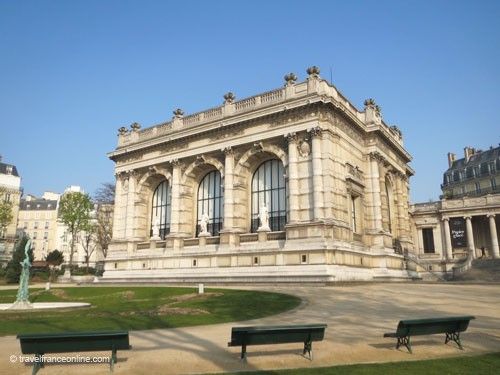
The Duchess of Galliera, Maria Brignole-Sale Ferrari, commissioned it after the death of her husband in 1876. He had indeed left her a considerable fortune as well as real estate in the 16th arrondissement of Paris. Known for her philanthropy and refined taste, the Duchess dedicated her resources to charitable causes. The Palais Galliera was thus carefully designed to showcase her extensive art collections to the public.
She bequeathed the palace to the French state in 1879. However, complications arose due to a legal error by her lawyer, who mistakenly designated the City of Paris as the beneficiary instead of the French State. This error led to a bitter dispute between the Duchess and the French government.
Seeking a solution, the Duchess decided in 1884 to transfer her art collections to the Palazzo Rosso in Genoa, her birthplace. This manoeuvre circumvented the legal impasse, but at the cost of her initial plan to make the Palais Galliera a museum housing her personal treasures. The Duchess died in 1888, but her heirs financed the completion of the Palais Galliera, which, unfortunately, never fulfilled its original purpose of exhibiting her collections.
Palais Galliera’s Italian Renaissance architecture
Paul-René-Léon Ginain, renowned architect and winner of the Prix de Rome, drew inspiration from the Duchess’s Genoa palace to design the Palais Galliera, infusing this Parisian landmark with touches of Italian Renaissance architecture.
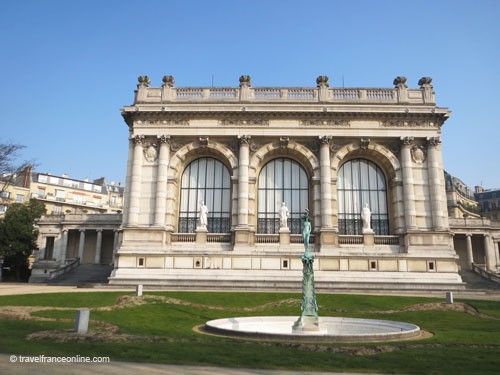
Amazingly, the Palais Galliera is built on a metal framework, the work of the famous workshops of Gustave Eiffel, one of the pioneers of late 19th-century metal architecture. The imposing facade is adorned with statues representing the arts, Painting by Henri Chapu, Architecture by Jules Thomas, and Sculpture by Pierre Cabelier. The interior decoration is just as exquisite as the exterior, featuring mosaic floors and superb domes created by Dominique Faccina.
In accordance with the Duchess’s wishes, the Palais Galliera stands in an elegant garden, the Square Brignole Galliera, a small oasis of calm between the Rue Brignole and the Rue de Galliera.
This public garden is adorned with statues, such as the God Pan and the Tiger, works by Just Becquet, and The Childhood of Bacchus, by Jean Perraut. It also features the Fontaine de l’April, created by Pierre Roche in 1916.
Musée de la Mode – Palais Galliera
The Palais Galliera transitioned to the City of Paris in 1894.

Over the years, the mansion underwent its first transformation to house the Musée d’Art Industriel (Museum of Industrial Art), which showcased the innovative Art Deco style. It was again renovated in 1954 to host the Salon des Peintres Témoins de leur Temps (Salon of Painters Witnessing Their Time), a prestigious event bringing together renowned the works of Chagall, Braque, Buffet, Léger, Matisse, Picasso, and Utrillo, among others. In the 1960s and 1970s, the Palais Galliera served as a venue for art auctions organised by the Auctioneers Company.
And since 1977, it has housed the Musée de la Mode (Fashion Museum), one of the most prestigious museums in Paris, renowned for its vast collections of costumes from the 18th to the 20th centuries, as well as for the creations of illustrious French couturiers. The Fashion Museum indeed displays a dazzling collection of clothing and accessories, hats, jewellery, bags, fans, and gloves, as well as hundreds of fashion photographs relating to the evolution of style through the centuries. Although generally accessible to the public only during temporary exhibitions, these collections are often on display for several weeks or months.
The Palais Galliera was restored between 2009 and 2013.
Directions: 16th district – 10 avenue Pierre 1st of Serbia
Metro: Iéna or Trocadéro on Line 9
Coordinates: Lat 48.865294 – Long 2.296883
Photo via Wikimedia Commons: Museum exhibition by Jean-Pierre Dalbéra CC BY 2.0