
Orval chariot burial dated to the Iron Age
The Orval chariot burial is located approximately 6 kilometres southwest of Coutances, in the commune of Orval.

This burial, which was unearthed in 2005 during roadworks, gives a glimpse into the practices of the Gauls from the Early Iron Age to the 1st century BC. Chariot burials, a remarkable funerary custom, were indeed reserved for high-ranking warriors, who were buried with their two-wheeled chariots and horses.
The Orval chariot burial is a thus unique discovery in Celtic Gaul, as it is the only known tomb from this period containing horses.
The presence of other archaeological vestiges discovered in the vicinity of Orval, such as the foundations of a large Gallic farm, attests that this region was continuously inhabited over the centuries.
The modest remains of the Orval chariot burial, primarily metal fragments from the chariot wheels, provide sufficient clues to reconstruct its original shape and dimensions. The richly decorated harnesses, adorned with ivory and coral of Mediterranean origin, attest to the extent of the trade networks of the period.
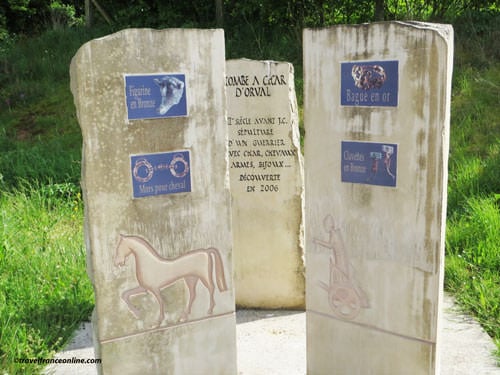
The burial of this high-ranking warrior also yielded a collection of precious objects, including weapons, a spear, a sword in its scabbard, and an axe, as well as ornaments such as fibulae and a gold ring, which attest to his status within the military elite. Analysis of this fibulae dates the burial to the mid-3rd century BC.
The funerary assemblage also included various tools such as hammers, knives, and a sickle. All these exceptional artefacts, which shed light on Celtic art and culture, are now on display at the Musée de Normandie in Caen.
While chariot burials are well documented in northern France, the Orval burial is a rare example in Normandy. Today, a magnificent memorial stands at the roundabout on the D971, south of Coutances, where three informational stelae shed light on this exceptional archaeological discovery.
Manche department
Coordinates roundabout on D971: Lat 49.023896 – Long -1.453248


