
Montpeyroux, citadel of the Counts of Auvergne
Montpeyroux is perched on a hill overlooking the Allier valley.
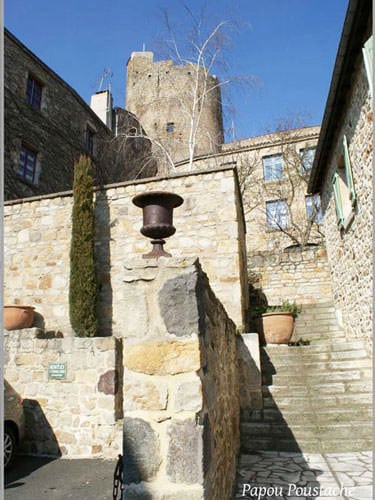
Once owned by the House of La Tour d’Auvergne, this charming fortified village is now ranked among the Plus Beaux Villages de France (Most Beautiful Villages of France).
This feudal dynasty maintained close ties with the Crown of France. Madeleine de La Tour d’Auvergne (1498-1519), indeed married Lorenzo II de’ Medici.
Their daughter, Catherine de’ Medici, was raised in Italy, but later married Henry II, son of King Francis I.
When Catherine became queen, she also inherited the titles of Countess of Auvergne and Lady of Montpeyroux.
From her marriage to Henry II, Catherine had ten children, five of whom became monarchs: Francis II, Charles IX, Henry III, Elizabeth (Queen of Spain) and Margaret of Valois, known as Margot, the first wife of King Henry IV.
Ramparts and belfry-gateway
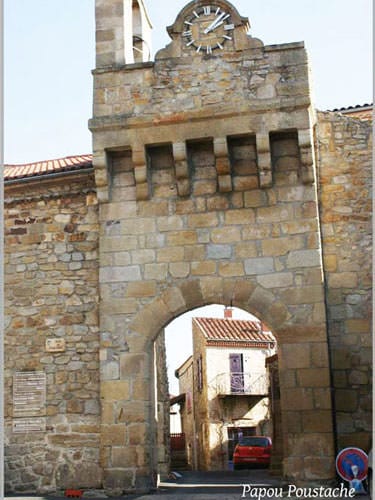
However, the origins of Montpeyroux date back to the 6th century, when the village began to prosper on the banks of the Allier, at the site of the current village of Coudes.
The citadel of Montpeyroux was built in the 11th century, on the top of a rocky hill called Mont Pierreux, a name which gradually evolved into Montpeyroux.
The first written mention of Montpeyroux dates from 1212, when King Philip-Augustus granted the fief to Bertrand de la Tour d’Auvergne.
The citadel of Montpeyroux commanded the Limagne plain and a major north-south route, known as the Chemin Français (French Way).
Today, the remains of the old citadel include five watchtowers and portions of the covered way along the northern part of the oval rampart.
The fortified 14th-century belfry-gate, the central element of these fortifications, is listed as a historical monument in 1951, also remains. A statue of the Virgin Mary, placed in a niche on its inner facade, blesses passersby a sthye embark on the Montée des Gardes, a picturesque lane that leads to the Donjon of Montpeyroux.
Donjon of Montpeyroux
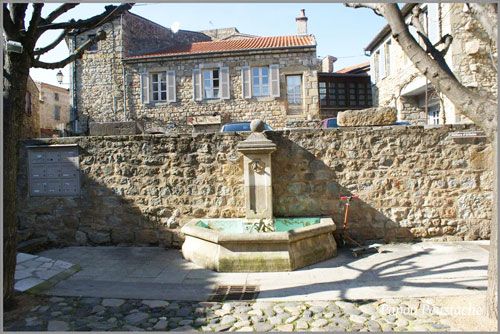
The southern part of the citadel remained unfortified, as it ended at the edge of a cliff.
The imposing donjon was therefore erected to protect the citadel’s southeastern flank. Erected in the second half of the 12th century, it illustrates the military architecture favoured by Philip-Augustus.
It served not only as a defensive stronghold, but also as a lordly residence and warehouse.
Over time, the village prospered around the keep, eventually expanding inside a secondary rampart.
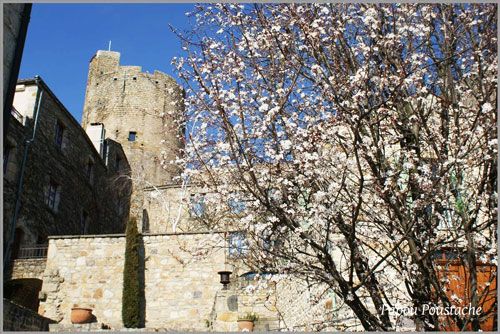
The Montpeyroux keep is a 30m-high round, crenellated tower. Its base is 14.25 metres in diameter, and the building gradually narrows as you go up the floors to ensure its stability; its upper platform is 13.20 metres in diameter.
The keep offers a 360-degree panorama, allowing the guards to monitor not only Montpeyroux, but also the Allier valley, which extends as far as Issoire to the south, the Chaîne des Puys mountain range to the west and northwest, and the old village of Coudes below, on the river banks.
The Montpeyroux keep is one of the oldest keeps in France and was classified as a historical monument in 1957.
Quarries of arkose of Montpeyroux
Montpeyroux is perched on a rocky base of arkose. Composed of quartz and at least 25% feldspar, this resistant sandstone is prized for its characteristic golden hue with shades of grey, and sometimes even a hint of red.
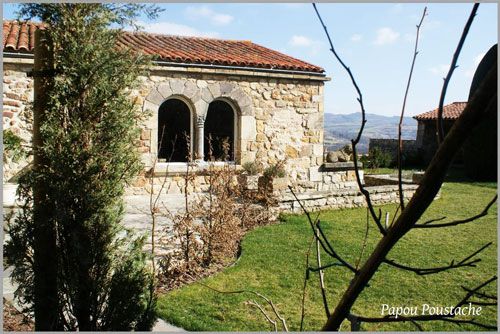
In the Middle Ages, the stonemasons of Montpeyroux extracted arkose from open-air quarries near the village entrance. These stones were used in the construction of magnificent Romanesque churches throughout Auvergne, including remarkable buildings: Sainte-Austremoine in Issoire and Notre-Dame-du-Port in Clermont Ferrand.
In 1848, the quarries employed 11 workshops and 30 stonemasons, fueling a flourishing industry.
However, as the First World War approached, only six arkose quarries remained in operation in Auvergne, their production now focused exclusively on the manufacture of millstones. Unfortunately, the once thriving quarries of Montpeyroux closed in 1935, marking the end of an era.
The Church and village
The church of Montpeyroux was built in the 1840s and is a remarkable example of Neo-Romanesque architecture in Auvergne.
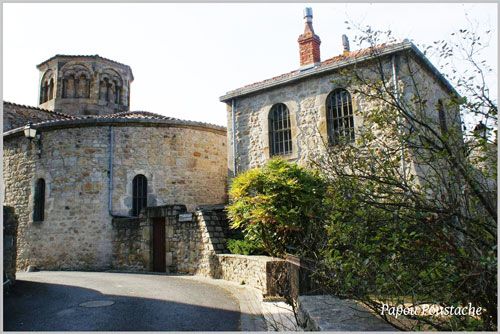
This basilica is renowned for its large ambulatory designed to accommodate large congregations, and its two imposing monolithic columns supporting the nave vault, each adorned with a unique capital.
Montpeyroux also experienced significant growth as a wine production centre in the 19th century. However, this prosperity was short-lived, as the vineyard fell victim to phylloxera, a scourge that ravaged French viticulture in the second half of the century.
The village faced new difficulties with the outbreak of the First World War, which led to a sharp decline in its population. At the end of the conflict, Montpeyroux had only 180 inhabitants left! However, the architect Pérol and the prefect Perony initiated the village’s revival in 1960 by launching a program to restore the town’s architectural and cultural heritage.
The revival of Montpeyroux
These rehabilitation efforts, led by its mayor, Mr Simon, paid off in 1989 when Montpeyroux was designated as one of the most France’s most beautiful villages (Most Beautiful Villages in France).
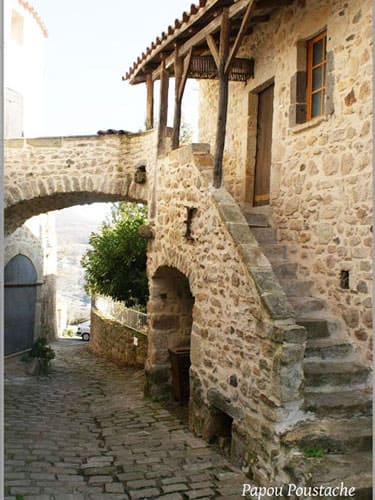
From its wine-growing past, Montpeyroux has retained winegrowers’ charming stone cottages grouped around the keep. These picturesque arkose dwellings, many of which are topped with Roman tiles, follow a uniform plan: a cellar on the ground floor complemented by an external stone staircase leading to the living areas.
You will also find elegant townhouses mainly near the village entrance.
Strolling along the village ancient alleyways, you will discover a wealth of architectural features, such as finely carved lintels, graceful arcades and verdant terraced gardens nestled in inner courtyards.
Montpeyroux is an unmissable destination in Auvergne!
Department of Puy-de-Dôme
Coordinates: Lat 45.621676 – Long 3.205481
Credits: Photos Jean Piludu – Wikimedia Commons: Header by Torsade de Pointes CC0


