
Antic Vesunna
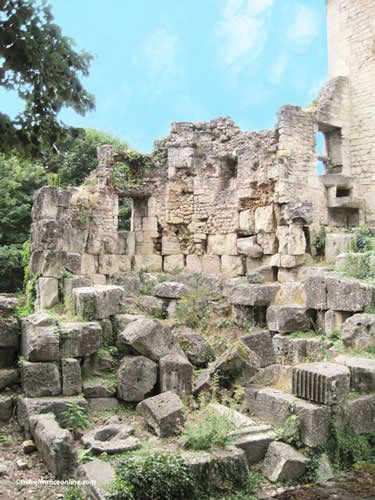
La Cité (The City) is the oldest district of Périgueux. In 200 BC, the Petrocorii, a Gallic tribe also known as the “Four Tribes“, established their capital on the banks of the Isle.
Their choice of location was strategic: the Vesunna (Vesone), a sacred spring, gushed forth at the intersection of the ancestral north-south route and the river.
After conquering Aquitaine in 16 BC, the Romans expanded Vesunna, the oppidum of the Petrocorii, transforming it into a prosperous spa town, which they renamed City of the Petrocorii – Cité des Pétrocores. The name evolved into Périgueux and Périgord.
At its height, the famous spa town, known simply as the Cité, had many important buildings, including a forum, a basilica, an amphitheatre, an arena, an aqueduct, and numerous temples and stately homes.
Tragically, the onslaught of barbarian invasions in the 3rd century AD, followed by the Visigoth siege in 418 AD, left the Cité in ruins.
La Cité

Today, all that remains of the once bustling Cité are scattered vestiges: fragmented stones, finely sculpted columns, eroded capitals and a multitude of architectural fragments.
In a desperate attempt to survive the invasions, the inhabitants indeed dismantled many buildings and monuments to erect a defensive wall around their Cité.
This rampart included 24 sturdy defensive towers and three imposing gates.
However, despite their efforts, the Cité never regained its former splendour, and by the end of the 5th century, it was nothing more than a modest fortified hamlet!
Porte Normande and Maison Romane

The Porte Norman is the only remaining gate of the three that once fortified the Cité.
It was named after the Vikings who, during their 9th-century raids, sailed up the Isle River from Bordeaux.
The Maison Romane – Romanesque House stands right next to the Porte Normande.
It was built in the 12th century on the foundations of the old rampart and against the remains of a defensive tower.
It subtly draws the eye with its understated yet striking appearance.
Château Barrière
The Barrière family were a respected aristocratic family who resided in the Cité.
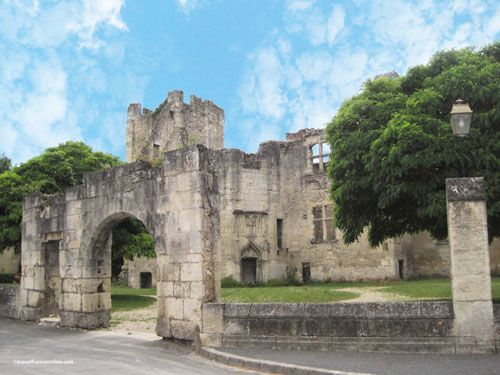
In the 13th century, they commissioned the construction of a fortified private mansion against the Gallo-Roman ramparts, next to the Maison Romane.
This residence was renovated and transformed into an elegant château during the French Renaissance. It was unfortunately destroyed during the Wars of Religion.
Remnants of its former splendour include numerous architectural vestiges, including two robust towers, elegant mullioned windows, and magnificent flamboyant sculptures adorning the entrance gate.
The Château Barrière was fortunately classified as a Historical Monument in 1862.
Amphitheatre
The amphitheatre was built in the 1st or 2nd century AD and, according to custom, on the outskirts of the city, as it required a vast space, including a gladiator school and animal facilities.
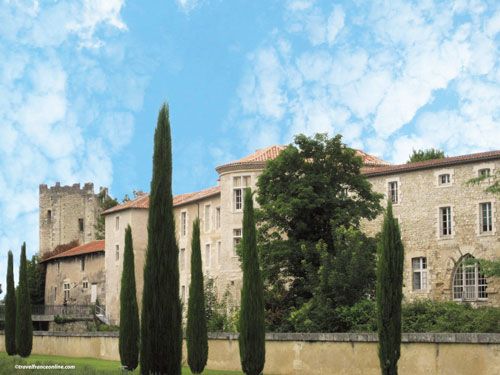
Today, only a few fragments of steps and arches remain, but these meagre remains have proven invaluable to researchers who have been able to reconstruct its original size. They thus found that the amphitheatre measured 141 metres long and 118 metres wide, was 25 metres high and could accommodate up to 18,000 spectators in its 80 bays.
Unfortunately, the inhabitants demolished it during the Hundred Years War to erect a fortress on its site. Having fallen into disuse, this building was eventually dismantled and exploited as a quarry.
The ruins of the amphitheatre were officially classified as a historical monument in 1840, and the site was developed into the Jardin des Arènes (Garden of the Arenas).
That said, you’ll find numerous partial remains of the Cité, scattered among the surrounding private properties.
Tour de Vésone
The Tour de Vésone (Tower of Vesunna) was part of the Roman temple built in the 2nd century AD and dedicated to the goddess Tutela Vesunna, in the southern part of the Cité.

This temple was later located on the lands of Count Wilgrin de Taillefer, who, upon his death, generously bequeathed them to the city of Périgueux.
Classified as a historical monument in 1846, the Tour de Vésone was nevertheless deprived of its perimeter wall and the remains of its peripheral structures during the construction of the railway!
The Tour de Vésone was the Cella of the Roman temple, a sanctuary reserved for priests. It was surrounded by a peristyle supported by 23 columns. A rectangular pronaos, flanked by six imposing columns, whose remains now lie scattered throughout the park, served as the entrance gate. All that remains are the metal hooks that anchored the marble slabs that once adorned its interior walls.
The imposing 17.10-metre-wide and 24.5-metre-high Cella stood on a raised podium. People entered the temple grounds through a monumental eastern gate. The temple dominated the City Forum, which stretched 141 metres long and 122 metres wide, and which has now given way to a green public garden.
Saint Etienne de la Cité Church
The Church of Saint-Étienne de la Cité was built between the 11th and 12th centuries. It replaces a 6th-century church that had been erected on the remains of a Roman temple dedicated to Mars.

Originally designed with a single nave of three square bays, an apse and two domes, it was transformed with the addition of four domes aligned behind the bell tower, and is today considered a superb illustration of Périgord Romanesque architecture.
However, it was ravaged during the Hundred Years’ War, and again in 1577. The Protestants destroyed the western bays, their domes, the bell tower and even the episcopal palace. Although reduced in size, the two eastern bays survived, and the bell tower was restored in 1620. However, the church was damaged again during the Fronde in 1652.
Despite this, Saint-Étienne de la Cité continued to serve as the cathedral of Périgueux until 1669, when the episcopal seat was transferred to the Saint-Front Church. The building was restored to its original Romanesque splendour under the Second Empire.
Saint-Étienne de la Cité boasts a magnificent and finely carved in oak-and-walnut 17th-century altar, and also houses the tomb of Jean d’Astide, Bishop of Périgueux from 1160 to 1169.
Domus Pompeius
In 1959, an ambitious building project unearthed the remarkable remains of the Domus de Vésone – Domus of Vesunna, also known as Domus Pompeius or Domus du Bouquet.
Although its origins date back to the 1st century AD, its foundations were elevated in the following century to protect it from river floods. Located in the Cité, near the Tour de Vésone and the Forum, and very close to the amphitheatres, this sumptuous residence undoubtedly occupied a privileged position.
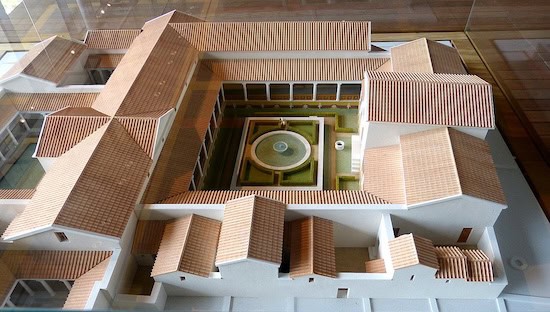
Due to its quality, refinement, decorative ornaments, generous proportions and strategic location, the Domus de Vésone probably served as an official palace. Spanning an impressive 4,000 square metres, it was organised around a central courtyard, bordered by an exquisite peristyle. Equipped with a state-of-the-art hypocaust heating system, private bathrooms and numerous outbuildings, the Domus de Vésone offered its inhabitants unparalleled luxury and comfort.
Fortunately, large portions of its superb frescoes and mosaics were saved, offering a glimpse of its former splendour. Today, these remains are proudly displayed in situ, protected by a contemporary glass-and-metal structure designed by architect Jean Nouvel. A network of walkways and balconies suspended above the ruins allows visitors to admire the layout and architectural subtleties of this ancient gem.
The Vesunna Museum was established in 2003.
Related articles: Périgueux Saint-Front Cathedral and Puy Saint-Front District
Department of Dordogne
Coordinates: Lat 45.181768 – Long 0.712314
Wikimedia Commons: Model of the Domus Pompeius by Wolfgang Sauber CC BY-SA 4.0


