
Honfleur and the 19th century painters
Honfleur is located at the northern end of the Côte Fleurie, on the south bank of the Seine estuary, and is connected to Le Havre, on the north bank, by the Pont de Normandie (bridge).
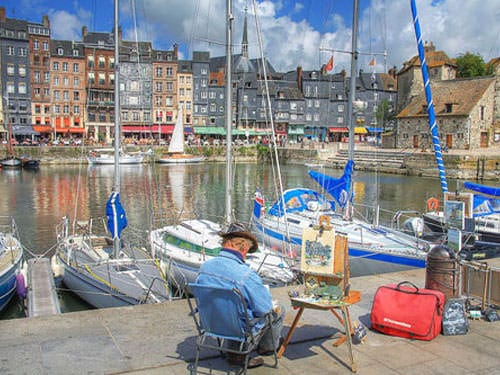
A former fishing port, Honfleur exudes a picturesque charm that has long inspired 19th-century painters. Artists, such as Gustave Courbet, Claude Monet, and Eugène Boudin, were captivated by Honfleur’s unique light and atmosphere, and founded the Saint-Siméon artistic circle, also known as the Honfleur School. Their works, along with those of other renowned painters, such as Georges Seurat and James Whistler, capture the very essence of the region’s beauty.
The Plateau Grâce, also known as Mont Joli, a hill located just 2 km southwest of Honfleur’s Vieux Bassin (Old Port), boasts exceptional views of the harbour, the sea, the Seine estuary, the Normandy Bridge, and Le Havre. It is named after the Notre-Dame de Grâce chapel, one of the oldest chapels in the region, and contains countless votive offerings left by sailors, fishermen, and residents. It was built in the early 17th century to replace the chapel erected in 1023 by Richard III, Duke of Normandy.
Honfleur a trhiving port
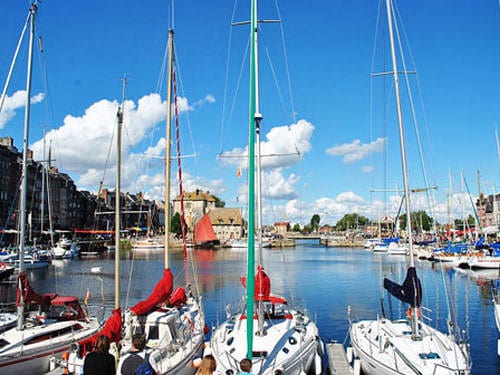
Located at the mouth of the Seine, Honfleur has always been a vital transit port for goods travelling between Rouen and England.
Thus, the ramparts were built during the Hundred Years’ War to protect the port and the estuary from potential English attacks.
Harfleur, situated on the south bank of the Seine, which already served as an additional stronghold before the construction of Le Havre, also saw its defences reinforced.
Honfleur also served as a base for French raids on England. However, despite its formidable fortifications, it experienced periods of English occupation, first in 1357, then for a longer period from 1419 to 1450.
A thriving port
Honfleur’s maritime trade experienced a revival after the Hundred Years’ War, and it flourished until the 18th century, despite a temporary slowdown during the Wars of Religion in the 16th century.

This period coincided with the golden age of maritime exploration, during which Honfleur played a crucial role as a departure point for expeditions to distant lands such as Brazil and Newfoundland. One of the most remarkable expeditions to depart from Honfleur was that of Samuel de Champlain in 1608, which led to the founding of Quebec City in Canada.
The town’s extensive maritime trade network, which extended to regions such as Canada, the West Indies, the African coast, and the Azores, contributed to the town’s unprecedented economic growth. Honfleur thus modernised to accommodate the expansion of its maritime trade. The Vieux Bassin (Old Port) was built, and the old ramparts were demolished to enlarge the town.
Howvever, the French Revolution triggered a period of decline that was exacerbated by the continental blockade imposed by Napoleon I. However, this blockade aimed to cripple the English economy by restricting its trade with Europe, affected all French ports.
Honfleur attempted to revive its maritime trade in the following years by developing the timber trade from Northern Europe. However, the silting up of its harbour entrance thwarted this endeavour. This limitation of river traffic favoured the development of the neighbouring port of Le Havre, which became the major maritime hub of the region.
Honfleur, present today
From its rich past, the port of Honfleur has preserved numerous historical monuments.
The Quai Sainte-Catherine, along the Vieux Bassin (Old Basin), is lined with tall, narrow houses built in the 17th and 18th centuries on the former moats of the fortification. These terraced houses vary in size, and some feature tiled facades.
The Lieutenance, located at the end of the Vieux Bassin, was once the residence of the King’s lieutenant and is the only intact remnant of the fortifications.

The charming Quartier Sainte-Catherine, the old fishermen quarter, developed within the ramparts. It unfolds around the Church of Sainte-Catherine, the largest half-timbered church in France, which was built after the Hundred Years’ War. The church and its freestanding bell tower are both listed as historical monuments.
The Greniers à sel (salt warehouses) were built in 1670 using stones salvaged from the ramparts. They were used to store salt for preserving fish, but also to collect salt taxes during the Middle Ages. These two remaining salt warehouses are listed as historical monuments.
The Eugène Boudin Museum highlights Honfleur’s importance to Impressionist painters. The museum houses a rich collection of paintings by Eugène Boudin and other artists.
The Maison Satie, a half-timbered house and an iconic landmark of Honfleur, is the birthplace of composer Erik Satie.
Finally, with its two magnificent beaches, Plage du Butin and Plage de Vasouy, Honfleur is also a thought after seaside resort.
Department of Calvados
Coordinates: Lat 49.418762 – Long 0.233262
Photos via Wikimedia Commons: Painter by the Vieux Bassin by Pir6mon CC BY-SA 3.0 – St Etienne Church and Vieux Bassin and Lieutenance by Ignaz Wiradi CC BY-SA 3.0 – Maisons Satie by Gortyna CC BY-SA 3.0


