
Fécamp and the Legend of the Fig tree Camp
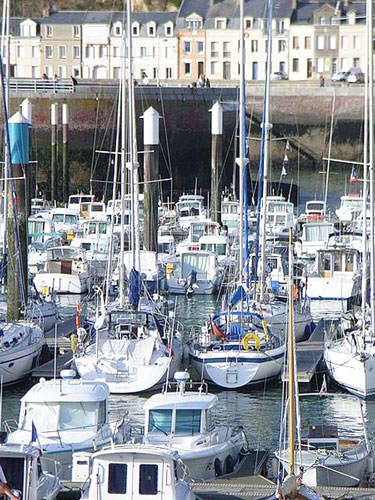
Fécamp is nestled in a valley surrounded by the highest cliffs in Normandy, about 35 km north of Le Havre, on the magnificent Alabaster Coast (Cote d’Albâtre).
The first mention of Fécamp dates back to the late 10th century, when it was referred to as Fiscannum.
According to accounts from the monks who founded the Benedictine abbey of Fécamp, Fiscannum derives from “Fici Campus,” meaning “camp of the fig tree.”
This version recounts how Joseph of Arimathea supposedly preserved the Holy Blood of Christ in the hollow trunk of a fig tree before embarking on a voyage across the seas to secure it.
Joseph’s vessel is said to have washed ashore on the banks of Fécamp, and when the fig tree trunk struck the ground, a fountain of blood flowed forth. The monks very cleverly transformed Fécamp into an important pilgrimage site throughout the Middle Ages.
Fécamp, the castle of William the Conqueror
So much for the legend; now let’s talk etymology! The name Fécamp likely evolved from the Old Germanic word “Fisc,” meaning fish. It seems like such a logical name for a fishing port!
In 911, the King of France created the Duchy of Normandy for the Vikings in exchange for their conversion to Christianity and their complete allegiance to the French crown. William of Normandy built the Château de Fécamp where, in 1067, he celebrated his victory over the King of England at Hastings the previous year.
The fortress remained the stronghold of the Dukes of Normandy until 1204, when the duchy was incorporated into the Kingdom of France. Two towers and part of the fortifications remain from this ducal palace, providing insight into the city’s influence throughout the Middle Ages.
A major fishing port
Fécamp’s economy was long built around fishing, particularly herring and cod fishing. From the 10th century onward, the town gained renown for its salted herring, and for its smoked herring in the 13th century. It indeed remained the leading cod fishing port in France throughout the 16th century, and thrived throughout the 19th and early 20th centuries.

In 1970, the town modernised and successfully transformed into a active marina. As a result, its seafront is lined with old fishermen’s houses that stand harmoniously alongside the villas of boat owners.
The fishermen erected the Notre-Dame-du-Salut chapel on Cap Fagnet, which rises 110 metres above sea level. A multitude of votive boats are placed at the foot of the statue of the Virgin, offerings that the fishermen left to ask for the Virgin’s protection before going to sea.
Not far from there stands a semaphore station, which replaces an old lighthouse, as well as a bunker, a remnant of the Atlantic Wall, the line of defence the Germans built during the Second World War.
Fécamp boasts another superb church, the Church of Saint-Étienne by the port, whose architecture is a magnificent blend of Gothic and Renaissance styles.
However, Fécamp’s renown is not limited to its maritime heritage; the town is also famous for its liqueur production, and more specifically for its Benedictine liqueur.
Palais and Liqueur Bénédictine
Fécamp is indeed the birthplace of Bénédictine liqueur, a delicious herbal elixir invented centuries ago by the Benedictine monks of Fécamp Abbey.
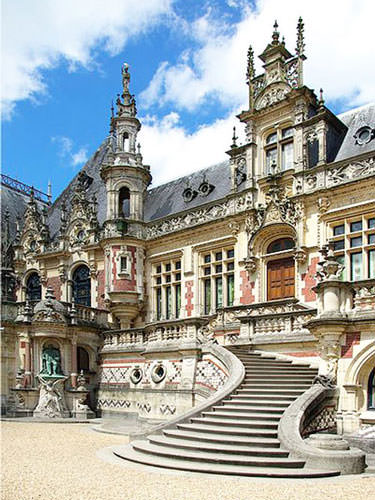
However, its production ceased during the French Revolution, when the abbey was demolished. In 1863, a local wine merchant named Alexandre Le Grand rediscovered the monks’ recipe and began selling it commercially.
Yet, the secret formula for this recipe remains to this day a closely guarded secret, and only three people, it seems, know the exact proportions. A visit to the magnificent Palais Bénédictine will allow you to discover the inner workings of the distillery, but don’t expect to uncover the secret of the recipe!
The mansion also houses a museum of sacred art, founded by Alexandre Le Grand, which displays a rich collection of paintings, sculptures, and manuscripts.
For lovers of the sea, the Musée des Terre-Neuva (Newfoundland Fishermen’s Museum) is a must-see. This museum indeed tells the epic story of the fishermen who embarked on long voyages to fish for cod in the waters off Newfoundland.
Department of Seine-Maritime
Coordinates: Lat 49.755601 – Long 0.380774
Photos via Wikimedia: Marina by Bodoklecksel CC BY-SA 3.0 – Palais Benedictine by Pierre Noël CC BY-SA 2.5 – Fishing boats by Ninetyone CC BY-SA 3.0


