
Luxembourg Palace, built for a queen

The Luxembourg Palace is today the seat of the French Senate and one of the most beautiful buildings in Paris.
At the beginning of the 17th century, Queen Marie de Medici commissioned the renowned architect Salomon de Brosse to create a palace inspired by her childhood home, the Palazzo Pitti in Florence.
At that time, the Luxembourg district was rural and sparsely populated, with only a few buildings, such as the Enclos des Chartreux, a monastery founded by King Louis IX in 1257.
Thus, in 1610, Marie de Medici acquired part of the monastery’s extensive gardens, as well as the nearby Palace of the Duke of Luxembourg.
Luxembourg Palace, the seat of the French Senate
During the French Revolution, the church, cloister, and various monastic buildings of the Enclos des Chartreux monastery were demolished to enlarge the Luxembourg gardens.
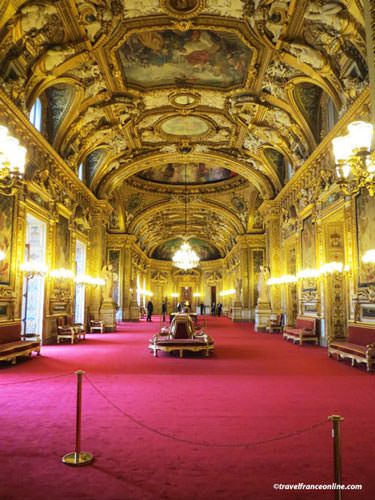
Fortunately, the main building escaped destruction and was converted into a prison in 1793, then became the seat of the Parliamentary Assembly from 1795 to 1797.
Napoleon I transferred the Senate there in 1801.
The building then housed the Chamber of Peers from 1815 to 1852, when Napoleon III reinstated the Senate on the premises.
Extensive restoration and renovation work was undertaken throughout the 19th century.
Chalgrin oversaw the interior restoration in 1804, while Gisors built the spectacular new facade, the two pavilions bordering the courtyard, and a cupola above the main entrance between 1836 and 1841. The palace was also remodelled and the Orangery was built.
Delacroix painted the magnificent frescoes in the library during this period.
Luxembourg Gardens
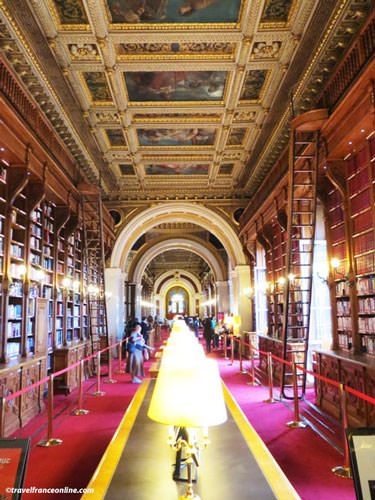
The Luxembourg Palace gardens are renowned as some of the most elegant in Paris.
This vast public park covers 24 hectares and features both formal French gardens and picturesque English landscape gardens.
The formal French gardens boast impeccably manicured lawns surrounding an oval pond, bordered by flowerbeds whose colours and themes change with each season.
The romantic English landscape gardens unfold to the west, while an experimental orchard lies to the south.
The Luxembourg Palace public park is a popular destination, offering a verdant oasis in the heart of Paris.
It’s indeed the perfect place for a relaxing afternoon, with free-access seating scattered along the ponds and flowerbeds.
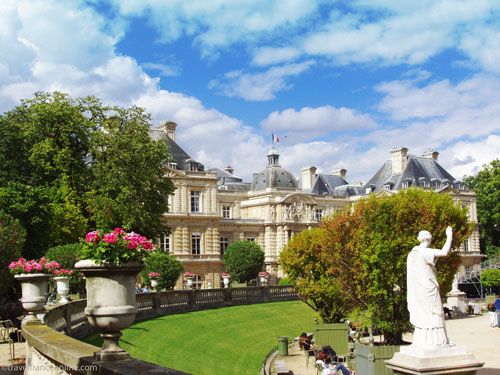
You’ll find many more seats in the wooded areas and along the statue-lined paths.
Several kiosks throughout the park offer refreshments.
Children especially enjoy the merry-go-round, one of the oldest in Paris, and the vast open spaces where they can play safely.
The gardens are accessible to everyone, regardless of age or ability, thanks to wheelchair-accessible paths, relaxation areas, and sensory gardens designed for visitors with disabilities.
Fontaine Medicis
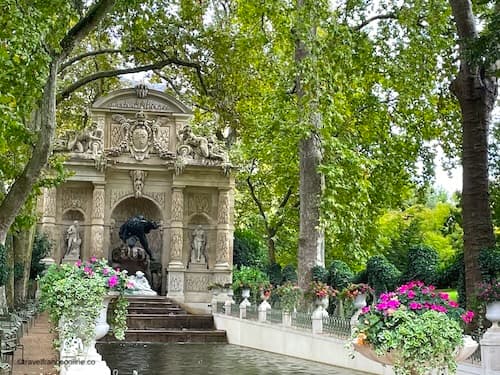
One of the park’s iconic features is the Medici Fountain, originally designed by Salomon de Brosse for Marie de Medici in 1634.
However, by the mid-1750s, the fountain and its elongated basin were in ruins, having lost many of their sculptures and decorative elements.
Thus, in 1811, Napoleon I commissioned the first restoration, but significant alterations took place during the Second Empire.
The architect Gisors oversaw the relocation of the fountain to its current location, to the east of the palace, where it was placed against the Leda Fountain to ensure the latter’s stability.

The monumental facade of the Medici Fountain is adorned with the Medici coat of arms and features four columns framing three niches. Two allegorical statues representing the Seine and the Rhône rivers, pouring their waters into the basin, flank the Medici coat of arms.
The side niches house statues of a faun and a huntress, each surmounted by a mask symbolising Tragedy and Comedy. These sculptures showcase the fountain’s centrepiece, Auguste Ottin‘s masterpiece, “Polyphemus Surprising Acis and Galatea.”
A final word: Public access to the Senate, and to the Petit Luxembourg, the official residence of the President of the Senate since 1825, are only possible once a year, during the Journées du Patrimoine – Heritage Weekends in September.
Directions: 6th District
RER B: Luxembourg
Coordinates: Lat 48.847856 – Long 2.337298


