
Domme, the Acropolis of the Dordogne

Domme is ranked among the Most beautiful villages in France, along with Monpazier and Eymet, two other magnificently restored bastides of the Périgord.
Its exceptional location has earned this fortified medieval city the nickname “Acropolis of the Dordogne“.
Perched on a promontory at an altitude of approximately 250 metres, Domme indeed boasts breathtaking views of the Dordogne valley from the Belvédère de la Barre, the Promenade des Falaises and the Jardin Public du Jubilé.
However, little remains of Domme-Vieille, the 9th-century fortress that once stood on the edge of the cliff.
Bastide of Domme
The Jardin Public du Jubilé is a narrow public garden landscaped between the cliff edge and the Moulin du Roy restaurant.
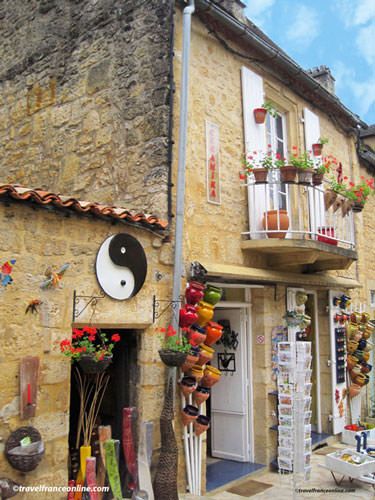
In 1283, King Philip III the Bold founded the bastide of Domme, which quickly gained a reputation for being impregnable. The cliff to the north was indeed considered virtually impassable, while sturdy ramparts fortified the rest of the town.
However, the English captured Domme in 1347, but control of the town changed hands several times throughout the Hundred Years’ War.
In 1588, during the Wars of Religion, the Protestant leader Geoffroi de Vivans and his men seized Domme by scaling the undefended cliff under cover of night! Once inside the ramparts, the attackers opened the gates, allowing the rest of their troops to enter the citadel.
Vivian exercised his control over Domme for four years, during which he burned down the church and the priory before finally selling the town to the Catholics in exchange for a large ransom.
Porte de la Tour
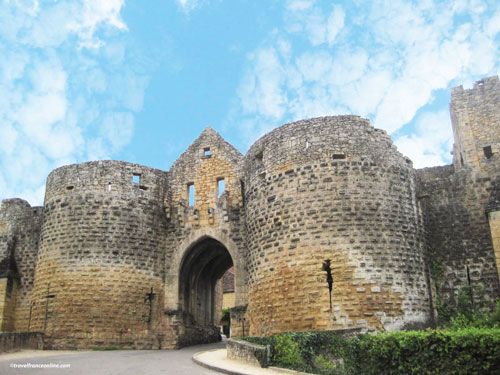
However, large sections of the ramparts and fortified gates have remained intact and have been meticulously restored, including the Porte del Bos, the Porte de la Combe and the Porte de la Tour.
There are a few small parking lots near the citadel’s entrance, in the lower town. However, you will find more spacious parking outside the eastern rampart by accessing the citadel via the Place des Armes and the Porte de la Tour.
Two semi-circular towers, originally used as guardhouses, still flank this imposing gate. They were converted into a prison to detain the Knights Templar during their controversial 1307 trial.

The walls still bear the many graffiti they carved into the rock.
Among these inscriptions are geometric figures symbolising various concepts, such as the Grail (octagons), Golgotha (triangles surmounted by a cross), the Temple (squares) and representations of their imprisonment (circles).
As you stroll through the streets, you will notice that Domme does not follow the typical rectangular plan of a bastide.
The architect indeed had to adapt the layout to the shape and slope of the rocky terrain, giving Domme its unique, more or less trapezoidal shape.
Although the streets attempt to follow a geometric pattern, their lack of uniformity contributes to their charm.
Another peculiarity of Domme: the houses are not organised around a single main square, but two!
Place de la Halle and Grotte de Domme
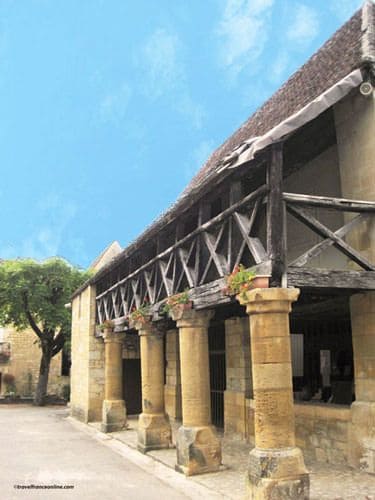
The market square, known as the Place de la Halle, is located in the upper part of Domme.
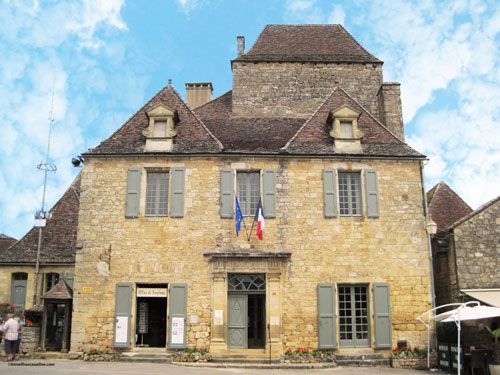
Most of the surrounding buildings have been converted into souvenir shops. But you will still find superb buildings, such as an imposing private mansion with an elegant turret. TheMaison des Gouverneurs, the former residence of the governors of Domme, now houses the Tourist Office.
The market stands out for its stone and woodwork, and now serves as the entrance to the Grotte de Domme. The cave extends over 400 metres of galleries adorned with fascinating rock formations. A small section is open to the public and, at the end of the visit, a glass elevator allows you to return to the surface.
Over the centuries, the cave has served as a refuge for the inhabitants of Domme during various conflicts, including the Hundred Years’ War, the Wars of Religion, and even the Second World War.
The Grand’ Rue is the main thoroughfare of Domme, and links the Place de la Halle to the Place de la Rode, further down the hill.
This steep street is lined with souvenir shops, stores offering local specialities such as foie gras and walnut oil, as well as charming cafes and restaurants.
Strolling along, you’ll discover several remarkable architectural features, including windows and porches in the French Renaissance style.
The town hall is located on Rue des Consuls, a narrow alley that branches off from the Grand’ Rue. It is housed in one of the oldest and most picturesque buildings in Domme, the former 13th-century Seneschal Law Court.
Place de la Rode
The Place de la Rode was named the breaking wheel that operated there, although, fortunately, no trace of this sinister instrument remains today!
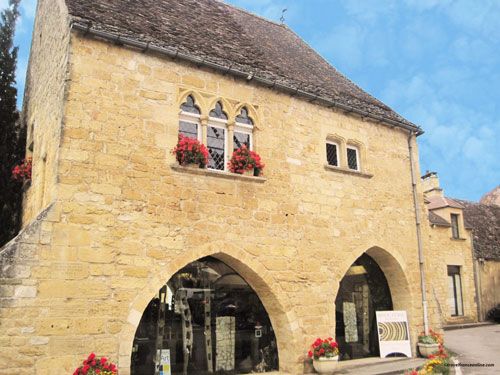
Now, the square is a lively and picturesque place, adorned with trees and flowerbeds, and lined with cafes, restaurants and shops with terraces.
At its founding, Domme received many privileges, including the right to mint its own currency. The Maison du Batteur de Monnaie du Roy (King’s Mintmaster’s House), a magnificently restored ancient Gothic building, still stands and stands out for its splendid arched windows.
Domme can usually be explored in a few hours by strolling in the charming lanes of the village or along the Promenade des Remparts. It is a popular destination for French and foreign tourists, especially during school holidays. Thus, large crowds are to be expected, particularly in summer. You also have the option of a min-train (for a fee), a more practical option for families with young children or people with reduced mobility.
Department of Dordogne
Coordinates: Lat 44.803738 – Long 1.216561


