
Christmas Banquet – Réveillon de Noël
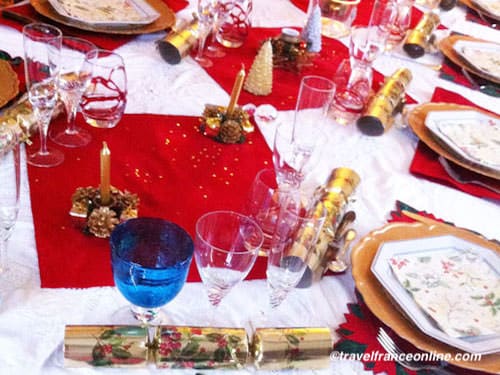
The traditional Christmas banquet, called Réveillon in France, is deeply rooted in our cultural heritage. It is customary in France to celebrate Christmas with family and New Year’s with friends.
Although Christmas banquet menus have evolved, with many opting for non-traditional dishes, some staples remain, such as stuffed turkey or goose and the Yule log (recipe).
The name Réveillon comes from the word “réveil” (awakening), because these sumptuous meals often last well past midnight (guests had to stay awake!)
Until recently, the main dish at the Christmas banquet was usually stuffed goose, a bird traditionally symbolising the sun.
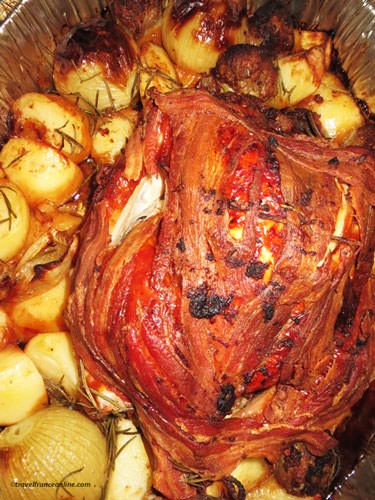
Historically, geese were associated with pagan celebrations of the winter solstice, and their tender, fragrant flesh made them a delicacy.
Geese do indeed hatch in the spring and take 8 to 9 months to reach maturity, just in time for Christmas. They used to feed on the remains of apples and corn in the fields after the harvest.
Although geese were domesticated around 3000 BC, the Romans introduced them to France about 2000 years ago.
Over time, the traditional Christmas goose gave way to the turkey from the 16th century onward. Christopher Columbus indeed brought the turkey back from America, initially naming it “Indian Chicken,” because he mistakenly believed he had reached India when he landed in America.
While the first turkey probably was served on royal tables, we don’t really whether it was first served at a Christmas banquet.
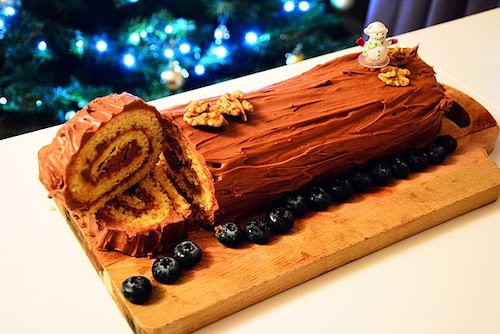
And of course, the essential dessert of a traditional French Christmas banquet is the Bûche de Noël (Yule log), a symbol of warmth and the festive spirit.
Bûche de Noël is part of the Christmas Banquet
The Yule log is a much-loved tradition in France, often enjoyed during Christmas and New Year’s meals. This log-shaped cake is made of a sponge cake covered with chocolate buttercream, finely textured to imitate bark. Adorned with sweet decorations representing snow, meringue mushrooms and spruce branches, it embodies the festive spirit of Christmas.

The origins of the Yule log date back to Scandinavia, specifically to the festival of Jule or Yule, which celebrated Jonir, the God of Alcoholic Drinks, Death and Fertility. Celebrated during the winter solstice, a period of darkness and cold, this festival lasted several days and was marked by bonfires and revelry.
Early Christians replaced the pagan Feu d’Yule (Yule’s Fire) with Sainte Luce’s Day on December 13, derived from the Latin “lux,” meaning light. During these celebrations, beer flowed freely, considered a ritual drink, bringing people around hearths where large logs burned.
The Yule log was believed to possess magical properties, offering protection against witchcraft as long as it burned. It was kept for twelve days, symbolising the length of the Christmas period. Once completely consumed, a small piece of charcoal was kept for the following year’s festivities, while the ashes were scattered in the fields to promote fertility.
This rich tradition, loaded with symbolism, highlights the deep cultural importance of the Bûche de Noël in French celebrations, uniting ancient pagan customs with Christian practices.
Yule Log, a pagan tradition made Christian!
The tradition of gathering around the fireplace on Christmas Eve was adopted by Christians, who opened their doors to those seeking hospitality before midnight mass. They perpetuated the custom of burning the Yule log for three days, symbolising the Holy Trinity.
This tradition, which persisted throughout centuries, allowed many poor peasants and priests to receive a large oak or beech log called a “tréfouet” (three fires), and (three fires) in some French regions. This imposing log was large enough to burn continuously throughout the three days of festivities.
The introduction of these Nordic traditions, including that of the Yule log, is often attributed to the Vikings who settled in Normandy in 911.
Photos via Wikimedia Commons: Yule log 1 by Mathieu MD CC BY-SA 3.0 – Yule log 2 by Mitantig CC BY-SA 4.0


