
Château de Boussac, a medieval fortess
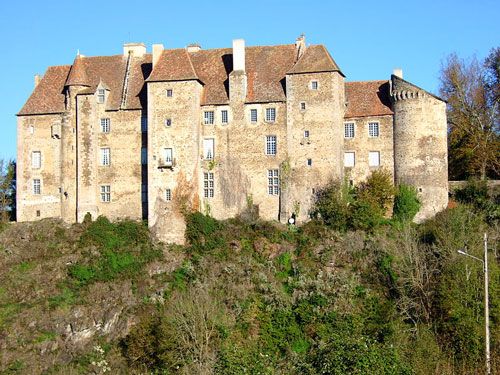
The Château de Boussac is located in the heart of the Limousin region, about fifty kilometres north of Aubusson, on the banks of the Petite Creuse, a tributary of the Creuse River.
Jean de Brosse built the château in the 14th century on the site of his ancestral fortress razed by English troops during the Hundred Years War.
The keep, fortifications, gatehouse, and crenellated roofs of the towers were dismantled during the French Revolution.
However, the main building was spared, as was the Brosse family coat of arms, which adorns the lintel of the main entrance.
The château was remodelled in the 18th century but retains many 15th-century flamboyant architectural features.
Its massive rectangular structure, enhanced by a large round tower, two square towers, and a triangular stair tower, remains imposing.
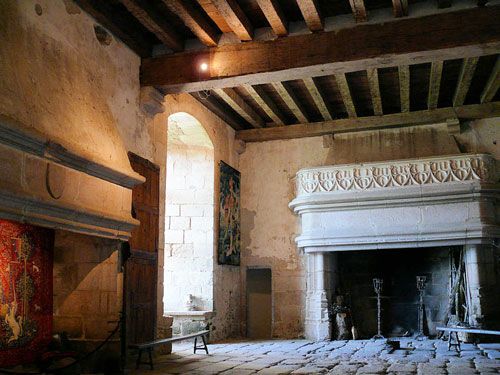
It also boasts remarkable features, such as the skylights and the two exquisitely crafted chimneys of the guardhouse, all classified as historical monuments in 1988 under the label “objects”.
The Château de Boussac was purchased by the village of Boussac in 1833 and acquired by the Creuse department in 1838 to serve as the residence of the sub-prefect of Boussac.
Lady and the Unicorn Tapestry in the Chateau de Boussac
The Château de Boussac gained worldwide renown a few years later when the celebrated writer George Sand and the Inspector General of Historical Monuments, Prosper Mérimée, discovered the Lady and the Unicorn tapestry there.
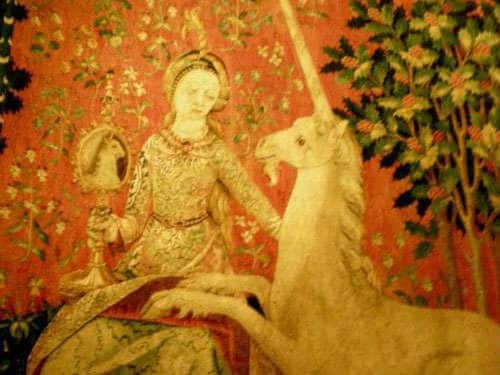
This splendid Flemish tapestry is now housed in the Museum of the Middle Ages of Cluny in Paris.
The interior also boasts other remarkable features, such as the 18th-century wood panelling that adorns the room where George Sand frequently stayed. This panelling was listed as a historical monument in 1998, in the “object” category.
In 1965, the industrialist Mr Blondeau acquired the Château de Boussac. The owner of the Saint-Jean Manufactory in Aubusson, he transformed the Château de Boussac into a prestigious exhibition space for numerous Aubusson tapestries, created by masters such as Jean Lurçat, Jean Picart le Doux, and Dom Robert. The Château de Boussac was officially classified as a historical monument in 1930.
Department of Creuse – Limousin region
Coordinates: Lat 46.347965 – Long 2.211079
Photos via Wikimedia Creative Commons: Photo1 Domaine public – Guardroom fireplaces and Header by MOSSOT CC BY-SA 3.0 – Castle Public domain – Lady and the Unicorn by Karin Bates Snyder aka karinlynn68 © All rights reserved


