
Nantes, the capital of the Duchy of Brittany
The Castle of the Dukes of Brittany is the westernmost of all the famous Châteaux de la Loire. It stands in the heart of Nantes, the capital of the former Duchy of Brittany.
Located on the Loire estuary, Nantes has long been a major seaport and industrial centre. Initially the capital of the Gallic tribe of the Namnetes, it then became the seat of a bishopric, and later the capital of a Frankish county at the end of the 5th century.
In the mid-9th century, King Nominoe unified Brittany and made Nantes its capital, a status it retained for centuries. The Duchy of Brittany, created a century later, solidified Nantes’ role as the heart of the region until 1532.
Over the centuries, Nantes prospered through trade, particularly with the French colonies, and, infamously, through its involvement in the slave trade during the 17th and 18th centuries.
Having become a dynamic industrial centre in the following centuries, Nantes remains closely linked to the port of Saint-Nazaire, reinforcing its status as a major metropolis in Western France.
Castle of the Dukes of Brittany – a few historical facts
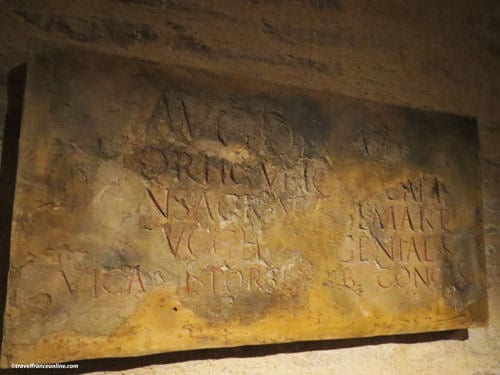
In the 15th century, Francis II, Duke of Brittany, replaced the austere 13th-century fortress, built on the ramparts of the ancient Gallo-Roman city of Namnetes, with the present castle.
This defensive stronghold protected the Duchy of Brittany from incursions by the French king.
The ducal palace, residence of the Dukes of Brittany until 1532, was located within its sturdy walls.
Duchess Anne of Brittany, daughter of Francis II, left an indelible mark on the castle. While becoming Queen of France through her marriages to Charles VIII and Louis XII, she remained devoted to her duchy, guaranteeing its independence until the end of her life.
The duchy was incorporated into the French Crown in 1532 and became the official residence of the French monarchs in Brittany until the 17th century, resulting in the construction of additional buildings within its walls.
The Castle of the Dukes of Brittany was then transformed to house a barracks, a prison, and a military arsenal, but was damaged by a series of disasters, including fires and explosions.
It was listed as a Historical Monument in 1862. The city of Nantes acquired it in 1915 and undertook significant restoration work, creating a history museum in 1924.
Unfortunately, the buildings suffered severe damage during World War II, as the Germans incorporated it into their defensive line, known as the Atlantic Wall, and erected a bunker within its walls.
Castle of the Dukes of Brittany today
The Castle of the Dukes of Brittany underwent a magnificent restoration at the end of the 20th century.
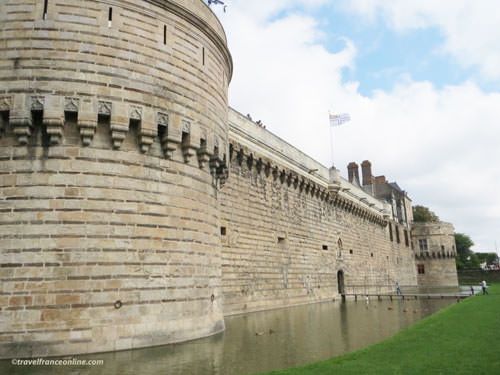
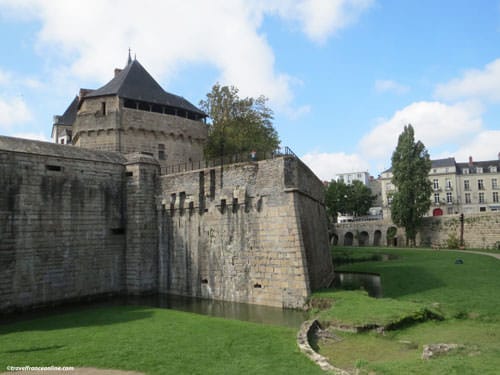
A walk along the 500 metres long and imposing 15th-century ramparts, with their seven towers and moat, offers a glimpse into the castle’s formidable defensive system.
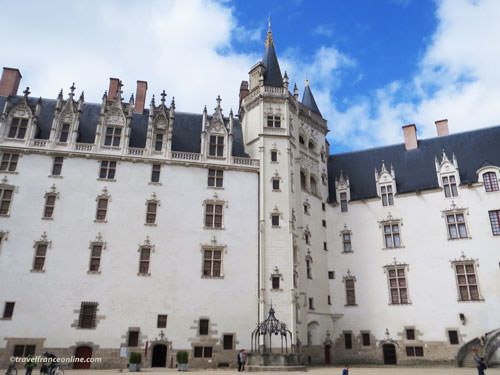
The Grand Logis, the former residence of the dukes, is nestled in the heart of the castle walls. This building, whose construction began under Francis II and was completed by his daughter Anne, is a superb example of Flamboyant Gothic architecture. Its early Renaissance-style facades showcase the region’s renowned white stone from which it was built.
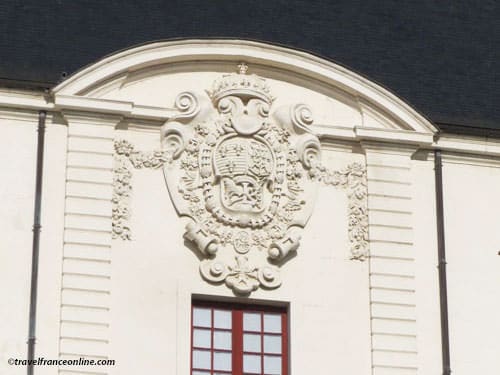
These facades bear the coats of arms of King Louis XII (the porcupine) and Anne of Brittany (the greyhound), symbolising the enduring alliance between the Kingdom of France and the Duchy of Brittany.
The La Tour de la Couronne, next to the Grand Logis, is also superbly adorned with early Renaissance-style loggias, which were added by Anne.
This building was rebuilt in the 17th century after a devastating fire, and suffered terrible damage in 1800 when the arsenal exploded, destroying the adjacent buildings.
The Petit Gouvernement, an annex considered a jewel of French Renaissance architecture, served as a private residence for King Francis I during his stays in Nantes.
The Conciergerie and the Bâtiment du Harnachement (Harness Building) both date from the early 18th century and now house various exhibitions.
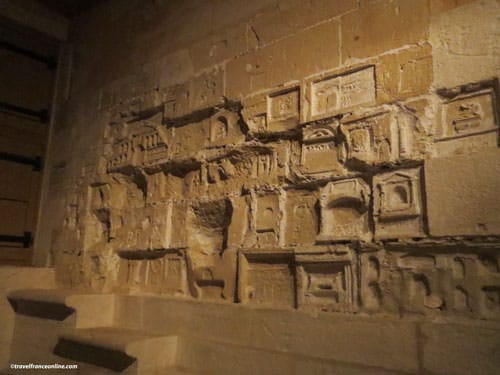
The Castle of the Dukes of Brittany now houses the historical museum of the city of Nantes, which was inaugurated in 1924. Comprising 32 rooms, it has recently been modernised and equipped with multimedia displays to facilitate the discovery of more than 850 objects.
A visit to the Castle of the Dukes of Brittany typically takes between two and three hours.
You can have lunch (or a snack) at a small restaurant located in one of the castle’s outbuildings, or at one of the many restaurants lining the surrounding streets.
Finally, a large car park at the foot of the castle provides easy access for everyone.
Department of Loire Atlantique
Coordinates: Lat 47.216262 – Long -1.548825


