
Bassin d’Arcachon, where sea water meets fresh water
The Bassin d’Arcachon is a remarkable natural wonder, shaped by the ebb and flow of the Atlantic Ocean. Like its iconic Sand Dune, it captures all the beauty of nature. The region is renowned for its seaside resorts and its thriving oyster farming, two essential pillars of its economy.
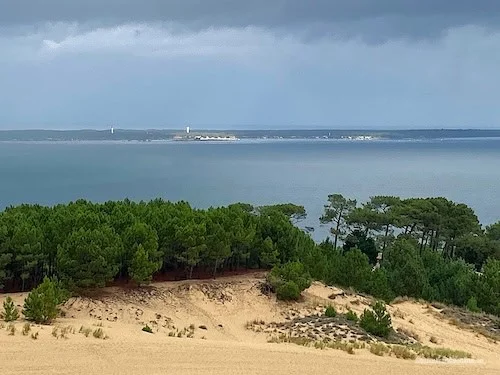
Nestled in the heart of the vast Landes de Gascogne, a natural area stretching across nearly 14,000 square kilometres through the departments of Gironde, Landes, and Lot-et-Garonne, the Arcachon Basin is a haven of peace. Situated between the ocean and lush forests, it benefits from a mild, temperate micro-climate that fosters abundant vegetation, making it a unique ecological gem.
However, the Bassin d’Arcachon, as we know it today, is a relatively recent feature of the landscape, having existed for only about 4,000 years. It was once a vast, enclosed lake fed by the modest River Eyre. Over millennia, the river gradually carved its way to the ocean, forming a wide opening that gave birth to the bay. In doing so, it also created numerous channels, lakes, and ponds that supply it with fresh water today. These channels, known locally as passes, are constantly reshaped by the tides. This perpetual transformation shifts mudflats, salt marshes, and sandbanks, continually redefining the bay’s unique and dynamic landscape.
Bassin d’Arcachon, the perfect home for oysters
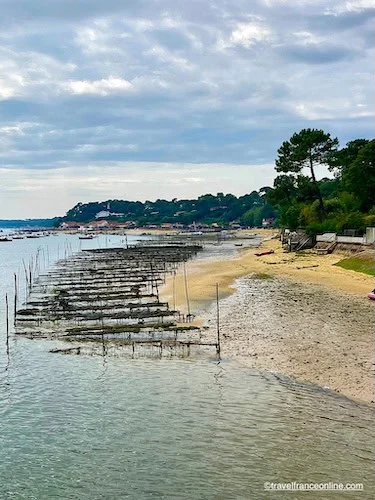
The clear waters and mild climate of the Bassin d’Arcachon offer ideal conditions for the development of natural oyster beds. Flat oysters, locally called gravettes, have been present there since Roman times, as evidenced by numerous historical documents. However, for centuries, oyster harvesting remained minimal and limited to small, local farms.
Everything changed in the 17th century when gravettes were introduced to the royal table, becoming a highly sought-after delicacy. This sudden popularity generated uncontrollable demand, which quickly led to the over-exploitation and depletion of the basin’s natural oyster beds.
It was only in the mid-19th century that oyster farming became scientifically regulated. This transformation began with the creation of oyster beds and the introduction of the limed tile method (tuile chaulée) for collecting young oysters, or spat. This process revolutionized oyster farming: semi-circular tiles, coated with a mixture of lime and sand, were used to attract and capture oyster larvae. Once the spat were attached to these collectors, they could be harvested undamaged and raised in oyster beds, thus ensuring sustainable growth and production.
Unfortunately, a viral disease decimated the flat oysters of the Bassin d’Arcachon in 1920, dealing a severe blow to local oyster farming. In response, producers introduced Portuguese oysters, but these too succumbed to the disease in the early 1970s. It was only with the introduction of the Japanese oyster (Crassostrea gigas), also known as the hollow oyster or Pacific oyster, that the industry was saved, allowing oyster farming to recover and flourish once again.
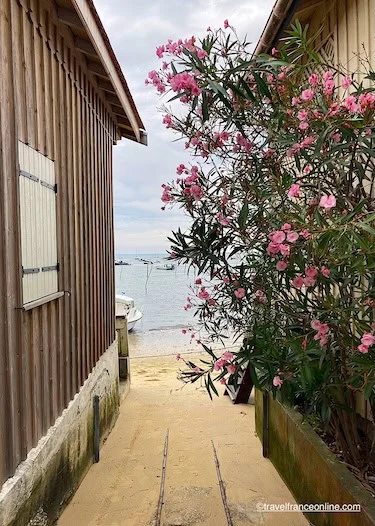
The results are remarkable: today, the Bassin d’Arcachon produces an impressive 18,000 tons of oysters per year. This thriving production is concentrated in oyster beds covering nearly 1,800 hectares. Another major success: the bay has become the main center for oyster spat production in Europe, supplying oyster larvae to other major French oyster-producing regions, including Cancale.
Despite being a healthy and well-regulated industry, oyster farming in the Bassin d’Arcachon faces a modern challenge: pollution. Wastewater discharges and the pressure of mass tourism have detrimental consequences. Between 2018 and 2023, the sale of local oysters was banned several times due to contamination risks. Fortunately, strict protective measures were implemented in 2024 to safeguard this thriving and essential sector.
Finally, if you are an oyster enthusiast, you may be able to identify their origin, much like the terroir for wine. Oysters feed on plankton, the flavour of which varies from region to region, subtly influencing their taste. To be honest, my palate isn’t refined enough to perceive these nuances, but that certainly doesn’t stop me from fully enjoying the oysters!


