
What is the Apocalypse tapestry?
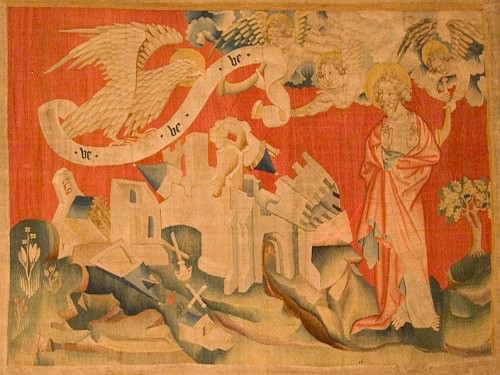
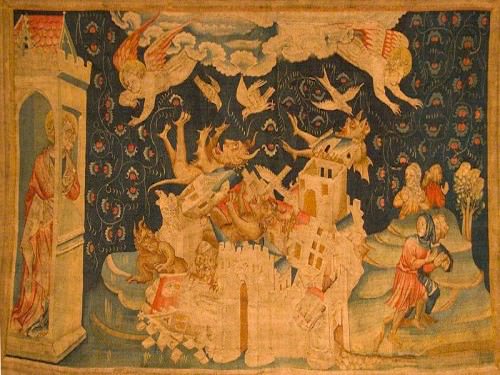
The Apocalypse Tapestry, the largest and oldest known tapestry made in Paris, is on display at the Château d’Angers.

Commissioned by Duke Louis I of Anjou, brother of King Charles V, it was woven between 1373 and 1383 for the marriage of Louis II and Yolande of Aragon in 1400.
The tapestry was initially displayed during religious celebrations until King René bequeathed it to Angers Cathedral.
Falling into oblivion over time, it was only restored during the Second Empire (1852-1870), a period marked by a renewed interest in Antiquity. It was then put away and forgotten for decades, but was rediscovered in 1938 by Jean Lurçat.

In 1952, a building was specially constructed on the site of the former kitchens of Angers Castle to house and preserve this remarkable tapestry.
The 103-metres-long and 4.5-metres-high Apocalypse Tapestry is composed of six panels of identical dimensions.
These panels depict 75 different scenes which illustrate the texts of the last book of the Gospel of John. The backgrounds alternate between red and blue, forming a vast checkerboard pattern. The front and back of the tapestry are identical. Amazingly, the original colours are still intact on the back.
Jean Lurçat Museum in Angers
A visionary and talented artist, Jean Lurçat breathed new life into the art of tapestry in France.
He indeed introduced original motifs, modern colours, and bold lines and designs, breaking with the traditional style. His contemporary approach earned him international renown.
The Musée Jean Lurçat et de la Tapisserie (Tapestry Museum) in Angers is housed in the former Saint-Jean Hospital. Founded in 1174 by Henry II Plantagenêt, this hospital is the oldest surviving civilian hospital in France.
Located in the Quartier d’Outre, on the north bank of the Maine River, it displays the vibrant tapestries created by Jean Lurçat.
The Apocalypse Tapestry was a major source of inspiration for Lurçat, when he created “Les Joies et les Souffrances de l’Humanité face à la Vie et à la Mort – Joys and Agonies of Humanity in the Face of Life and Death,” an 80-metre-long tapestry divided into 10 sections.
One of his most famous works, “Le Chant du Monde – The Song of the World,” is on display in the hospital vaulted Salle des Malades (patients’ dormitory). The nearby Centre Régional d’Art Textile (Regional Centre for Textile Art) traces the history of various weaving techniques.
You can also admire some of Lurçat’s tapestries at the Galerie des Gobelins in Paris.
Please note that photography of the Apocalypse Tapestry is prohibited in the exhibition hall to preserve it.
Department of Maine-et-Loire
Coordinates: Lat 47.470000 – Long -0.560000
Photos via Wikimedia Commons: Tapestry in its gallery by Chatsam CC BY-SA 3.0 – L’Aigle du Malheur and La Chute de Babylone by Kimon Berlin User:Gribecon CC BY-SA 3.0 – Le chiffre et la bete by Anonymous (supposedly Robert Poisson) Public domain


