
Angers, from a Gallo-Roman to a French city
In the 1st century BC, Angers was just a modest fishing village. Under the leadership of their chieftain Domnacus, the village valiantly resisted Roman incursions, albeit in vain, which solidified his legend as a local hero.
By the 4th century AD, this modest village had transformed into the prosperous Gallo-Roman city of Juliomagnus.
The dawn of the 5th century saw the emergence of the Kingdom of France under the rule of Clovis, King of the Franks, a pivotal moment also marked by his conversion to Christianity.
Throughout the country, zealous preachers then undertook missions to spread the new faith among our pagan ancestors, inaugurating an era of religious transformation. In this fervent atmosphere, churches, chapels, and monasteries began to dot the landscape, bearing witness to the growing influence of Christianity.
Angers became the seat of an important religious council at this time, while the founding of the abbeys of Saint-Aubin and Saint-Serge in the 6th and 7th centuries attracted settlers who contributed to the growth and cultural wealth of the city.
Medieval Angers

The city prospered until the Norman invasions of the 9th century. In a swift and brutal campaign, the Normans seized Angers and for an entire year, they pillaged, razed, and occupied the city with impunity.
Legend has it that King Charles the Bald orchestrated a daring plan to reconquer Angers, supposedly by diverting the Maine River to counter the Vikings’ advance in their long-ships. Whether fact or fiction, this story testifies to the desperate measures taken to repel the invaders.
The 9th century also marked another turning point in French history with the fall of the Carolingian dynasty. The weak and ineffective descendants of Emperor Charlemagne squandered their authority in petty squabbles, paving the way for the rise of regional lords.
Faced with the Norman threat, these powerful vassals sought royal approval to fortify their domains, effectively transforming them into autonomous fiefdoms.
In exchange for their loyalty and military support against the Normans, Charles the Bald granted them hereditary titles and lands, further fragmenting France into a patchwork of independent kingdoms.

The Norman threat finally subsided in 911 with the creation of the Duchy of Normandy by the Treaty of Saint-Clair-sur-Epte, negotiated by King Charles the Simple.
Despite this, internal struggles persisted among the major vassals, the most influential of whom was the House of Anjou, perpetuating a cycle of territorial conflicts and rivalries.
The descendant of this exceptional lineage, Henri Plantagenêt, ascended the throne of England as Henry II in 1154, significantly affecting Franco-British relations.
Angers city – 15th century to present day
Angers experienced a new phase of growth and development from the beginning of the year 1000.
The 15th century was another pivotal moment in the city’s history with the installation of the first printing press in the Loire Valley. Gutenberg’s revolutionary invention in 1450 indeed democratized access to culture, ushering in an era of intellectual progress and social transformation.
At the same time, the French kings discovered the Renaissance during their Italian campaigns and introduced new ideas and artistic concepts to the country. This intellectual and cultural awakening reshaped French society, paving the way for a period of profound upheaval.
In the 16th century, the rise of Protestantism posed a major challenge to the established religious order. Angers, among other cities, became a hotbed of religious conflict, with tensions escalating between Catholics and Huguenots. These conflicts, which lasted from 1560 to 1598, culminated in the signing of the Edict of Nantes by the Protestant Henry IV, promising religious tolerance and peace.
However, the outbreak of the French Revolution in 1789 ushered in a new period of upheaval and destruction. In 1793, royalist forces briefly seized Angers before being driven out by the revolutionaries, who retaliated with brutal repression. Following these events, Angers lost its prestige, reverting to being a provincial town.
The Industrial Revolution and the construction of the Paris-Nantes railway line in 1849 heralded a new era of prosperity for Angers.
Since then, the city has experienced constant growth and renewal. Today, Angers is a dynamic economic hub in the Loire Valley, renowned for its trade in wines, fruits, vegetables, flowers, and horticultural and medicinal products. A lively university town, it also attracts students from all over the world.
Angers, City of Art and History
Angers’ rich historical heritage has earned it the prestigious title of City of Art and History. The old town is home to around a hundred historical monuments, testaments to a fascinating past.
It’s impossible to list them all, but below is a selection.
The imposing fortress of Angers, along with the captivating Tapestry of the Apocalypse, attracts a constant stream of visitors and tourists, offering a glimpse into the city’s medieval past.
The Palais du Tau is an 11th-century episcopal palace nestled against the Gallo-Roman ramparts.
This jewel of Romanesque art has undergone transformations over the centuries, illustrating the evolution of French architecture through the ages.
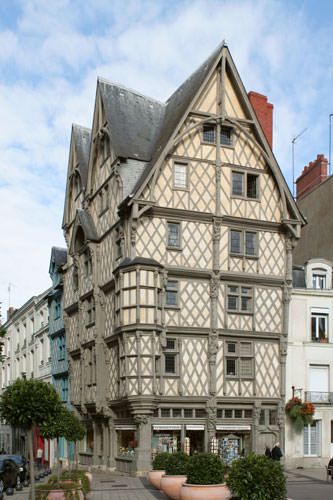
Not far from there stands the Maison d’Adam, a house that perfectly exemplifies Renaissance half-timbered architecture.

Its facade is indeed adorned with finely sculpted animals and figures, including the emblematic figures of Adam and Eve, which naturally gave it its name.
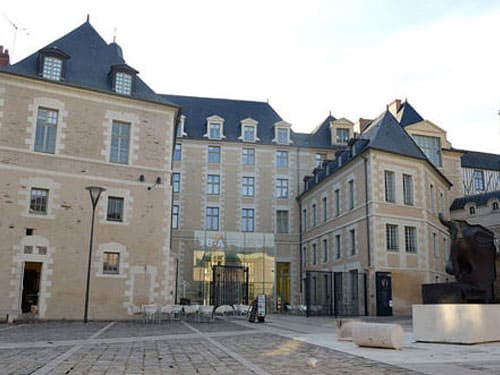
The Logis Barrault, the oldest private mansion in Angers, is located on Place Saint-Éloi. It now houses the Angers Museum of Fine Arts, which boasts a wealth of masterpieces.
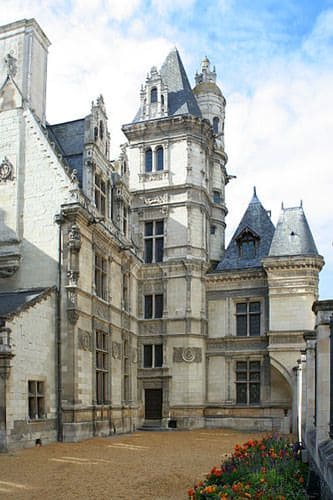
Finally, the elegant Logis Pincé, another jewel of French Renaissance architecture, houses a museum primarily dedicated to Greek, Roman, Etruscan, and Egyptian antiquities.
Medieval Quartier de la Doutre
The historic Quartier d’Outre Maine – district on the other side of the river Maine, located as it name suggests on the other side of the Maine River, underwent a remarkable revitalisation in the 20th century, to showcase several exceptional buildings.
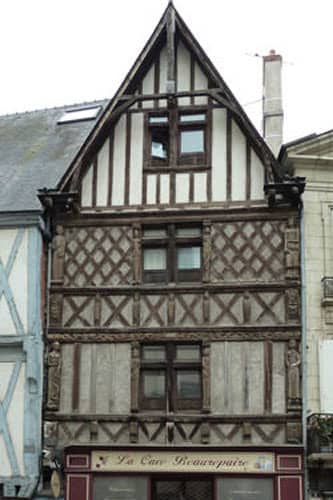
Among them are the Maison de Simon Poisson, a Renaissance-style half-timbered house renowned for its refined details, and the Hôtel des Pénitentes, a Flamboyant Gothic building from the late 15th century, admired for its ornate facade.
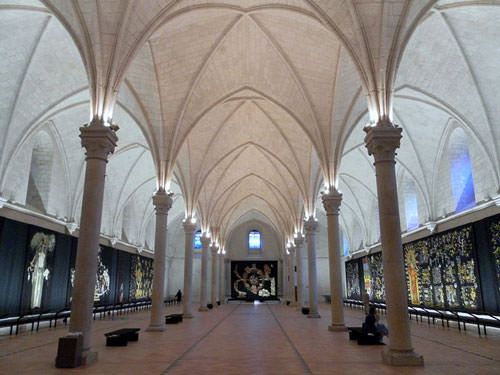
The Jean Lurçat Tapestry Museum is housed in the former Hôpital Saint-Jean. Founded in 1174 by Henry II Plantagenêt, it is the oldest non-military hospital in France. This Romanesque building is accessible via the Pont de la Haute Chaîne (bridge).
Jean Lurçat‘s fascination with tapestries was rekindled in 1938 following his rediscovery of the extraordinary Apocalypse Tapestry. Inspired by this monumental work, he created The Joys and Sorrows of Humanity Facing Life and Death, an 80-meter-long masterpiece divided into ten sections.
Among Lurçat’s most celebrated creations is The Song of the World, prominently displayed in the Salle des Malades, the former vaulted patients dormitory. These remarkable tapestries are a tribute to Lurçat’s artistic genius in an exceptional setting.
Present day city
The city of Angers also boasts a collection of magnificent 19th and 20th-century buildings.
Among them is the stunning Grand Théâtre, a true cultural hub that hosts a diverse program of shows and events.
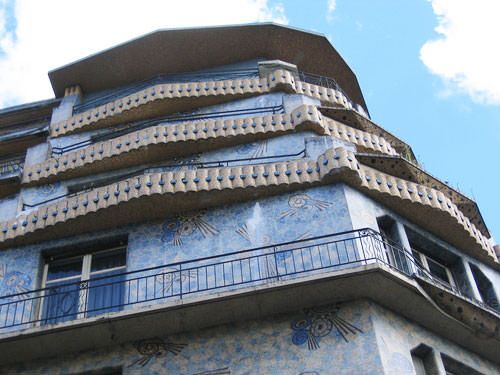
The Maison Bleue, a superb illustration of Art Deco style, is also remarkable for its unique design, sure to appeal to fans of this 1920s-1930s style.
Finally, the Romano-Byzantine Church of Notre-Dame-des-Victoires is renowned for its beauty and the exquisite detail of its architecture. Its soaring spires and ornate facade make it one of the city’s iconic landmarks.
These are just a few examples of the many exceptional buildings that make up Angers’ architectural heritage.
Department of Maine-et-Loire
Coordinates: Lat 47.478419 – Long -0.563166
Photos via Wikimedia Commons: Logis Pincé and Maison d’Adam and Header by Coyau CC BY-SA 3.0 – Maison de Simon Poisson by Sémhur CC BY-SA 4.0 – La Maison Bleue by Armagnac-commons CC BY 3.0 – Grande Salle des Malades Hôpital St-Jean by Patrick89 CC BY-SA 3.0 – Logis Barrault by Selbymay CC BY-SA 3.0 – Galerie du Roi René by Pj44300 CC BY-SA 3.0 – Logis royal and chapel by Manfred Heyde CC BY-SA 3.0


