
Cantal Cheese, one of the oldest French cheeses

Cantal is a hard or semi-hard cheese that comes in the form of a large, bright yellow cylinder.
Produced in the Cantal Mountains, it is among the oldest cheeses in France.
Indeed, more than two millennia ago, our distant Gallic ancestors were already producing it!
Cantal cheese, or Fourme de Cantal, has made a stylish entrance into the culinary world.
It was indeed served on the table of King Louis XIV, alongside Saint-Nectaire and Salers cheeses, thanks to Henri II de Sénectère, Count of Auvergne!
Production
There are two varieties of Cantal: Cantal fermier (farmhouse cheese) and Cantal laitier (dairy cheese).

Cantal fermier represents 80% of annual production, and is made from raw milk, while Cantal laitier is produced on a larger scale with pasteurised milk.
Cantal is made exclusively from Salers cows’ milk, collected during the winter season (from November 15 to April 15) when the cows are in the barn and fed hay. Cantal cheese is the result of a rigorous manufacturing process.
After collection, the milk is inoculated with rennet, a natural enzyme present in the cows’ stomachs, to trigger coagulation. The resulting curd is then cut into small grains, the size of a grain of wheat or corn, and separated from the whey.
These curd grains are compacted into a solid mass, called a “cake”, which is gradually pressed and then cut into individual slices. Throughout this process, the curd is turned at least twice to ensure a uniform shape and consistency.
The cheeses are then unmoulded and left to rest for at least 10 hours, thus promoting the development of lactic bacteria in the milk.
They are then coated in salt and left to rest for at least an hour before being placed in moulds lined with fine linen.
At this stage, a green label is affixed to farm-produced Cantal cheese (fermier ), while a brown label is affixed to pasteurised dairy Cantal cheese (laitier). The cheeses undergo a second slow pressing: 12 hours for small Cantal cheeses and 18 hours for larger ones.
Finally, they enter a maturation phase of 1 to 6 months, during which they develop a more pronounced flavour. Cantal Vieux (mature) can be aged for up to one year.
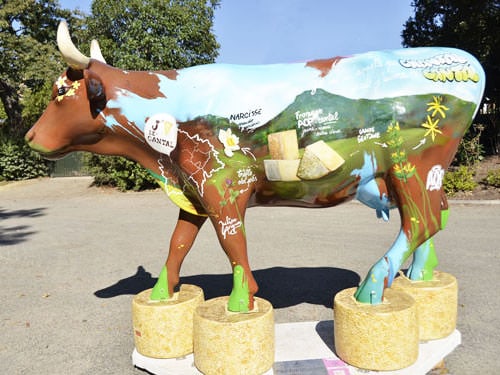
Credits: Photo Labels and source article Jean Piludu – Translated and edited by and for Travel France Online – Cheese by Francine SAUTRET CC BY-SA 3.0 – Advertising cow from Pixabay


