
Huelgoat, an antic mining town
Huelgoat, whose name originates from the Breton huel, meaning high, and goat, meaning wood, is on the edge of a large artificial lake.

The Celts and then the Romans exploited the lead and silver mines in the nearby forest, giving rise to a flourishing mining industry that peaked in the 18th and 19th centuries.
At the time, approximately 1,600 miners extracted up to 700 tons of lead and nearly 2 tons of silver per year. These mines gave their name to the Argent River (Silver), which originates in the lake.
In the 16th century, German miners built two canals to power the hydraulic machines of the old lead and silver mine. Today, only the old galleries, the wheel, and the ruins of the mine owner’s house remain.
Le Chaos De Rochers – Eccentric rock formations
Huelgoat is also renowned for its Arboretum du Poërop – Les arbes du monde au Huelgoat, which boasts 3,600 species of trees and shrubs from the five continents and is really worth a visit in spring and autumn.
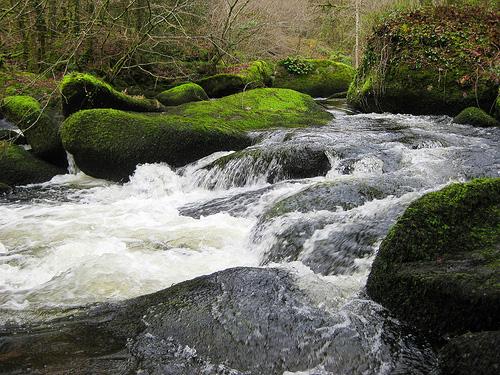
However, Huelgoat is best known for its 1,000-hectare forest dotted with strange rock formations. The enormous granite blocks (sometimes reaching 20 metres high) of the Le Chaos De Rochers (Chaos of Rocks) border the shimmering Silver River. These rocks all have a name and a legend.
La Roche Tremblante – Trembling or Shaking Rock

La Roche Tremblante (Trembling Rock) is also called Logan’s Stone.
It is one of the most impressive erratic boulders in the forest.
This 137-tonne, 7-metre-long granite block is articulated in such a way that it can be moved by pressing on the pivot point, hence its name, of course!
This type of stone is also called a roulers (rolls), which the druids considered a symbol of universal balance.
Le champignon – Mushroom
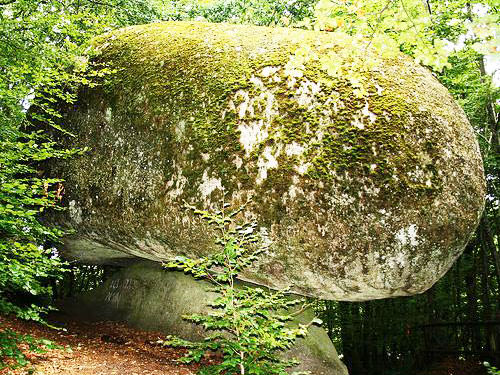
The Mushroom is another erratic boulder with an evocative name!
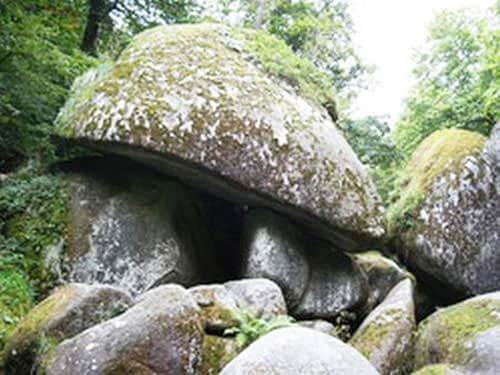
This enormous 200-tonne rock rests in equilibrium on a smaller stone, thus forming a mushroom.
You will have to leave the forest to admire it, as it is located in a small wood opposite the Intermarché supermarket, on the road linking Huelgoat to Berrien.
If you can’t see it from the road, look for the sign opposite the supermarket parking lot.
That said, be aware that in spring and summer, dense vegetation can obscure it.
Legends of the Forest of Huelgoat
As you can imagine, these eccentric rock formations have given rise to many legends, many of which relate to the Arthurian Tradition. However, several versions exist; Here is a selection of our favourites.
Le Camp d’Artus and La Grotte D’Artus
Excavations showed that the Camp d’Artus (Camp of Artus) was a large oppidum (hill fort) from the Iron Age. However, its name and ancient origins once led locals to believe that King Arthur was buried with his servants in the natural cave of the Grotte d’Artus. Legend has it that Merlin the Enchanter helped Arthur find a fabulous treasure in the Valley of No Return, and that this treasure is hidden in this cave. But beware! Demons, taking the form of will-o’-the-wisps, guard it!
La Grotte du Diable – Devil’s Grotto
The Devil’s Cave is near the Lake of Huelgoat. Access is easy: park in town and walk to the entrance of the Chaos, near the bridge located at the end of the lake.

The cave is also located a few hundred metres from the Moulin du Chaos, a watermill that has been in operation since 1339!
A slippery metal staircase, though equipped with a handrail, leads down to the cave. Be careful, it’s quite dark inside: a flashlight is highly recommended!
It is said that the cave is the gateway to Hell…
Legend has it that it’s located at the end of Chemin de l’Enfer – Road to Hell, a street lined with bars. However, the devil would let anyone, who managed to reach the last bar on the street while still sober, go home. And, he would even spare their misdeeds!
La Rivière de Sang – River of Blood
In the 4th century, Gradlon Mawr, known as Gradlon the Great, king of Cornwall, fell in love with a beautiful creature, half-woman, half-fairy.
They had a daughter, Dahut, whom Gradlon raised after her mother left.
However, the mother eventually returned and took possession of Dahut’s mind and turned her into a cruel princess who took a new lover every night. However, in the morning, she threw them into the Silver River from the towers of Castle of Guibel, which was perched on a promontory.
In strong winds, one can hear the cries and lamentations of her deceased lovers coming from the depths of the lake. If you ever hear them, you must recite the ritual formula “May God forgive the dead” and pray for their eternal rest.
Le Chaos d’Huelgoat
In ancient times, a giant named Gargantua stopped in the forest of Huelgoat, and suddenly became terribly hungry. The very poor inhabitants offered him only a meagre gruel which, one can imagine, was not enough to appease his hunger.
He thus continued his journey towards the region of Léon and found other people who served him a hearty meal. However, later, while walking along the coast, he remembered the meagre meal that the inhabitants of Huelgoat prepared for him and, losing his composure, picked up large rocks on the shore, which he sailed towards Huelgoat.
He thus created the fantastic chaos of moss-covered stone blocks that can be admired today in the forest!
La Mare aux Sangliers – Wild Boar Pool

Legend has it that the fairy of the forest bestowed healing powers upon the crystal-clear spring. One legend tells of the Lady of the Lake who visited Arthur while he was bathing there and healed his wounds with the spring’s magical water.
Another legend recounts that one day, Saint Peter and God descended to Earth, disguised as a woodcutter and a farmhand, respectively. A pregnant sow accompanied them.
The holy figures arrived at the home of an old baker. They told her that the sow was about to give birth and that they would entrust her to her on the condition that she receive half of the piglets upon their return. The woman agreed. They said they would return in a week.
So the woman built a shelter for the animal and cared for her. The next day, the sow gave birth to eight piglets. The woman thought that Saint Peter and God wouldn’t know how many piglets she had given birth to. So she decided to tell them that only four piglets had been born and hid four of them in the unlit oven.
When the travellers returned, they asked how many piglets had been born. “Four,” replied the baker’s wife. God and Saint Peter asked, “And what about the ones in the oven? Don’t they count?”
The woman immediately apologised for her lie, and Saint Peter opened the oven. The four piglets then ran off into the forest. However, the hot ashes had burned their fur. Since then, the locals have said that the pigs of Huelgoat have brown hair.
La Mare aux Fées – Fairies Pond
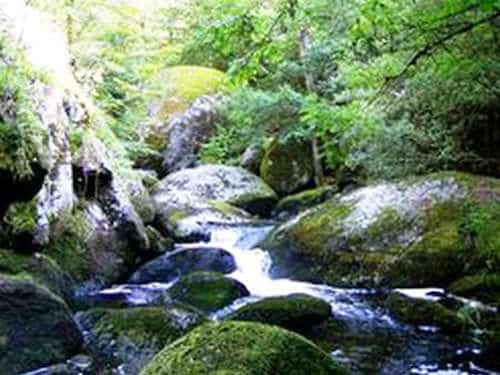
Legend has it that, during the day, the fairies dyed their long hair with golden combs and used the pond as a mirror.
However, if a fairy was caught talking to a boy, she was thrown to drown into the pond as punishment!
One days that can see the fairies at the bottom of the pond in the moonlight.
But beware!
They transform into ugly, toothless witches who would cast a spell on you!
Le Ménage de la Vierge – Virgin’s Household
According to local folklore, this is the site of the Virgin Mary’s first home.
The stacked rocks do indeed form a shelter, with strangely shaped stones resembling everyday utensils. One can distinguish a cauldron, a ladle, a butter dish, a butter churn, bellows, armchairs and a bed! It is even said that you can see Jesus’s cradle!
Departement of Finistère
Coordinates: Lat 48.364725 – Long -3.745646
Source photos and text: © Maria Richardson – Header via Wikimedia Commons Header by Moreau.henri CC BY-SA 3.0


