
Bayonne, a city full of surprises!

Bayonne is a magnificent city, rich in culture and boasting breathtaking architecture. It would take pages to do it justice (and thankfully, the local tourist brochures already do a wonderful job!).
Instead, let me introduce you to the five characteristics that have earned it international renown. Where to begin?
With its fascinating history, when it was an English possession more than nine centuries ago? With its tempting local specialties, such as the world-famous Bayonne ham, or its rich chocolate-making tradition? With its Feria de Bayonne, a vibrant and prestigious summer festival? Or perhaps with the fact that the city gave its name to a weapon?
Bayonne’s strategic location
Let’s start by placing Bayonne on the map.

Located in the French Basque Country, the city is both a river and sea port. It lies on the left bank of the Adour River, at its confluence with its tributary, the Nive. Geographically, it marks the western border between the Basque Country and Gascony and is just 6 km from the golden beaches of the Atlantic Ocean. To the north, on the other side of the Adour, lies the Landes department, renowned for its vast pine forest.
This strategic location has attracted people for millennia. During the Bronze Age, the region was inhabited by the Tarbelli, a proto-Basque tribe whose capital was located in what is now the city of Dax. Impressive remains of a fortified Gallo-Roman site dating from the 1st century AD are still visible.
The city’s cultural importance is undeniable. Shaped over time by Basque and Gascon influences, Bayonne boasts a rich, sometimes tumultuous past that has bequeathed a remarkable architectural heritage.
Today, Bayonne is the main city of the French Basque Country and a dynamic centre of commerce and tourism in the Adour basin. It plays a key role within the Bayonne–San Sebastián Basque Eurocity, a cross-border economic and cultural partnership uniting this region of France and Spain.
A glimpse into Bayonne’s past
Let’s travel back in time to the 12th century for a brief overview of Bayonne’s rich history.

In 1152, the marriage of Eleanor of Aquitaine to Henry Plantagenet, the future King Henry II of England, brought Bayonne under English rule. Thanks to its strategic location at the mouth of the Adour River, the city prospered rapidly, becoming both a military stronghold and a thriving trading port. Trade with England grew steadily, making Bayonne a successful centre of international exchange.
But this golden age was short-lived. In 1451, towards the end of the Hundred Years’ War, Bayonne was recaptured by the French. Trade with England ceased, marking the beginning of an economic decline. As if that weren’t enough, the Adour River began to silt up and divert its course northward, depriving the city of its port access and further weakening its commercial importance.
However, Bayonne’s situation improved again in 1578. A major engineering project redirected the Adour River back to its original mouth, thus restoring the city’s access to the sea and reinstating its status as a regional and international maritime and river port.
Bayonne, the French capital chocolate
It was in the 17th century that the city welcomed a new and delicious product: chocolate!
The story begins in 1528, when the famous conquistador Hernán Cortés brought chocolate back to the Spanish court after his expedition to the Americas. But the drink he introduced was already quite different from the bitter and spicy beverage once consumed by the Aztecs and Mayans. In these ancient Mesoamerican civilizations, cacao beans were so precious that they served as currency. Chocolate was a sacred luxury, reserved for medicinal purposes or religious rituals.
The Spanish colonists transformed the drink by sweetening it with honey, cane sugar, and exotic spices, creating a rich and smooth version that quickly reached the royal courts of Europe, thanks in particular to the political alliances forged through marriage.
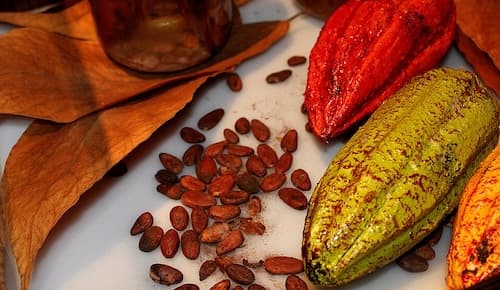
In the 17th and 18th centuries, the city had become a thriving centre of regional and international trade, a vital link between Southern and Northern Europe. A wide variety of goods were sold there: salted cod, whale oil, fabrics, wool, wheat, spices, tobacco, and sugarcane… and, above all, cocoa beans.
This new ingredient paved the way for the emergence of a nascent chocolate-making industry. The rise of the chocolate trade in Bayonne was driven by Sephardic Jews, a community exiled from Spain and Portugal during the religious persecutions of the Catholic monarchies. Seeking refuge, many of them settled in Bayonne, where Spanish was widely spoken, and formed the Quartier Saint-Esprit, a district located just outside the city walls.
These skilled merchants and artisans brought with them the know-how and techniques of chocolate making, developing it not only as a luxury beverage but also for its therapeutic properties (so yes, there’s a good historical excuse to enjoy chocolate!) They perfected their recipes using honey, spices, vanilla, and other natural sweeteners, creating rich and complex flavours.
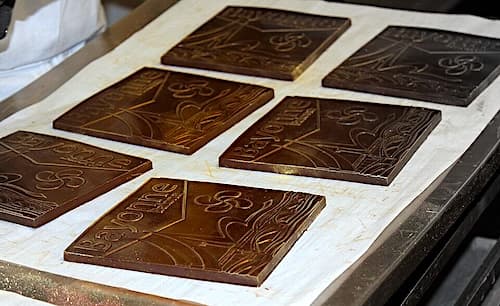
However, this community was subject to strict restrictions: they were only allowed to enter the fortified city of Bayonne at sunrise and had to return to Saint-Esprit before nightfall. Inside the city, its members worked discreetly in grocery stores or for the wealthy.
At that time, chocolate was a luxury item, a status symbol reserved for the richest. Each chocolatier jealously guarded their secret recipes to stand out from the competition, giving rise to veritable chocolate dynasties. Bayonne chocolate was used to make candies, pastries, and even ice cream. Over time, it became more accessible to the general public and began to spread throughout France and Europe, earning Bayonne the title of “Chocolate Capital,” both for its artisanal expertise and for the impressive number of chocolatiers it trained.
As early as 1825, Bayonne chocolate had already won prestigious awards and obtained patents. The chocolate trade quickly expanded to other towns in the Basque Country. In just thirty years, the city boasted 32 master chocolatiers! Although industrial chocolate production eclipsed Bayonne’s artisanal dominance in the 20th century, the city never severed its connection with chocolate. Today, historic chocolate shops perpetuate the tradition, ensuring the continued existence of Bayonne’s chocolate heritage.
Bayonne Ham
But chocolate isn’t Bayonne’s only culinary treasure, far from it! The city is also renowned for another iconic specialty: Jambon de Bayonne, a cured ham prized for its delicate flavour and melt-in-your-mouth texture.
The story of Bayonne ham begins, as is often the case with great traditions, with a legend. It is said that Gaston Fébus, Count of Foix (1331-1391), wounded a wild boar during a hunt. The injured animal escaped but eventually died in a salt spring in Salies-de-Béarn. Months later, hunters found its remains, remarkably well-preserved thanks to the natural salt!
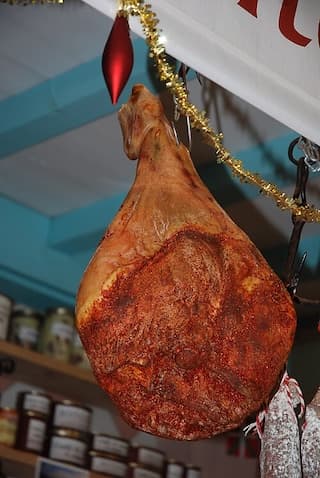
This story inspired the beginnings of salting as a preservation method, a technique that would become essential to the production of Bayonne ham.
In fact, the salting technique wasn’t invented in the city of Bayonne! It originated in the surrounding villages, where each ham once bore the name of its place of origin. However, the city’s status as a prosperous port city played a crucial role in this history. From the 15th century onward, it facilitated the export of these exceptional hams to other regions and countries. Naturally, the name “Jambon de Bayonne” became established, thanks to the city’s commercial importance.
Bayonne ham received royal approval, quite literally! The Gascon king Henry IV, and later Louis XIV, served it at their tables, bestowing upon the product unparalleled prestige and renown through publicity. Building on this recognition, it quickly became a symbol of culinary excellence, its reputation extending far beyond the borders of the Basque Country.
Today, Bayonne ham is still produced using time-honored methods: rubbed with local salt, air-dried, and matured to perfection, it is a proud ambassador of Basque gastronomy!
Bayonne, the citadel
Let’s now return to the city’s historical roots, this time through its impressive fortifications, which still shape its landscape today. While impressive remains of its original Gallo-Roman ramparts still exist, the current fortifications were built in 1599 at the behest of King Henry IV. The objective? To defend the city from repeated Spanish threats!

Although peace was officially signed between France and Spain in 1659 by the Treaty of the Pyrenees, tensions remained high. Determined to strengthen the border, King Louis XIV called upon his renowned military engineer, Marshal Vauban, to fortify the city. Vauban arrived in 1680 and inspected the city’s defenses. His verdict? The existing fortifications were solid, but he reinforced them with sophisticated outer works, creating a multi-layered defense system that became a hallmark of his military architecture throughout France.
These fortifications were severely tested during the Napoleonic Wars. From February 27 to May 5, 1814, the citadel was besieged by a coalition of Spanish, British, and Portuguese forces led by the Duke of Wellington. Inside the ramparts, Napoleon’s troops resisted fiercely, making Bayonne the scene of intense and bloody fighting. Despite the city’s determined resistance for weeks, the siege ultimately ended in defeat, one of the final blows to Napoleon I, who abdicated shortly thereafter.
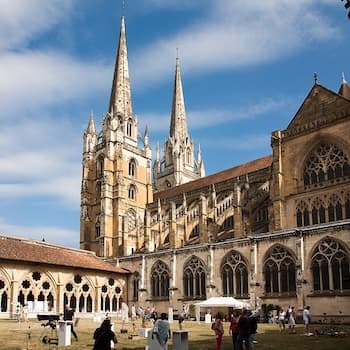
A walk along these ancient ramparts offers breathtaking views of the city, dominated by the majestic Sainte-Marie Cathedral, as well as the Nive and Adour rivers, which both flow through the heart of Bayonne. The cathedral has been a UNESCO World Heritage Site since 1998, and its cloister, built in the 13th and 14th centuries, is one of the largest in France!
The city reveals two distinct personalities through its different districts: Grand Bayonne charms visitors with its medieval streets, while the trendy Petit Bayonne district vibrates with colour, from its lively facades to its street art. And if you wish to immerse yourself in Basque culture and the city’s detailed history, a visit to the BBasque Museum and the History of Bayonne is ‘a must’. It is housed in the Maison Dagourette, a former 16th-century port house, on the Quai des Corsaires.
The bayonet
Let’s stay in the realm of warfare and explore another powerful and formidable invention, this one originating in the region: the bayonet (or baïonnette in French as Bayonne is known as Baiona in Basque and Gascon).

This simple yet brutal weapon, a blade attached to the barrel of a rifle, became one of the most iconic instruments of war from the 17th century until the First World War. In the 16th century, the musket was the infantry’s weapon of choice (and even gave its name to the famous musketeers). But it had a major flaw: once the powder ran out, the musket became unusable in close combat!
Legend has it that the bayonet was born out of necessity. According to the story, during a battle, the peasants of Bayonne, defending their land, ran out of powder. Thinking quickly, they inserted the handles of their penknives into the barrels of their muskets, instantly transforming them into spears. What began as a makeshift weapon on the battlefield quickly became essential. Military leaders recognized the potential of this new dual-purpose weapon, and by the 17th century, the bayonet had become standard equipment for armies across Europe. It was one of the simplest yet most effective inventions in history, transforming every rifleman into a potential hand-to-hand combatant, even without ammunition.
The Bayonne Festival, a celebration like no other
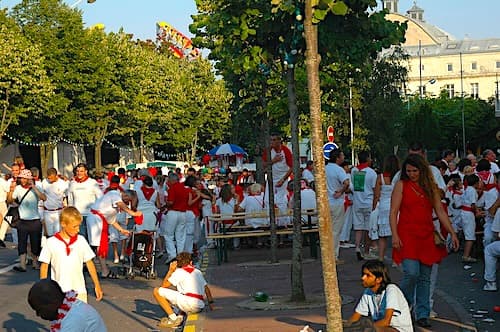
Let’s end our whirlwind tour of Bayonne in style with its most famous event: the Fêtes de Bayonne, also known as the Feria de Bayonne.
This legendary festival, created in 1932, takes place every year from the Wednesday before the first weekend of August until the following Sunday: five days of non-stop festivities! During the festival, the city is transformed. Everyone dons traditional dress: white clothing enhanced with a red scarf and sash, a nod to its Basque and Gascon origins. Red represents strength and passion, while white symbolizes purity and honesty!
The festivities offer a vibrant mix of local traditions and joyful excitement: Basque pelota; folk music and regional dances; bullfights (controversial for some, but deeply rooted in local culture); and bullfighting (friendly cow races in an arena). Parades, brass bands, concerts, open-air dances; Toros de Fuego (a spectacular fireworks display in the shape of a bull), and of course, a huge funfair for all ages!
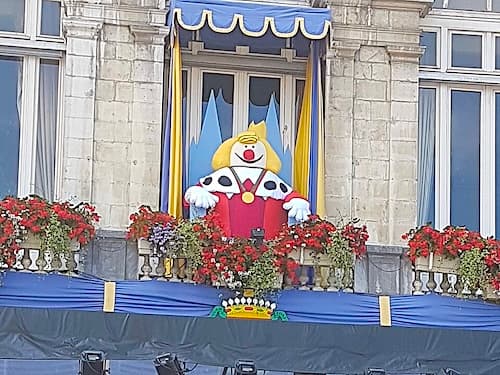
All of this takes place under the watchful eye of King Léon, a giant puppet who became the official mascot of the Bayonne Festival in 1987. In recent years, the Bayonne Festival has attracted over a million visitors over five days, making it one of the most popular festivals in France!
So here is Bayonne, a city of history, flavours, and festivities, with a character as rich and bold as its chocolate and ham. If you haven’t yet been tempted to visit the French Basque Country… perhaps now is the time to pack your bags and discover Bayonne for yourself!
Department: Pyrénées-Atlantiques
Wikimedia Commons: Header and Nive river and cathedral and Cathedral and cloister by Daniel VILLAFRUELA is CC BY-SA 4.0 – Fortifications advanced outer works by Glaz is CC BY-SA 3.0 – Medieval district by Georges Jansoone is CC BY 2.5 – Roi Leon by Belarra64 is CC BY-SA 4.0 – Feria and Ham by Harrieta171 is CC BY 2.5 – Chocolat and Cocoa beans by Atelier du Chocolat Bayonne is CC0 – Basque museum by Alberto-g-rovi is CC BY 3.0 – Botanical Garden by Pantxoa is CC BY-SA 4.0


