
The Eiffel Tower, a controversial metal architecture
The Eiffel Tower was built for the Universal Exhibition of 1889 to commemorate the centenary of the French Revolution.
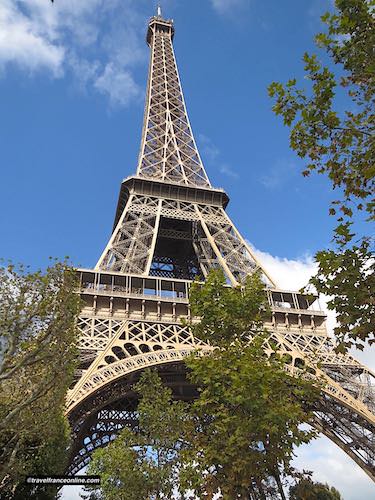
This metal structure, the product of innovative architectural concepts that emerged at the end of the 19th century, became the centrepiece of the exposition, attracting millions of visitors from around the world.
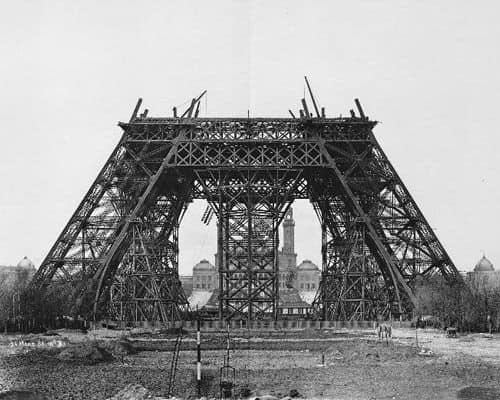
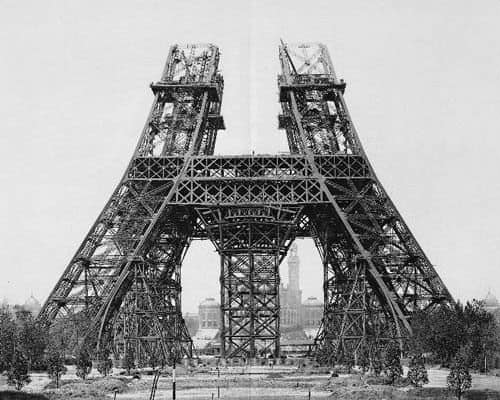
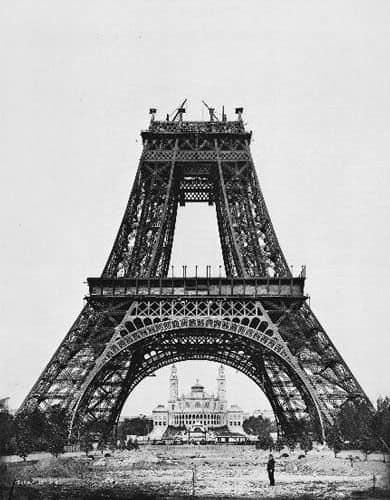
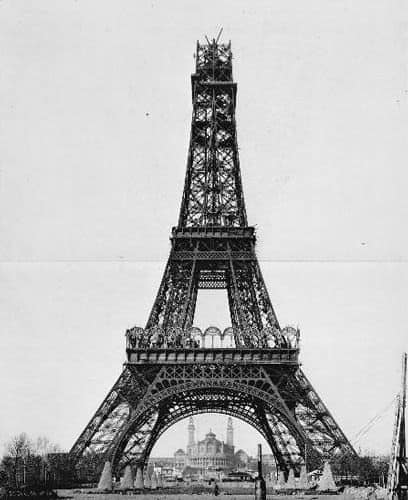
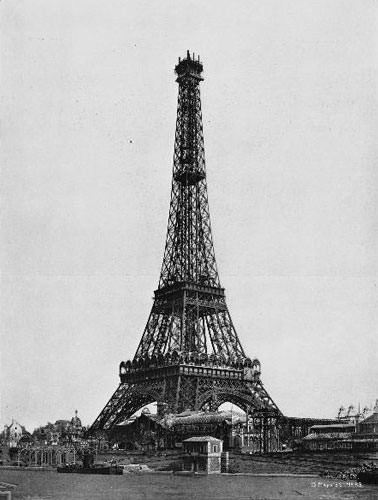
Construction of the Eiffel Tower began in 1887, and the inauguration took place on March 31, 1889.
Today, the tower is the emblem of Paris. However, at the time of its construction, it sparked intense controversy and much criticism. Purists indeed demanded its immediate demolition, arguing that its silhouette “polluted” the beauty of the Paris.
At 300 metres tall, the Eiffel Tower remained the tallest building in the world until the completion of the Empire State Building in 1931.
Although initially designed as a temporary structure intended to last 20 years, it escaped demolition thanks to its height, which proved invaluable for communication.
A useful tower!
Scientific experiments conducted between 1904 and 1911 indeed led to the installation of wireless communication antennas on its summit.
These antennas proved their usefulness during the First World War, when the army requisitioned the tower for communication purposes.
Thus began the long and rich history of the tower!
It accommodated meteorological observation instruments for the French Central Meteorological Service and an aeronautical beacon. In 1916, a transmission terminal was installed, establishing the first transatlantic radio telephone link.
The first Radio France broadcasts were transmitted from the tower in 1921 and became regular the following year.
The Eiffel Tower took on a new purpose in 1925 with the installation of spotlights to illuminate the Exhibition of Modern Decorative and Industrial Arts on the Esplanade des Invalides.
The first television broadcasting trials took place from the Eiffel Tower also in 1925 and became regular after World War II.
The installation of a French television transmitter in 1957 increased the tower’s height from 300 to 320 metres.
In 1981, the Eiffel Tower expanded its functions once again when a radio transmitter for the local station Paris Tour Eiffel was installed at its summit.
One might have thought the Iron Lady would stop there, but no, she continued to evolve and amaze!
As the new millennium approached, the Eiffel Tower was indeed adorned with a thousand lights and displayed the countdown marking the beginning of the year 2000.
Our beloved Tour Eiffel thus entered the 21st century with brilliance and splendour, as famous and prestigious as ever!
The Eiffel Tower in numbers
The Eiffel Tower is built of wrought iron, a metal renowned for its flexibility, durability, strength, and cost-effectiveness.
Its base is a square measuring 129.22 metres on each side.
It has three levels located at heights of 57.63 metres, 115.73 metres, and 276.13 metres, respectively.
Its spire reaches a height of 320 metres above the ground.
Remarkably, the tower does not sway more than 12 cm in strong winds, thanks to its foundations supported by a system of hydraulic jacks.
Its angles are perfectly aligned with the four cardinal directions.
Its weight of nearly 10-million-kg is evenly distributed, which minimises pressure on the ground.
Its height can vary by approximately 15 cm depending on the temperature, as the density of the metal varies according to weather conditions.
To maintain its iconic appearance, 30 painters and 50 tons of paint are needed every three years to repaint the 7,000 tons of metal.
The three platforms are open to the public and offer superb views, a panoramic restaurant, souvenir shops, and a small audiovisual museum on the first floor that recounts its extraordinary history.
The Eiffel Tower is a true masterpiece of architecture and engineering!
Born in the 19th century, it has not only survived two world wars, but it has also witnessed and adapted to the remarkable changes and scientific advancements of the 20th century. It has gone from a controversial structure to an indispensable communication tool and a symbol of innovation and modernity.
Visiting Gustave Eiffel’s masterpiece
To avoid long queues, it’s recommended to book your tickets online.
The Eiffel Tower indeed attracts around 7 million visitors each year and is nearing capacity.
The bad news is that it needs to increase its revenue without attracting more visitors; ticket prices will therefore increase by 50%.
Hopefully, this won’t deter you from visiting.
While you’re queuing for the visit, look for the gilded bust of Gustave Eiffel, a work by sculptor Antoine Bourdelle.
You will find it in front of the northeast pillar, next to the ticket office. This bust, unveiled in 1930, pays tribute to one of the most talented engineers of his time!
Directions: 7th District
Metro: Champ-de-Mars-Tour-Eiffel on Line 6 and RER C
Coordinates: Lat 48.858370 – long 2.294481
Photos via Wikimedia Commons: Construction phases: 20 Mars 1888 – 15 Mai 1888 – 21 Aôut 1888 – 26 Decembre 1888 – 15 Mars 1889 All images are in the Public Domain Source Gallica-BNF


