
The discovery of the Venus de Sireuil
The village of Sireuil is located on the plateau overlooking the village ofLes Eyzies de Tayac, to which it was annexed in 1973.
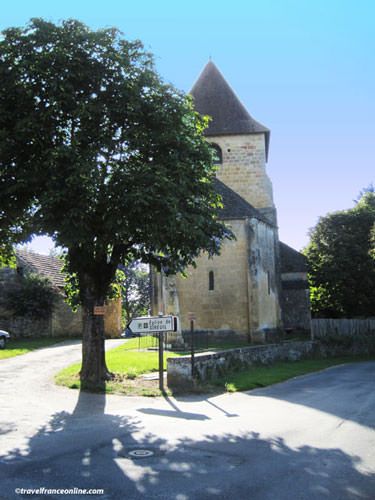
While the Sireuil’s small Romanesque church is a listed historical monument, the tiny village owes its renown to the discovery of the Neolithic statuette known as the “Venus de Sireuil.”
This 92 mm high statuette, carved from a slightly translucent, amber-colored calcite pebble, represents a headless female figure. Experts compared its morphological characteristics to those of other statuettes discovered in the region to determine its age, estimating it to be approximately 25,000 years old. This estimate was supported by the discovery of flint tools dating from the same period nearby.
Its discovery was due to sheer chance. Indeed, Mr Prat, a resident of the neighbouring hamlet of Manaurie, found the Venus de Sireuil as he was trying to free the wheel of his heavily laden cart, which had become stuck in a muddy rut near the Goulet de Cazelle. As he was struggling to free it, he noticed an unusually shaped “stone” protruding from the mud and picked it up.
This anecdote illustrates the fortuitous nature of many prehistoric discoveries. Indeed, just as with the discovery of Lascaux, the Venus de Sireuil likely remained hidden for centuries, partially damaged and buried under gravel.
The Venus de Sireuil statuette
Although the Venus de Sireuil is headless and its arms are broken, it bears clear traces of carving and cutting.
This invaluable statuette was initially entrusted to Dr Capitan, who oversaw the restoration of the magnificent Arènes des Lutèce in Paris. It was placed in the Musée des Antiquités nationales in Saint-Germain-en-Laye, where it forms part of a prestigious collection of prehistoric artefacts.
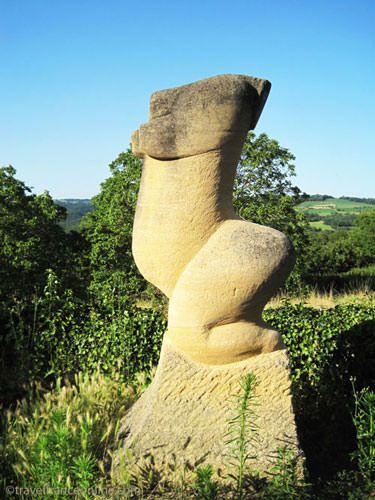
This iconic statuette depicts a kneeling woman, her arms crossed beneath her breasts, with short, stocky legs. Her prominent abdomen and buttocks suggest a possible pregnancy, while her small breasts indicate a young age. A carved line emphasises her waist, and the curve of her back is clearly visible. A hole in the lower part of her legs suggests that it may have been worn as a pendant.
It is contemporary with the Venus de Tursac, which was also sculpted from amber calcite and is on display at the National Archaeological Museum.
In 2000, the artist Philippe Marpillat created a 90cm-high replica of the Venus de Sireuil, which was installed near the church in the village of Sireuil.
Dordogne department
Coordinates: Lat 44.939886 – Long 1.074628


