
The medieval Pont du Diable
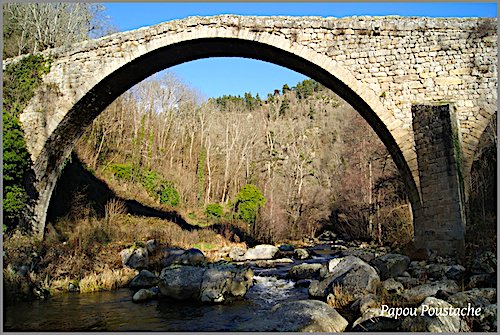
The Pont du Diable (Devil’s Bridge) spans the small Ance River, and is accessible only on foot.
Built in the 10th century under the aegis of the lord of Chalençon, the bridge was a vital link between his castle and the town of Retournac, providing direct access to the Rhône Valley.
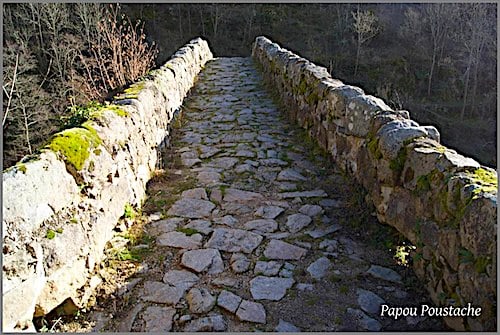
The fifty metres long Pont du Diable features a central pier adorned with mid-level nose-bays that support its two arches, while large, uneven granite slabs pave the narrow 2-meter-wide passageway.
Considered a feast of medieval architecture and engineering, the Pont du Diable is a listed historical monument.
Why did the villagers choose to name their bridge the Pont du Diable?
Legend has it that the workers who built it over ten centuries ago encountered numerous obstacles due to the rugged terrain and the frequent flooding of the Ance River. Despite the workers’ best efforts, the project indeed seemed impossible.

This misfortune attracted the attention of the devil, who offered his help in building the bridge. However, the cunning devil proposed a pact to the lord of Chalençon: in exchange for his help, he demanded the soul of the first man to cross the bridge once it was completed. Chalençon agreed.
When the fateful day arrived, and the bridge was finally finished, the lord of Chalençon, true to his word, was ready to sacrifice himself and offer his own soul to protect his people. But just as he was about to honour his pact with Satan, his faithful dog leapt forward and crossed the bridge before him, saving him from Satan’s clutches.
Barony of Chalençon
The history of the Pont du Diable (Devil’s Bridge) is inextricably linked to that of the Chalençon barony. It unfolds alongside the construction of the castle and the surrounding village, which would soon become the seat of baronial power.
During the reign of the Lords of Chalençon, two bridges were built: the Pont du Diable and the Pont Bounery, a single-arch bridge upstream, leading to the Tiranges road. These crossings over the turbulent River Ance were essential for the region, providing vital links for trade and travel.
Chalençon, the only local crossing point on the Ance, naturally became a flourishing commercial centre, benefiting from the transport of goods between the Velay region and the Rhône Valley. Over time, the Lords of Chalençon became among the most influential in the Velay. Their influence grew further when they entered into marriage alliances with the prestigious Polignac family in the 14th century.
Château de Chalençon
The lords of Chalençon eventually abandoned their once majestic castle, letting it slowly fall into oblivion. Today, only the vestiges of the round keep and two turrets, meticulously restored in the 19th and 20th centuries, remain. However, the castle chapel, transformed into a parish church in the 18th century, boasts a remarkable coffered ceiling, which replaced the original vault in the 17th century. Composed of a myriad of small white coffers, it is adorned with intricate patterns of precious stones and monograms. The chapel and the castle are listed as historical monuments and are now open to the public.
To return to the devil, it seems he once had a weakness for bridges, as evidenced by the legend of the Devil’s Tower on the Pont Valentré in Cahors…
Department of Haute-Loire – Saint-André-de-Chalençon Pont du Diable – Auvergne region
Coordinates: Lat 45.283271 – Long 3.984591
Photos are ©Jean Piludu cpauvergne


