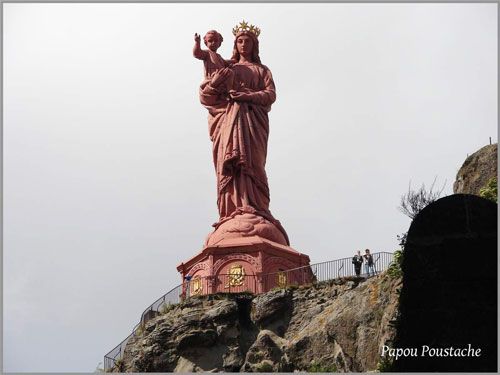
The iconic statue of Notre-Dame-de-France – Our Lady of France overlooks the city of Le Puy-en-Velay from the summit of Rocher Corneille, a 132-metre-high volcanic spur.
Virgin Mary with the Child Jesus
Sculpted by Jean Bonnassieux in 1860, the statue depicts the Virgin Mary, adorned with a radiant crown of stars. She holds the Infant Jesus in her arms, along with a globe, and triumphantly crushes a serpent under her foot.
In 1850, Father Xavier Ravignan and Bishop Pierre Darcimoles conceived the idea of creating this statue during a walk on Rocher Corneille. Indeed, captivated by the remains of an ancient castle that stood atop Rocher Corneille, Father Xavier exclaimed: “This is an exceptional place. This is where a gigantic statue of Our Lady should be erected, a statue visible from afar like a beacon.”
The idea was born, but a major challenge remained: finding the funding for the construction of the statue of Our Lady of France!
Jean Bonnassieux
The public subscription began on July 16, 1850, with funds collected during daily services and parish festivals.
Notre-Dame de France
Remarkably, the million gold-francs raised were enough to move the project forward. All that remained was to find a talented sculptor. The diocese thus launched a competition and, on October 9, 1853, selected Jean Bonnassieux’s design from among thirty others.
The inauguration of the statue of Notre-Dame-de-France took place on September 12, 1860, in the presence of 120,000 pilgrims. However, Bonnassieux’s success aroused jealousy and gave rise to unfounded rumours. Some claimed there had been a design flaw in the position of the Infant Jesus on the Virgin’s arm. These rumours, however, dissipated as quickly as they had appeared!
Notre-Dame-de-France statue in figures
Notre-Dame-de-France was cast using bronze from Russian cannons captured at the Battle of Sevastopol, a generous gift from Emperor Napoleon III.
Seen from afar
However, constructing such a monumental statue presented significant logistical challenges. A full-size plaster prototype was initially created to determine the joints for the 105 cast iron pieces that make up the statue. These pieces were then assembled using 900 large bolts and various other components. The exterior of the mould, derived from the prototype, was made of silica and compacted clay, while the interior consisted of sand and resin.
Standing 16 metres tall, the statue rests on a 6.70-meter-high pedestal carved from local arkhose stone. The entire monument has a circumference of 17 metres. To appreciate its exceptional dimensions, one needs only know that the Virgin’s hand measures 1.56 metres across, the circumference of the Infant Jesus’ head is 4.80 metres, and the monument weighs 1.1 tons. The statue alone weighs 110 tons, to which must be added 680 tons for the hollow pedestal, for a total of 835 tons.
Here is an idea of its size
The interior of the pedestal houses three glass-enclosed levels offering breathtaking views of the city and its surroundings. A 33-step staircase provides access to each level of the pedestal, while another 58-step staircase leads inside the statue. From there, you must climb a 16-rung ladder to reach the crown of Notre-Dame.
The statue and its pedestal were listed as historical monuments in 1997. Following a full restoration in 2012, which included the reopening of staircases previously closed for safety reasons, Notre-Dame-de-France remains one of the most visited monuments in Haute-Loire, attracting nearly 90,000 visitors annually.
Le Puy-en-Velay – Department of Haute-Loire – Auvergne region Coordinates Notre-Dame-de-France: Lat 45.047619 – Long 3.885211
Bourbon-l’Archambault, a famed spa town nestled in a valley of the historic Bourbonnais, and the cradle of the dynasty of Dukes of Bourbon, Kings of France
Ferdinand Cheval, a rural postman who built from 1879 to 1912 his dream palace, since known as Palais Idéal du Facteur Cheval, a masterpiece of Naïve Art
Tournemire is ranked among France’s Most Beautiful Villages, and is nestled in the heart of Auvergne Volcanoes Natural Park in Cantal
We Value Your Privacy!
Welcome! Our website uses cookies to enhance your experience. Cookies are little files saved on your device that help us remember your preferences and understand how you use our site.
Independent Analytics Professional runs inside your WordPress site and tracks visitors in a privacy‑friendly manner. It does not use cookies or store personally identifiable information (PII); all data is stored on your server. Since it uses cookie‑less tracking, no consent is required and this tracking is always active.
Cookies that Save Visitor Preferences
These cookies remember your choices, such as your preferences for embedded videos.
Cookies that Enable Sharing to Social Media
We use plugins that let you easily share our content on social media.