
Place Charles de Gaulle-Etoile
The Arc de Triomphe marks the centre of the Place Charles de Gaulle – Étoile and faces the prestigious Avenue des Champs-Elysées.
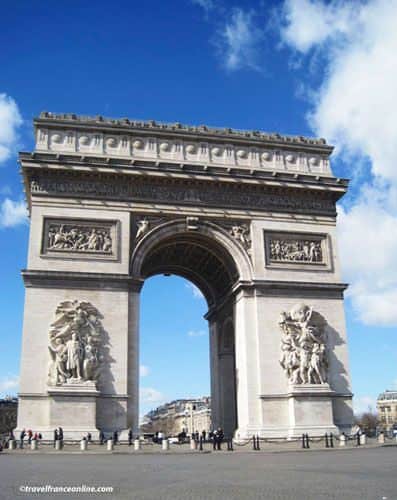
It is thus aligned with the Arche du Carrousel at the Louvre and the Grande Arche de la Défense. This axis is known as the Voie Royale (Royal Way).
Until the 1770s, the site was known as the Colline du Roule. This hill was levelled to reduce the slope during the construction of the Grand Cours (the future Avenue des Champs-Élysées). This work included the construction of five avenues that converged at the summit of the Colline du Roule.
In 1854, Baron Haussmann opened seven new avenues, giving the roundabout its star shape, hence its name Place de l’Étoile (Star Square).
The architect Hittorf built the twelve nearly identical private mansions that surround the Place de l’Étoile. The square was renamed Place Charles de Gaulle-Étoile in 1970 to honour General de Gaulle.
Arc de Triomphe dedicated to Napoleon’s victories
Napoleon entrusted the architect Chalgrin with the monumental task of building the Arc de Triomphe to commemorate his military victories.
Construction began in 1806, at the height of Napoleon’s popularity.
However, the project was interrupted after Chalgrin died in 1811, but it resumed in 1833, under the reign of Louis XVIII.
The king called upon the most renowned artists of the time to complete the monument.
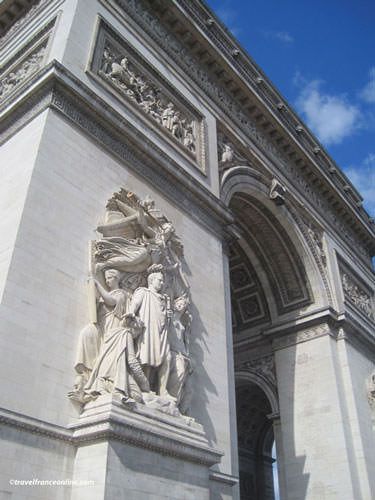
François Rude, Jean-Pierre Cortot, and Antoine Etex thus sculpted the monumental allegorical groups depicting Napoleon’s heroic exploits and military victories that adorn the four pillars of the Arc de Triomphe.
François Rude‘s sculpture, “La Marseillaise,” also known as “Le départ de 1792 – The Departure of 1792,” immortalises the symbolic moment when revolutionary volunteers from the city of Marseille marched on Paris.
Their march had such an impact that it inspired the French national anthem “La Marseillaise.”

Jean-Pierre Cortot‘s work, “Le Triomphe de 1810 – The Triumph of 1810,” depicts Napoleon being crowned by the goddess of Victory at the Treaty of Schönbrunn. Signed on October 14, 1809, between France and Austria (also known as the Treaty of Vienna), this agreement marked the end of the Fifth Coalition. This coalition, which lasted from April to July 1809, pitted the Austrian Empire and the United Kingdom against France.
Antoine Etex sculpted “La Résistance de 1814 – The Resistance of 1814,” an allegorical representation of the French Resistance during the Sixth Coalition. This coalition, active from 1812 to 1814, united the British, Russian, Prussian, and Austrian empires, as well as Sweden and several German states, against France.
Etex also sculpted “La Paix de 1815 – The Peace of 1815,” symbolising the Treaty of Paris signed on November 20, 1815, following Napoleon’s defeat at the Battle of Waterloo.
The Unknown Soldier’s grave
Louis-Philippe inaugurated the Arc de Triomphe in 1836.

The monument is inscribed with the names of 660 generals who served under the Empire and the French Republic, as well as those of Napoleon I’s great victories.
In 1840, the funeral procession carrying Napoleon’s remains to the Hôtel des Invalides passed under the Arc de Triomphe. You can discover more in the museum dedicated to Napoleon that was established at the top floor of the arch.
Finally, on January 28, 1921, the ashes of the Unknown Soldier were placed in a tomb located beneath the arch. The Flame of Remembrance, first lit on November 11, 1923, is rekindled every evening at 6:30 p.m.
Directions: 8th District
Metro: Charles de Gaulle-Etoile on Line 1,2, 6 and RER A
Coordinates: Lat 48.873781 – Long 2.295026


