
Mornac-sur-Seudre, a picturesque village
Mornac-sur-Seudre is a charming village located in the vast Seudre estuary, and was once a thriving fishing and trading port.
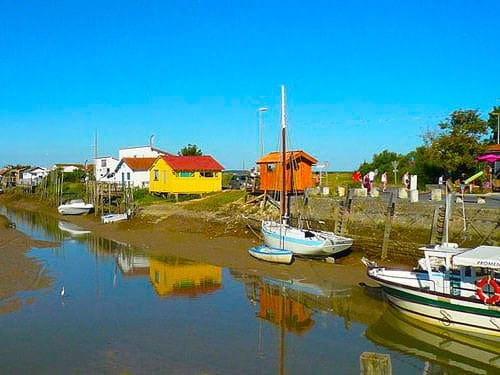
Surrounded by beautiful marshes, Mornac-sur-Seudre has become an important centre for oyster farming and salt production, and is listed among the most beautiful villages in France.
Located a stone’s throw from Royan, the Île d’Oléron, and the Atlantic coast resorts, the village enjoys a mild oceanic climate that contributes to its charm all year round.
With its breathtaking scenery and renowned Marennes-Oléron oysters, Mornac-sur-Seudre offers a blend of natural beauty and gastronomic delights, making it a prime destination for those seeking the charm of a quaint French coastal village.
La Seudre river and estuaire
The history of Mornac and the Seudre River is inextricably linked. Flowing peacefully for 68 kilometres, the Seudre meanders through verdant marshes before emptying into a vast estuary in the Bay of Biscay, opposite the magnificent Île d’Oléron.
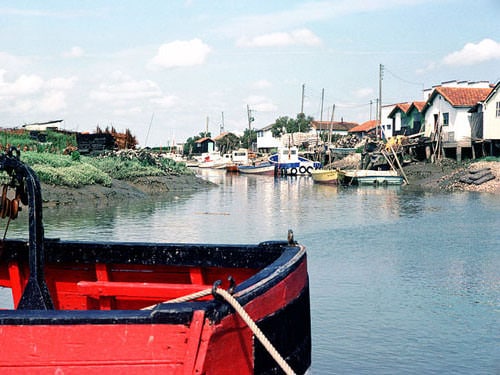
Nestled on the left bank of this estuary lies Mornac, while Marennes stretches along the opposite bank, connected by a bridge to the seaside resort of La Tremblade.
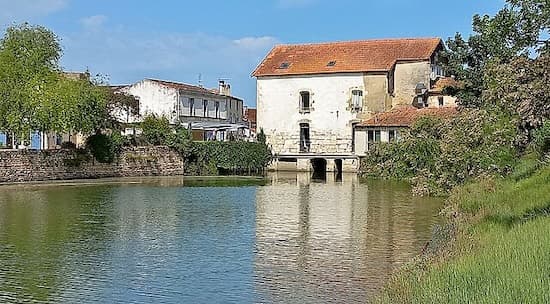
It is in the heart of the Seudre marshes, former salt marshes, that oyster farmers raise and refine their prized oysters in the oyster beds (claires), bathed by the ebb and flow of the tides, which were once regulated by tidal mills. The Seudre estuary and the Île d’Oléron are indeed the cradle of the delicious Marennes-Oléron oysters, renowned for their exceptional flavour and quality. A handful of tidal mills remain, once an essential cog in the regional economy. One of the last, Le Moulin, now houses a charming restaurant. A sluice gate, ingeniously operated from inside the mill, regulates the flow of water through the surrounding marshes.
Mornac’s salt marshes
The Romans were the first to exploit the salt marshes of Mornac two thousand years ago, and the lords of Mornac continued to develop salt production in the estuary, a lucrative industry that flourished until the 18th century. This flourishing activity led to the emergence of numerous hamlets and villages in the salt marshes that stretched as far as the eye could see.
Renowned for its exceptional quality, particularly the Blanc de Liman salt harvested around Mornac-sur-Seudre and L’Eguille, the salt from the Saintonge region became highly sought after, establishing itself as the best in the area.
Throughout its long history, Mornac-sur-Seudre remained a prosperous fishing port and an affluent village and is a renowned tourist destination.
Mornac-sur-Seudre, one of the most beautiful villages in France
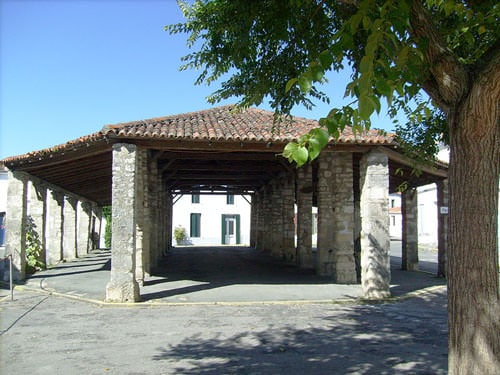
Only vestiges remain of the ramparts that protected the Château de Mornac that was built in the 11th century next to the parish church. Its strategic importance and the activity of the port attracted the covetousness of local lords, who throughout history attempted to seize it. Protestants succeeded in seizing Mornac in 1622 during the Wars of Religion, but they fled after the revocation of the Edict of Nantes to escape reprisals.

The Romanesque church of Saint-Pierre in Mornac was built at the turn of the 11th century. It replaced the chapel erected when the village was founded in the 6th century.
Although the building suffered damage during the Hundred Years’ War, it was rebuilt in the 15th century.
However, the most significant alterations took place in the mid-20th century, following a devastating fire caused by lightning that reduced the bell tower to ashes. The chancel, transept, and nave are now listed as historical monuments.
Mornac-sur-Seudre is a must-see when in the Charente region!
Department of Charente-Maritime – Historic Province of Saintonge
Coordinates: Lat 45.70972 – Long -1.02833
Photos via Wikimedia Commons: Header and Marais de la Seudre by Rundvald CC BY-SA 4.0 – Tide mill by JGS25 CC BY-SA 4.0 – Covered market and Church by Cobber17 CC BY-SA 3.0 – Port by Jean-Pierre Bazard Jpbazard CC BY-SA 3.


