
Limeuil, ranked among Les Plus Beaux Villages de France

Limeuil, a charming fortified medieval village, is ranked among the Most beautiful Villages in France and is among the most popular destinations in the Dordogne.
A Celtic tribe established its oppidum, which they called Lemoialum, meaning “the place planted with elms“, at the top of the hill overlooking the confluence of the Dordogne and the Vézère.
However, there are few historical documents of the city before the Norman incursions of the 9th century, when the first fortress was built.
Limeuil gradually expanded throughout the Middle Ages and was fortified with a second, then a third rampart. Indeed, the fortified village came under alternating English and French occupation during the tumultuous Hundred Years War , and later the Wars of Religion, each time suffering degradation.
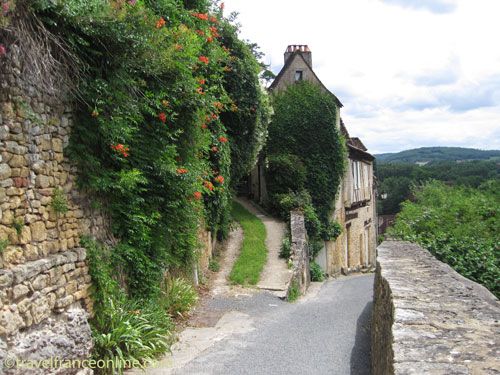
Today, Limeuil is spread over two districts: the Ville Basse – Lower Town, clinging to the side of the cliff, and its Ville Haute – Upper Town, on the plateau.
The village has undergone significant restoration work, and its fortified gates remain the only access points. Thanks to the master craftsmen and entrepreneurs who opened a wide variety of art-and-craft shops, workshops and restaurants, Limeuil is a prosperous village.
During the summer, the blacksmith and glassblower open their workshops to the public, something not to miss!
Limeuil and the river trade
For centuries, Limeuil prospered thanks to the flourishing river trade that dominated its economy and set the rhythm of its inhabitants’ daily life.
Loaded barges and canal boats indeed sailed on the Dordogne and Vézère rivers, bringing goods such as wine, salt and cooperage wood, which were stored in the village warehouse, the Chai. These goods were then transshipped onto lighter boats to continue their journey downstream to the busy port of Bordeaux.
However, the second half of the 19th century marked a decisive turning point for Limeuil. The construction of two bridges, along with the development of adequate road and rail infrastructure, signalled the end of the era of river trade.
The prosperous port gradually fell into oblivion, eventually becoming a public beach popular for canoeing and kayaking.
From this period remains the 15th-century Ancre du Salut (House of the Anchor of Salvation), which formerly housed the headquarters of the Boatmen’s Association. This residence, almost adjoining the fortified Porte du Port, now houses a café-restaurant with a riverside terrace.
Rue du Port connects the Ville Basse to the Ville Haute
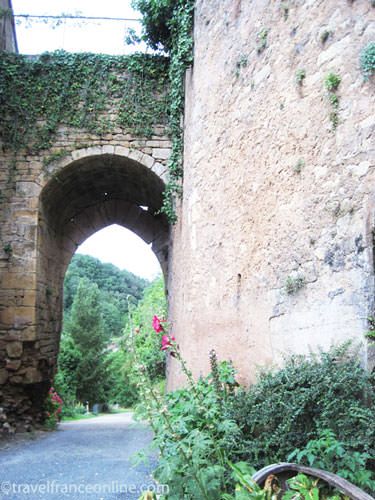
The Port Gate provides access to the Ville Basse – Lower Town.
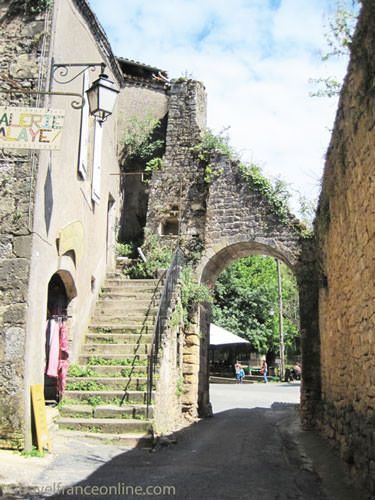
If you look at the left wall, you will see several lines are engraved; each commemorates the floods that struck the village during the 20th century. The most significant was the 1944 flood, which inundated the bakery on the village side, behind the gate, and deprived the village of bread for weeks!
The Couvent des Recollets, now the town hall, is located on the other side of the bakery, hidden behind a stone wall.
From there, the Rue du Port, a narrow and steep lane, winds its way towards the Château de Larmandie. Built in 1639 on the site of the former garrison of the lords of Limeuil, this imposing mansion is an important landmark along the street.
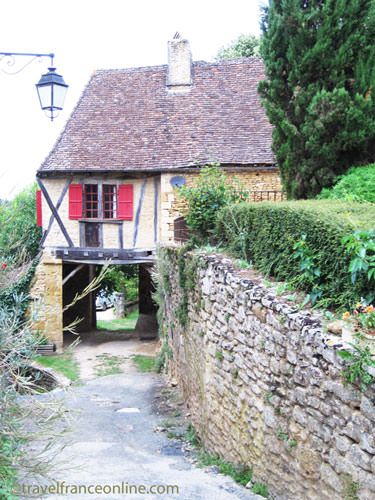
Continuing along Rue du Port, you will discover the Vieille École – Old School, the former town hall and village school, before reaching the Maison du Porche, which spans the street, near the old stables of the castle.
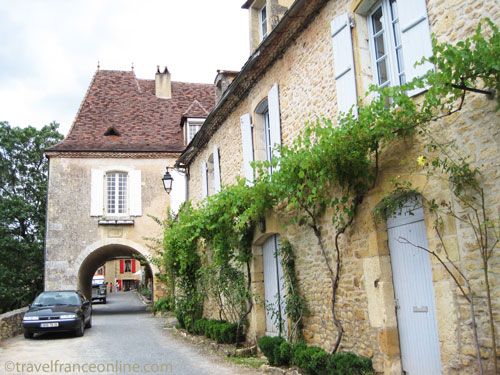
The street then runs alongside the Maison de Turenne and leads to the top of the hill, at the Place des Fossés. This square, named in memory of the castle’s vanished moat, is surrounded by historic buildings.
The nearby 15th- and 16th-centuries fortified Porte du Réclousou opens directly onto vast fields and woods. Its exterior and interior arcades display different architectural styles, as they were rebuilt at different times.
The Place des Ormeaux was once the village square.
An iron cross, placed in its centre, marks the site where the Protestant temple once stood. This temple was demolished after the revocation of the Edict of Nantes in 1598.
The Maison de la Justice (Law Court), a magnificent half-timbered building that formerly served as a prison, also overlooks the square.
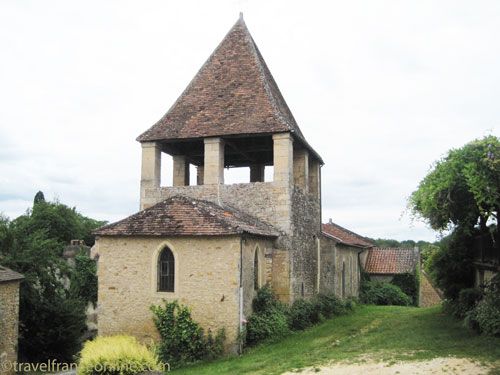
The Romanesque Church of Sainte-Catherine boasts an amazing early 19th-century Empire-style porch. It also houses an authentic bénitier shell (font) and a Vierge Noire – Black Virgin, patron saint of boatmen.
This statue originally adorned the Notre-Dame-des-Anges Chapel, which was destroyed during the Wars of Religion. The Hôtel Beauregard was built on its site.
The Huguenots threw the statue into the Dordogne, but it was found, restored and discreetly painted black to hide the damage, hence its name Black Virgin.
Finally, the Porte du Marquisat, also called the Porte de Sireuilh, provides access to the plateau and the Route des Crêtes, a picturesque country lane winding through fields and woods, and offering an exceptional vista of the valley.
Gardens of Limeuil
The Jardins Panoramiques de Limeuil, also known as the Jardin ethnobotanique de Limeuil, were landscaped in the grounds of Dr Linares‘ estate.
Dr Linares, who served at the court of the Sultan of Morocco in the 19th century, acquired the private mansion at the top of the village.
He transformed the building with a touch of oriental architecture, introduced new plant species and vibrant colours reminiscent of his time in Morocco. Unfortunately, the estate fell into ruin after his death.
In recent years, the municipality of Limeuil and the local association Au Fil du Temps have undertaken the restoration of the park, organising it by themes.
Advice: car traffic is prohibited inside the village because of its steep, narrow streets. However, a parking area is provided by the river. It is advisable to wear appropriate footwear to explore the village.
Department of Dordogne
Coordinates: Lat 44.882858 – Long 0.889576


