
The discovery

The Regourdou site is located only 500 meters from the Lascaux Cave, and is a major Neanderthal archaeological site.
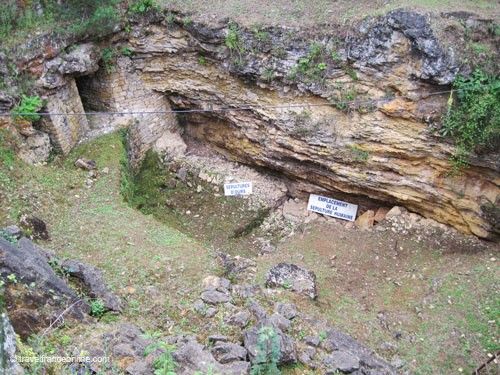
The site was discovered in 1954 by Mr Roger Constant, owner of the Regourdou Farm, after a violent storm uprooted a tree in his yard.
This uprooting caused the unstable ceiling of a natural underground cave to collapse, revealing a chasm and uncovering a remarkable discovery:
A burial containing the almost complete skeleton of a young adult Neanderthal!
Le Régourdou, a Neanderthal burial ground
However, although he discovered the burial site in 1954, he did not unearth the human mandible until September 22, 1957! The excavation permit he had obtained was quickly revoked, as experts understood that he had unearthed not only a Neanderthal burial site, but also a nearly complete human skeleton. The discovery of such well-preserved and complete fossilised human bones, dating to approximately 70,000 to 90,000 years, was an exceptionally rare event.
Mr Constant eventually reached an agreement with the archaeologists. He allowed them to search the tomb, but also obtained permission to dig a few metres away, hoping to discover a passage linking his farm to Lascaux. Unfortunately, he never found that passage.
However, the 35-metre-deep pit he dug between 1970 and 1993 revealed numerous marine fossils dating back to the Mesozoic era. Even more surprisingly, the site also contained an ochre deposit, which the artist Monique Peytral later used to recreate the paintings of Lascaux II.
It was long believed that the Magdalenian artists who painted Lascaux had exploited this deposit. However, subsequent research has shown that the pigments they used were different from those of Regourdou.
The equipment used by Mr Constant for the excavations, including the now rusty steel crane, the bucket and the wagon used to transport the soil, is still on site.
Excavations of Le Regourdou burial ground
Archaeologists Georges Laplace and Eugène Bonifay led the excavations of the Neanderthal site.

Unfortunately, they had to break through an imposing 850 kg stone slab that blocked it to access the burial site, as it was unstable and threatened to collapse at any moment.
The tomb contained the almost complete skeleton of a young adult Neanderthal in a fetal position. The skeleton was surrounded by stone tools and weapons characteristic of the Mousterian industry, as well as hunting trophies, including many brown bear bones and teeth.
Although the man’s skull and lower limbs were missing, his upper body was remarkably well preserved. His fossilised skeleton has thus become a reference for the study of the Neanderthals’ physical characteristics.
Le Regourdou and the cult of the brown bear
Twenty stone boxes containing bear bones surrounded the skeleton.

This has led archaeologists to conclude that a brown bear cult existed in the Middle Palaeolithic.
However, this theory has since been re-examined.
It is now believed that the presence of so many brown bear bones indicates that these animals hibernated in the cave.
Despite this, the excavations clearly show that brown bears were very important to Neanderthals.
Humans and bears indeed shared similar size and stature, which may have led Neanderthals to identify with these animals and potentially develop a bear cult.
Brown bears program at Le Regourdou
In 1988, Mr Constant decided to reintroduce the brown bear to Le Regourdou.

Mr Constant died in 2003 at the age of 81, after having dedicated his entire life to Regourdou. His descendants took over, transforming his farm into a small museum to display the many objects he discovered there.
They also continued the brown bear reintroduction program that he had initiated. Today, six magnificent brown bears live in a large enclosure, protected by a wall and a tall metal fence. The two youngest, Balou and Léopold, were born in Le Regourdou.
Le Regourdou has been a listed historical monument since 1959.
Practical information: The site still belongs to the Constant family, who maintain it brilliantly! It has free parking, drinks are available at the ticket office, and there is an interactive activity area for children. Le Regourdou is open every day from 11 am to 6 pm.
Department of Dordogne
Coordinates: Lat 45.055078 – Long 1.178324
Photo via Wikimedia Commons: Aerial view by Le Régourdou CC BY-SA 3.0


