
Le Puy Mary in the Parc Regional des Volcans d’Auvergne
Le Puy Mary is part of the Cantal Mountains massif, a collection of ancient volcanoes nestled in the heart of the Auvergne Volcanoes Regional Natural Park. The summit, a remnant of the largest stratovolcano in Europe, rises to 1,783 metres and was designated a Grand Site of France in 2012.

It was named after the preacher Marius, who played a key role in the evangelisation of Auvergne in the early 4th century.
Puy Mary is connected to Puy de la Tourte, another extinct volcano, by the Pas de Peyrol, the highest road pass in the Massif Central, located at 1,589 metres.
However, this pass is impassable in winter and generally only reopens at the end of May, due to the large snowdrifts that cover the northern slope of Puy Mary. The largest of these snowdrifts, the Névé de Miarou, also known as the Névé de l’Aigle (eagle) due to its distinctive shape, explains the prolonged closure of the Pas de Peyrol pass.
Numerous marked hiking trails and wooden flights of steps have been judiciously installed on the steepest sections to preserve the natural environment around Puy Mary. With an impressive 600,000 visitors annually, Puy Mary is the most popular tourist destination in Auvergne.
Extinct volcano and fertile nature

Le Puy Mary, an extinct volcano of exceptional natural beauty, illustrates the complex interplay of geological and climatic forces.
Formed approximately 6.5 million years ago, its distinctive pyramidal shape is the result of glacial erosion during the last Ice Age, which sculpted its cone and carved out the seven valleys radiating from its summit.
Water, in liquid and frozen form, has long played a crucial role in the evolution of Puy Mary.
As the first mountain between the Atlantic Ocean and the Massif Central, it is also subject to significant oceanic influences.
With an average annual rainfall of 2.5 meters and abundant snow-melt, the mountain feeds a network of streams and waterfalls cascading down its steep slopes.
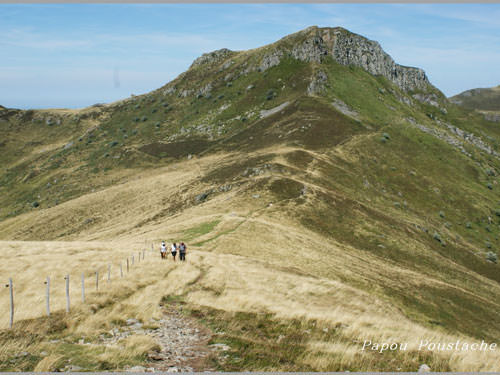
The unique combination of climate, altitude, rich volcanic soils, and low population density fosters diverse flora and fauna, including many protected plant species.
Among these plants is the yellow gentian, used in the production of traditional regional liqueurs such as Salers and Alveze.
And finally, in winter, Le Puy Mary offers a modest ski area accessible via the Col de Serre pass. Spanning 90 kilometres of marked trails between 1,200 and 1,450 meters in altitude, this area caters to both traditional skiers and skating enthusiasts.
Department of Cantal – Auvergne region
Coordinates: Lat 45.109435 – Long 2.676172
Credits: Photos ©cpauvergne


