
Jumièges Abbey, an influential Norman abbey

Following negotiations, King Charles the Simple of France created the Duchy of Normandy for the Vikings in 911, in exchange for peace and their allegiance.

Decline of the abbey
The devastating impact of the Wars of Religion in 1562 left Jumièges Abbey destroyed and desecrated, its treasures looted, despite the monks’ efforts to preserve the precious manuscripts and artefacts.
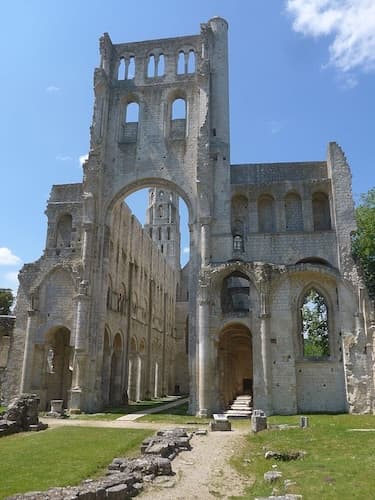
While some parts, such as the nave, the facade, and certain walls, remained relatively intact, the chancel and apse suffered severe damage, retaining only faint traces of their former grandeur.
The monks returned to their abbey after the conflict and sold land to finance the arduous task of restoration. However, their efforts were in vain, as the French Revolution loomed on the horizon.
Jumièges Abbey became national property and was sold to private individuals who transformed it into a stone and timber quarry. Thus, stone by stone, beam by beam, the magnificent abbey was systematically dismantled!
The 16th-century cloister and the 18th-century dormitory were among the first buildings to be demolished, followed by the chancel, dismantled by a timber merchant.
Nicolas Casimir Caumont inherited what remained of Jumièges Abbey when he married the daughter of the unscrupulous merchant.

Mayor of Jumièges and a man of the Enlightenment, he became, in a way, the guardian of the site, dedicating several years to preserving the abbey from further deterioration.
Caumont died in 1852, but the Lepel-Cointet family continued his work, preserving what remained of the abbey.
However, it was Victor Hugo‘s intervention that truly sparked renewed interest in the abbey, and thanks to him, Jumièges Abbey was classified as a historical monument.
The “most beautiful ruin in France,” as it became known, attracted artists and writers seeking inspiration in its unique atmosphere.
In 1947, the French state acquired the abbey to ensure its preservation. The Seine-Maritime department took over the management in 2007, thus consolidating the abbey’s status as a national treasure.
Department Seine-Maritime
Coordinates: Lat 49.431932 – Long 0.819054
Photos via Wikimedia Commons: Header by Schorle CC BY-SA 4.0 – Photo1 by Zairon CC BY-SA 4.0 – Abbey church by Nikater Public domain – Ruined abbey church by Alfred Löhr CC BY-SA 4.0 – Detail architecture by Demeester CC BY-SA 3.0


