
Ile de Sein, a small but beautiful island
The Île de Sein, called Enez-Sun in Breton, is a tiny island located 8 km off the coast of Finistère, barely 1.5 m above sea level. Only 2 km long and 200 to 500 m wide, its shape resembles an inverted S.
Perched on the Chaussée de Sein, a 25 km long granite formation stretching from the Pointe du Raz to the Raz de Sein channel, this island is constantly battered by sea winds and waves. Over the centuries, its houses, harbour, dunes, and crops have suffered considerable damage.

Vegetation struggles to take root in this harsh environment, where neither trees nor shrubs grow. The fields, mostly left fallow, are bordered by old dry-stone walls that serve as meagre windbreaks. Despite efforts to reinforce its pebble and sand beaches with seawalls, the island remains vulnerable to violent storms, a phenomenon exacerbated by its small size and lack of elevation. According to experts, the island loses one metre of coastline with each major storm, a natural erosion process amplified by the impact of tourism.
The proliferation of rabbits further aggravates the situation, as their burrows allow seawater to seep beneath the island’s surface. Faced with these challenges, the village houses huddle together, connected by a network of narrow alleyways, forming a protective barrier around the harbour against the harsh weather and strong winds.
Legend and megaliths
Despite its harsh environment, the island has been inhabited since the Neolithic period.
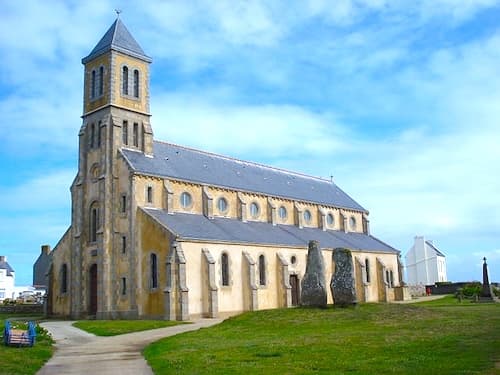
Our distant ancestors left behind several burial mounds and megaliths, including dolmens and menhirs. While many of these structures have succumbed to marine erosion over the centuries, some have survived, notably Les Causeurs, known as Ar Fistillerien in Breton.
These two menhirs stand on the tumulus where the Church of Saint-Guénolé now stands. Positioned facing each other, one leaning slightly towards the other, they resemble two people engaged in conversation, earning them the affectionate nicknames of Grand Orateur (Great Orator) and Petit Orateur (Little Orator). These megaliths were listed as historical monuments in 1901.
Legends of St.Guénélé and St.Corentin
The neo-Romanesque Church of Saint-Guénolé houses a sacred relic: a fragment of bone that belonged to Saint Guénolé. Built in 1901, it replaced a ruined church erected in the 14th century by the monks of the abbey of Landévennec. This earlier church replaced an even older sanctuary, built in 32 AD and dedicated to Saint Collodan.

Local tradition intertwines the history of the island with that of Saint Guénolé, who, according to legend, arrived on the Île de Sein around 440 AD with a few young disciples to found a priory. He then left for the mainland, where he founded Landévennec Abbey, which, for centuries, provided religious services to the inhabitants of the Île de Sein.
The island is home to another, even more remarkable sanctuary: the Chapel of Saint-Corentin, located in Goulénez, one of the island’s oldest sacred sites with a freshwater spring. Enclosed by a dry-stone wall, this secluded chapel is dedicated to Saint Corentin, the first bishop of Cornouaille, who evangelised the region in the 6th century AD. A charming tradition linked to the chapel is interwoven with daily life on the island. The islanders would orient the statue of Saint Corentin in the direction of the winds they wished to blow. If their wishes were granted, they would clean the statue and would thank God. Conversely, if their prayers went unanswered, they would cover it with seaweed until their wishes were fulfilled.
Why is it called Ile de Sein?
The origin of the island’s name is deeply rooted in Celtic mythology and ancient traditions.

According to one belief, the name comes from the Senes or Cenes, Celtic priestesses who are said to have resided on the island and delivered oracles. Ancient sailors attributed mystical powers to them, believing they could enchant the winds and waves with their songs, thus guiding ships through the treacherous reefs.
Some scholars suggest that Seidhun could derive from the Gaulish word “senos,” meaning “old.” This term may have been influenced by the Latin “Senus,” meaning “curve” or “bay,” a connection also found in the etymology of Cap Sizun, the peninsula to which the Chaussée de Sein is attached.
Historical records reveal an evolution in the island’s name, from Seyn insula or Sena insula in the 1st century AD to Insula Cenæ, Senæ, Sena, Senisse, Seyn, Seidhun (in 1050), and finally Sizun. Over time, these variants gave rise to Île des Saints, Île des Sains, Île de Saintz, Île de Sainct, and ultimately Île de Sein.
Shipwrecks and sea rescue
The reefs of the Chaussée de Sein encircle the Île de Sein, rising precariously close to the surface, and pose a constant danger to sailors.

Centuries of navigation have seen numerous shipwrecks, prompting the islanders to exercise their right to salvage cargo from stranded vessels. However, they have also taken on the role of rescuers.
This tradition has continued since 1980, with the islanders officially operating the all-weather lifeboat “Ville de Paris,” a gift of the French National Sea Rescue Society (SNSM).
During World War II, of the 400 men who answered General de Gaulle’s historic appeal on June 18, 1940, 130 were from the Île de Sein. Tragically, 27 of them never returned.
In recognition of their contribution, courage and dedication, the Île de Sein was honoured in 1946 with the title of Companion of the Liberation.
Ile de Sein, one of the most beautiful villages in France
Despite its small size, the village of Île de Sein boasts the prestigious Plus Beaux Villages de France (Most Beautiful Villages of France) label.

With a population of 280 in 2022, the island experiences a significant influx of visitors during the summer season, bringing its population to approximately 1,500 as tourism is the island’s main economic activity. The island remains pedestrian-only year-round, and bicycles are prohibited from July to August to protect its environment.
Located far from the mainland, the island is not connected to the mainland power grid. However, it has achieved remarkable energy self-sufficiency. Electricity is produced locally in a small power plant housed in the lighthouse, supplemented by generators to meet the island’s energy needs.
Furthermore, the islanders have implemented a sophisticated water supply system. Thanks to a reverse osmosis process, powered by the island’s power plant, seawater is pumped and desalinated to produce drinking water, thus ensuring the island’s independence and sustainability.
Lighthouse and museums
The Grand Phare de l’Ile de Sein was listed as a historical monument on December 31, 2015. It was built in 1951 to replace the original lighthouse, built in 1839, which was destroyed during the Second World War.
In addition to its iconic lighthouse, the island is home to two small museums that offer a fascinating glimpse into its history and culture. The L’Abri Marin – Marine Shelter explores the daily lives of the islanders, from past to present, and also addresses the profound impact of the Second World War on this close-knit community. The Station de Sauvetage en Mer – Sea Rescue Station, meanwhile, pays tribute to the courageous rescuers, displaying objects recovered from shipwrecks and celebrating their unwavering commitment to saving lives at sea.
Despite its small size and population, the Île de Sein remains connected to the mainland. The Penn Ar Bed shipping company provides daily crossings (weather permitting) between the island and the ports of Douarnenez and Audierne. These one-hour crossings are more frequent during the summer, and Finist’mer offers additional services to Audierne, thus providing residents and visitors with easy access to the island throughout the year.
Department of Finistère
Coordinates: Lat 48.037190 – Lat -4.851741
Photos via Wikimedia Commons: Header and Island seen from the lighthouse by Portalix Public domain – Abri du Marin and Dry stone walls and Chapelle Saint-Corentin by Ji-Elle CC BY-SA 3.0 – Les Causeurs and Church of St. Guenole by Havang(nl) Public Domain


