
Ecole des Cadets Gentilhommes
The École Militaire (Military School) is a prestigious military academy for officers, located opposite the Champ-de-Mars, its former parade ground.

In 1752, King Louis XV commissioned the architect Ange-Jacques Gabriel to build the academy, whose mission was to train 500 young men of modest means or orphans of noble birth in the military profession. Admission required proof of four degrees of ancestry through the paternal line. Among these students was Bonaparte, the future Napoleon I, who trained there as an artillery lieutenant in 1784-1785.
Construction dragged on for over thirty years due to a lack of funds. Initially known as the École des Cadets Gentilshommes (School for Gentlemen Cadets), it finally opened its doors in 1777. The academy closed in 1787, two years before the French Revolution. It was converted into an ammunition depot, then a grain and flour warehouse, and finally a barracks.
From 1793 to 1814, it housed the cavalry and later the artillery, necessitating the construction of several annexes. These additions gave the École Militaire its current appearance: a 440-m-long by 260-m-wide rectangle. Further renovations and expansions took place between 1856 and 1865.
Hôtel Royal de l’Ecole Militaire
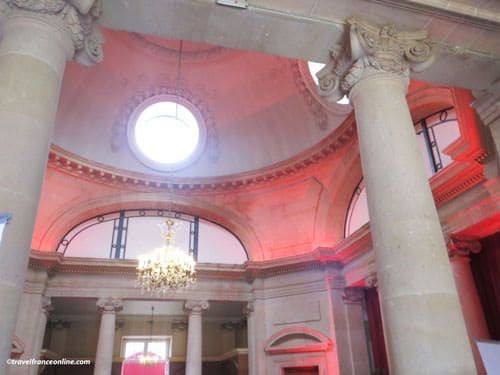
The buildings definitively returned to their military purpose in 1878 with the opening of the École Supérieure de la Guerre (War College), followed in 1911 by the Centre for Advanced Military Studies.
From 1951 to 1966, the Ecole Militaire housed the NATO Defence College, now based in Rome.
The château, the academy’s main building, is a masterpiece of 18th-century classical architecture. It is surmounted by a magnificent quadrangular dome reminiscent of the Louvre’s.
The two-storey facade, overlooking the Champ de Mars, is adorned with Corinthian columns and a triangular pediment topped by a dome. Three massive doors provide access to the interior.
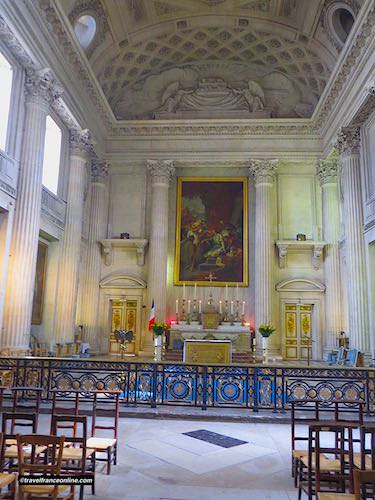
The Hall of Honour, the library, the reception rooms, and the staircases are all exceptional.
The library, renowned for its superb woodwork, painted ceilings, and Louis XVI-style fireplaces, is a listed historical monument.
The Saint-Louis Chapel, dedicated to Louis IX (Saint-Louis), patron saint of the French armies, was converted into an ammunition depot during the French Revolution and sadly suffered significant damage. However, it was restored and reopened for worship in 1952.
Napoleon Bonaparte received his diploma in 1785 in the Rotonde Gabriel, the Academy’s original chapel.
Abandoned during the Revolution, the Rotonde Gabriel served as a warehouse for decades. Restored and converted in 1945, it has since housed the officers’ mess.
Various military organizations
The Ecole Militaire consists of several military organisations: the Centre for Advanced Studies on Armaments (CHEAr), the Defence Intelligence College, and the Defence Information and Communication Delegation, founded in 1998.
The Institute for Advanced Studies in National Defence (IHEDN), a public institution under the authority of the Prime Minister, and the Centre for Higher Military Studies (CHEM), founded in 1952, are also part of the Academy.
The Ecole Militaire remains operational and has been listed as a National Historic Monument since 1990.
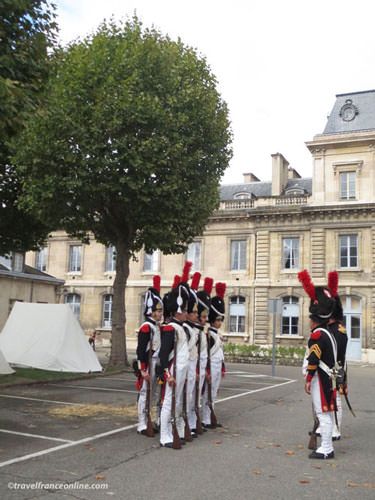
The site is open to the public during the Journées du patrimoine – European Heritage Days, when historical reenactments are organised.
Directions: 7th District
Metro: Ecole Militaire on Line 8
Coordinates Ecole Militaire: Lat 48.852400 – Long 2.303651


