
Dieppe, the town with four ports
Dieppe is on the stunning Côte d’Albâtre (Alabaster Coast), at the mouth of the River Arques.
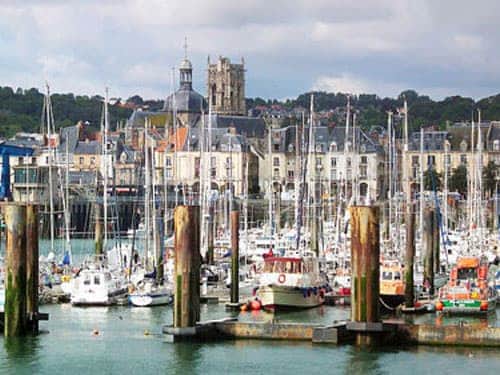
It is known as “the city of four ports”, as it boasts four distinct ports: a fishing port, a commercial port, a cross-Channel ferry terminal, and a marina, where trawlers, ferries, cargo ships, and pleasure boats ply its bustling waterways.
Historical texts mention the existence of the fishing port of Deppea as early as the 11th century. The town then flourished on both banks of the river, giving rise to two distinct districts.
During the Hundred Years’ War, Dieppe was destroyed and rebuilt several times. The French finally recaptured the town in 1435 and fortified it with strong ramparts. Today, Dieppe is a superb and dynamic coastal town, renowned for its rich maritime heritage and modern infrastructure and attractions.
From the French Renaissance to the early 19th century
Placed under the patronage of Renaissance monarchs Charles VIII, Louis XII, and Francis I, Dieppe rose to prominence. It indeed became a major port and a thriving commercial centre, specialising in the lucrative trade of spices and ivory.
It also boasted a flourishing maritime industry, with adventurous sailors undertaking voyages to distant lands such as Sumatra, Brazil, and Canada. Prominent figures, such as Captains Aubert and Verassen, left their mark, the latter naming the St. Lawrence River during a voyage to Newfoundland in 1508.
In the 16th century, Dieppe became a stronghold of the Protestant faith, and many of its inhabitants embraced the religious movement. However, the revocation of the Edict of Nantes in 1685 led to the voluntary exodus of several thousand of them.
The Dutch fleet destroyed the port in July 1694 during the Nine Years’ War. Reconstruction stretched over several decades and was not completed until 1720, significantly impacting its importance and commercial status.
Napoleon, I commissioned the construction of the Bérigny basin, a port capable of accommodating warships, to revitalise Dieppe. Although this port was later filled in and developed, Napoleon’s efforts laid the foundations for Dieppe’s rebirth as a strategic maritime centre.
A trendy seaside resort of the Belle Epoque
Dieppe became a fashionable seaside resort in 1824 when Caroline de Bourbon ordered the demolition of the unsighty ramparts. The inauguration of the Paris-Dieppe railway line in 1848 contributed to the town’s appeal, attracting the elite of the time.
However, Dieppe was consecrated as “The seaside resort” when Napoleon III and Empress Eugénie spent their honeymoon there in August 1853.
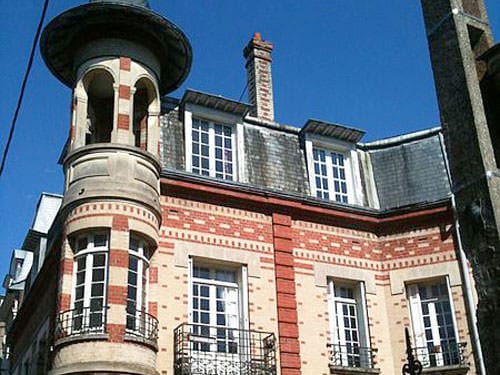
Dieppe experienced a golden age from the Belle Epoque to the First World War. The town indeed modernised and expanded its fishing port, saw the construction of numerous lavish villas, a Moorish-style casino (inaugurated in 1886), and a seaside golf course.
The introduction of a steamship line between Dieppe and England attracted French and foreign royal families, as well as renowned artists and celebrities, including Saint-Saëns, Debussy, Monet, Renoir, Montesquiou, Proust, and Leopold II of Belgium.
However, Dieppe’s status as an upscale seaside resort declined with the introduction of paid vacations in France in 1936. A new clientele, composed of workers and employees, indeed flocked by train to Dieppe in search of holidays, pushing the elite to seek refuge in less popular destinations such as Deauville, Cabourg, or Trouville. Even the construction of a new Art Deco casino in 1932 failed to attract the world’s elite back to Dieppe!
Dieppe, present days
Dieppe suffered intense bombing during the Second World War, but a few historic buildings miraculously survived destruction.
The town has recently initiated an economic development program focused on tourism.
Thus, the 15th-century Château de Dieppe, a listed historical monument, now houses a museum that traces the town’s rich maritime history, as well as a collection of paintings of Dieppe by renowned artists: Renoir, Pissarro, Sisley, and Boudin, as well as works by foreign artists, such as Walter Sickert.
It also features superb collections of ivory carvings made by sailors during their voyages at sea.
Today, the port of Dieppe remains the beating heart and economic engine of the town, having evolved from the leading banana port in France to the leading shellfish port in France.
The Oceanarium and the marine life centre at Estran Cité de la Mer offer an immersive experience into marine ecosystems, popular attractions for tourists and vacationers.
Beyond its maritime activities, Dieppe is a picturesque town boasting a rich architectural heritage, including the Church of Saint-Jacques, a medieval gem built in 1195 and remodelled over the centuries, and the Church of Saint-Rémi, buit in the 16th and 17th centuries.
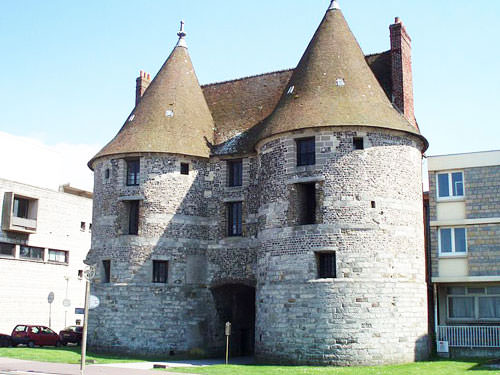
The Porte des Tourelles (Gate of the Turrets) is the only remaining of the five gates that were part of the 14th-century fortifications and served as a prison during the French Revolution.
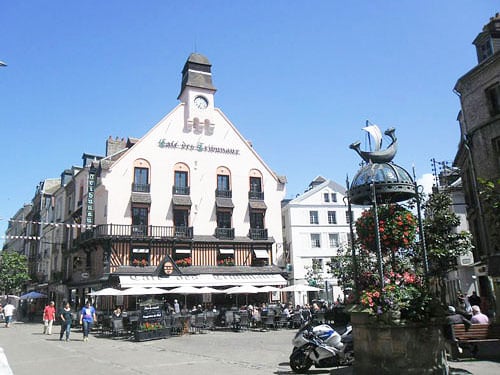
The Place du Puits Salé (Salt Water Well) is another remarkable site. It was named as such because salt water mixed with the well water at high tide.
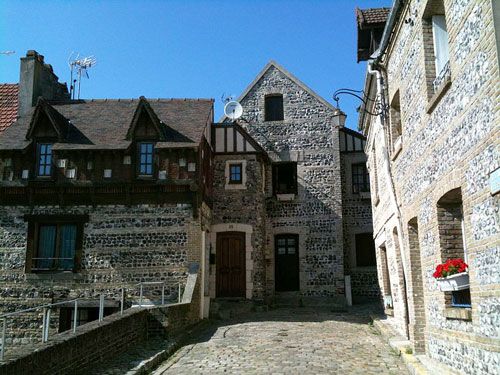
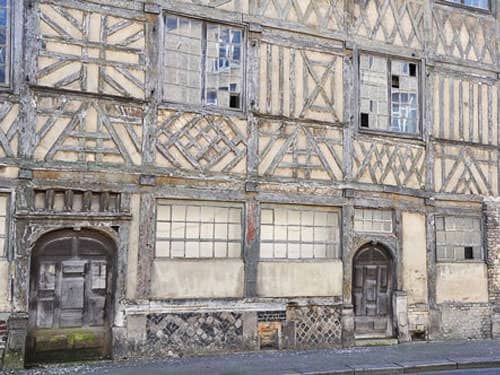
The Maison Miffant is a superb half-timbered house dating from 1624.
Located on Rue d’Écosse, the main thoroughfare of the old town, this remarkable building boasts a facade that miraculously survived the Second World War bombings. It is, of course, a listed historical monument.
Le Pollet is the picturesque fishermen’s quarter of Dieppe, renowned for its charming alleyways and lively port.
Rue de la Barre and Boulevard de Verdun are lined with elegant bourgeois houses built in the 18th century by the port’s notables.
Finally, Dieppe is located 6 km from the Canadian War Cemetery des Vertus in Saint-Aubin-sur-Scie.
Department Seine-Maritime
Coordinates: Lat 49.922992 – Long 1.077483
Photos via Wikimedia Commons: Marina by Mattis CC BY 2.0 – Le Pollet and Place du Puits Salé and Porte des Tourelles and Villa Belle Epoque Rue de la Barre by Sygogne CC BY-SA 3.0 – Maison Miffant by Philippe Alès CC BY-SA 3.0


