
Combarelles Cave, Les Eyzies de Tayac
The Combarelles cave is located at the confluence of the Petite Beune and the Grande Beune, along the D47 road leading to Sarlat-la-Canéda.
The villagers had always known of the cave’s existence and had even built a farm against its entrance, which they later transformed into a stable.
In 1892, various objects were unearthed during superficial excavations at the cave’s entrance.
However, it was only in 1901 that the archaeologists Louis Capitan, Abbé Breuil and Denis Peyrony officially “discovered” the Combarelles cave.
The old farmhouse adjacent to the cave now houses a visitor centre.
A major Sanctuary of the Magdalenian Culture
The discovery of the Combarelles cave was a major archaeological event. It comprises two galleries, only one of which is open to the public. This winding corridor extends for 240 metres, with varying heights from 50 cm to 2 m and widths from 1 m to 2 m. It contains between 600 and 800 engravings, testifying to the exceptional quality and know-how of the Cro-Magnon artists (from 14,000 to 9,500 years ago). This earned the Combarelle Cave international renown and the title of major Sanctuary of the Magdalenian Culture.
An exceptional diverse bestiary
Dr Capitan and Abbé Breuil began their excavations in 1902 and unearthed 109 representations of various animal species inside the cave.
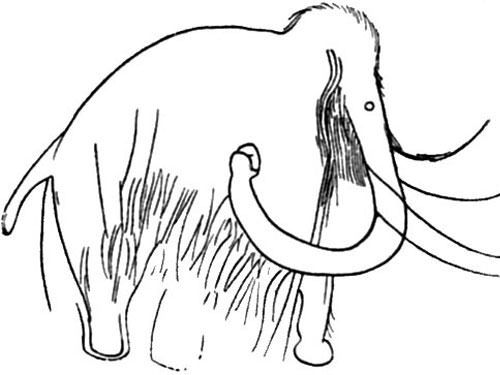
These engravings, located 125 m from the cave’s entrance and extending over 100 m, demonstrate exceptional finesse and precision, some carvings being 4 to 5 mm deep. Some drawings feature animals outlined in black, enhancing their visual impact.
Magdalenian artists depicted horses, alone or in groups, often alongside other species such as bison, mammoths, cave bears, lions, reindeer, ibex, rhinoceroses and bovids, thus creating a bestiary of incredible diversity.
These representations, generally life-size and sometimes limited to the head, invariably present the animals in profile, whether at rest, walking or running.
Despite the complex interweaving and superimposition of the engravings, probably due to ritual significance or spatial constraints, they retain a remarkable degree of accuracy and realism, leaving no ambiguity about the animals depicted.
A sophisticated level of artistic skills
Traces of pigment indicate that these engravings were originally painted.
Among the most intriguing engravings are those depicting four horses. They are depicted with animal skins on their backs and lines that undoubtedly represent harnesses, suggesting that Cro-Magnon men had domesticated horses.
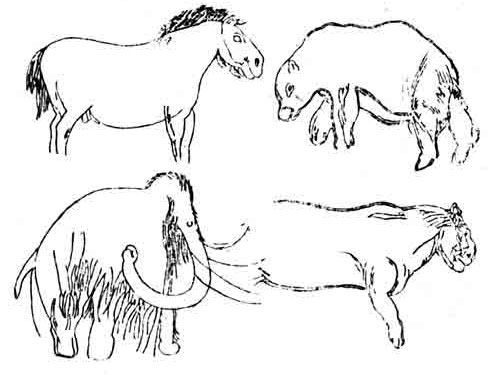
Another remarkable engraving depicts a mammoth with signs (two hooks angled towards each other) on its flanks. These signs could be the artist’s signature or a trademark.
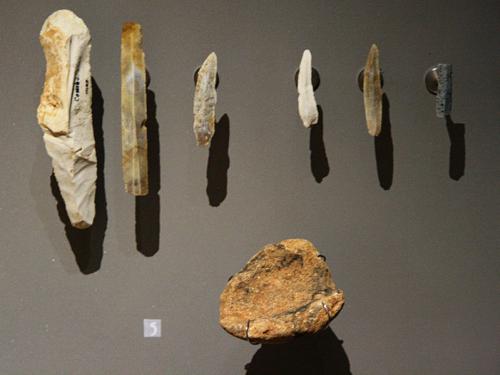
Tools and weapons, such as spears and bone harpoons, have also been discovered at the Combarelles cave. Carbon-14 dating of the bones indicates that the cave was occupied from approximately 13,680 to 11,380 years before present. These dates coincide with the disappearance of mammoths, then ibex and reindeer from the region at the end of the Magdalenian, due to significant climatic changes.
However, Magdalenian art remains a major enigma for experts. To this day, no one can fully explain how and why it appeared and disappeared so suddenly. The only traces that remain are these magnificent caves.
UNESCO recognised the importance of the Combarelles cave by including it as a World Heritage Site in 1979.
Department of Dordogne – Les Eyzies de Tayac Sireuil
Coordinates:Lat 44.936085 – Long 1.017341
Photos via Wikimedia Commons: Header by Ethan Doyle White CC BY-SA 3.0 – Prehistoric tools by Sémhur CC BY-SA 4.0 – Various animals and Mammoth both in the Public domain


