
Collonges-la-Rouge in Limousin
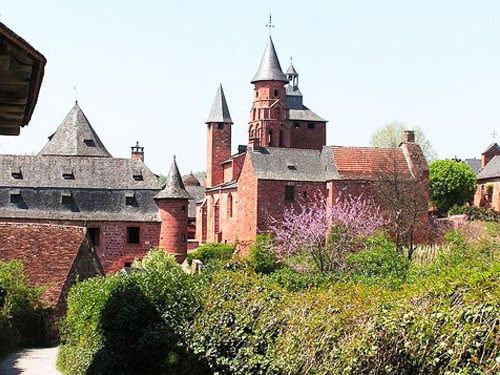
Collonges-la-Rouge is located approximately 20 km south of Brive-la-Gaillarde.
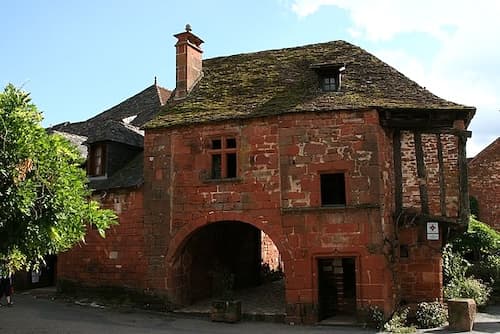
Called simply Collonges until 1969, it was renamed Collonges-la-Rouge for the red colour of the local sandstone used to build all the houses.
The name Collonges evolved from the Latin colonicas, a term that designated a large agricultural estate belonging to a colon during the Gallo-Roman period.
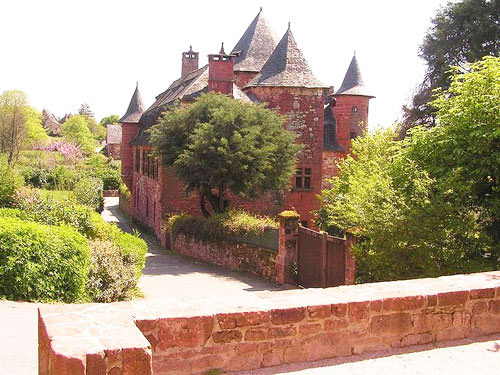
Nicknamed La Cité aux vingt-cinq tours – The City of Twenty-Five Towers, Collonges-la-Rouge is indeed home to numerous private mansions dating back to the time when the town held the status of a viscounty in the Middle Ages.
Formation of the red sandstone on the norther basin
The region’s unique red sandstone originates from the Meyssac Fault, a geological fault formed by the movement of a tectonic plate at the beginning of the Mesozoic Era.

Two distinct basins thus formed on either side of this fault, evolving independently and at different times, which explains the diversity of their soils and landscapes.
The red sandstone of the northern basin dates back approximately 250 million years. Sandstone, a rock composed of sand grains bound by clay, was formed by the erosion of the Massif Central. Initially, the rocks fragmented into pebbles, then into grains of sand. Torrents rushing down the mountains transported this sand and deposited it in the basin.
The intensity of the sandstone’s red colour is influenced by the high iron oxide content present during the solidification of the sand grains. Periods of hot, dry climate favoured the formation of iron oxide. Indeed, as the dense forests covering this bassin disappeared and disintegrated, they left behind deposits that transformed into a red clay rich in iron oxide. For millennia, this clay cemented the grains of sand, giving rise to the red sandstone formations.
Formation of the marl and marine limestone of the south basin
The soil of the southern basin is primarily composed of marl and marine limestone, formed between 150 and 200 million years ago.
At the beginning of the Mesozoic Era, this area was submerged by a vast sea, on the seabed of which the shells of marine animals were deposited.
Over time, these shells solidified and fossilised to form the layers of marl and limestone that we see today.
You can discover this geological feature by following two separate discovery trails that follow the boundary line and pass through the villages of Meyssac, Collonges, and Noailhac.
The Meyssac fault has been inactive for a very long time, and the safety risks are minimal, with the last major landslide dating back to 1914.
Collonges-la-Rouge, part of the Viscounty of Turenne
While agricultural activity existed in the area since the Gallo-Roman period, Collonges-la-Rouge really began to develop in the 8th century around a priory established on the pilgrimage route to Santiago de Compostela.

Initially attached to the Viscounty of Turenne, a feudal domain created in 823, the town gained significant importance during the Crusades (1096-1291). The kings of France indeed granted the lords of Turenne special privileges in recognition of their military contributions.
In the 13th century, Collonges-la-Rouge became the capital of a castellany (châtellenie) within the viscounty. By the following century, the Viscounty of Turenne had become one of the largest fiefs in France, enjoying considerable autonomy and functioning almost like a state within a state.
This status conferred upon Collonges-la-Rouge a charter of freedom and broad jurisdictional rights, including high, middle and low jurisdiction.
The property of the Counts of Auvergne
The House of La Tour d’Auvergne, Counts of Auvergne, acquired the Viscountcy of Turenne in 1444. Henri de La Tour d’Auvergne, a companion-in-arms of King Henry IV, converted to Protestantism around this time.The Viscountcy of Turenne experienced a resurgence After the end of the Wars of Religion. New districts were indeed annexed to the castellany of Collonges-la-Rouge, leading to the construction of numerous turreted townhouses to house the viscounty’s officers. However, the prosperity of Collonges-la-Rouge came to an end on June 8, 1738, when the last Viscount of Turenne was forced to sell the viscounty to Louis XV to settle his debts.
Decline of Collonges-la-Rouge
Incorporated into the Kingdom of France, the castellany of Collonges-la-Rouge lost its privileges and influence, and the priory’s outbuildings were demolished at the French Revolution, contributing to the town’s gradual decline throughout the 19th century.
The devastation caused by the phylloxera epidemic of the 1850s-1870s, which destroyed the vineyards, triggered a rural exodus.
However, Collonges-la-Rouge experienced a revival in the first half of the 20th century. A group of residents indeed created a heritage preservation association and, in 1942, obtained the listing of most of the town’s many buildings as historical monuments.
Collonges-la-Rouge also received the prestigious Plus Beaux Village de France – Most Beautiful Villages of France label and is now the most visited site in the Limousin region. The town began a major restoration project in 2014, planned in three phases.
Collonges-la-Rouge, a unique architectural heritage
The town’s prosperity during its heyday in the 15th, 16th, and 17th centuries is reflected in the numerous buildings listed as historical monuments.
Among them is the Halle au vin et grains, a covered market dedicated to wine and grain. The Maison de la Sirène (House of the Mermaid), a Gothic building named after a mermaid sculpture, features a remarkable truncated tower and now houses a Museum of Folk Arts and Traditions.
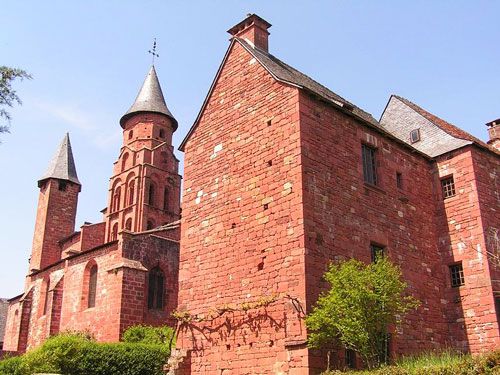
The 16th-century priory, which served successively as a convent, a court of the castellany, and a town hall, boasts exceptional architectural details.
Many private mansions were also built for the governors and captains attached to the Viscounty of Turenne: Châteaux de Benge, de Maussac, and de Vassinhac; Maison Ramade de Friac; Château du Martret; Château du Breuil; and Manoir de Beauvirie, to name just a few.
Collonges-la-Rouge has preserved vestiges of its 14th-century ramparts: the Porte Plate (Flat Gate) and the Porte du Prieuré (Prior’s Gate).
You can also visit the 15th-century Chapelle des Pénitents (Penitents Chapel) and the fortified Church of Saint-Pierre, built between the 11th and 12th centuries and fortified during the Wars of Religion. Its Romanesque bell tower with gables, one of the oldest in the Limousin region, features an original tympanum carved in white limestone, contrasting with the surrounding red sandstone.
Before leaving Collonges-la-Rouge, be sure to sample the local gastronomic specialities, such as the delicious foie gras and walnuts, as well as the famous local straw wine, or vin paillé.
Department of Corrèze – Limousin region
Coordinates Collonges-la-Rouge: Lat 45.060939 – Long 1.654225
Photos via Wikimedia Commons: Header by E gargadennec CC BY-SA 3.0 – Village street and Church and Castel de Vassinhac1 and Castel de Vassinhac2 by Alertomalibu CC BY-SA 3.0 – Castel de Vassinhac and Tympanum by Accrochoc CC BY-SA 3.0 – Maison de la Sirène by Sail over CC BY-SA 3.0


