
How did Lyon become the French capital of silk?
The term “canuts” is inextricably linked to Lyon’s prestigious silk industry. The canuts were indeed the skilled silk weavers who lived and worked in the Quartier de la Croix-Rousse , a district of Lyon considered the cradle of the French silk industry. The exact origin of the name “canuts” remains uncertain. However, the most common hypothesis is that it may derive from the word “canette,” that referred to the small bobbin thread used for weaving.
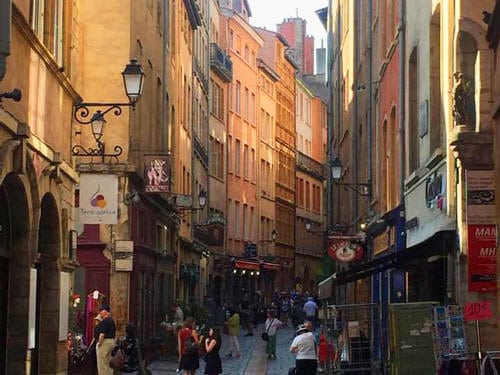
So, how did Lyon become the capital of silk?
Lyon became the French capital of silk in the 16th century, during the reign of François, a prominent patron of the French Renaissance. Silk weaving first appeared in Lyon in 1536, thanks to the arrival of Italian immigrants, including two Piedmontese silk merchants, Turquet and Naris. Together they founded Lyon’s first silk weaving workshop, where they produced exquisite fabrics adorned with gold, silver, and silk threads. Their success inspired many other artisans to settle in Lyon, leading to a dramatic increase in the population, which passed from 30,000 to 100,000 inhabitants in just a few decades.
To regulate this flourishing silk industry and ensure product quality, a production organisation was established. La Grande Fabrique brought together the master weavers, the Canuts, who operated the looms, and the merchant-manufacturers, or Soyeux, who supplied them with designs and distributed the finished fabrics. While the Canuts’ workshops were located in the old town and the Presqu’île district, the Soyeux’s workshops operated from the Terreaux district.

Technological advances, combined with the talent of skilled artisans, ensured the quality and prestige of Lyon’s silk industry in the 17th and 18th centuries. Notable innovations, such as Claude Dangon‘s improvement of the Italian loom, which facilitated the weaving of fabrics with complex patterns, as well as the contributions of talented pattern designers such as Revel, Pillement, and Philippe de Lassalle, stimulated the silk industry and turned Lyon into one of Europe’s silk capitals.
However, the French Revolution led to the decline of Lyon’s silk industry, as the nobility and clergy, traditionally great patrons of luxury goods, were dispossessed of their property and wealth, and some were even executed. Many silk weavers then sought better opportunities abroad, emigrating to Switzerland or Germany. However, Lyon’s silk industry experienced a revival that restored its position as the French capital of silk during the Napoleonic era, when Emperor Napoleon I commissioned the creation of sumptuous fabrics to adorn his palaces and clothe his court.
Joseph-Marie Jacquard revived Lyon silk industry
In 1801, Joseph-Marie Jacquard revolutionised the silk weaving industry with his invention of an innovative loom.
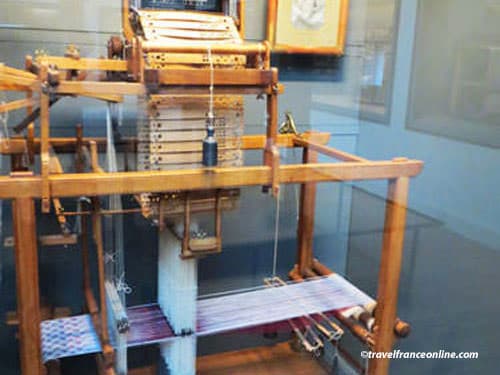
The Jacquard loom featured a punched card mechanism that provided a precise and easy selection of the warp threads. This loom significantly streamlined the weaving process, enabling a single worker to operate it efficiently.
Its introduction thus played a crucial role in revitalising the silk industry in Lyon’s workshops and providing employment for the city’s silk weavers, the Canuts.
However, the adoption of the Jacquard loom also necessitated the modernisation of outdated workshops. These traditional spaces were indeed poorly suited to the new looms and required extensive renovations to fully utilise the potential of the revolutionary technology.
La Croix-Rousse – Quartier des Canuts
The Quartier de la Croix-Rousse developed on the nearby hills and became the nerve centre of Lyon’s silk industry, earning the nickname “Quartier des Canuts” (Silk Weavers’ Quarter). The silk weavers indeed left their old workshops to settle in La Croix-Rousse, where they established themselves in spacious workshops with large windows and high ceilings, bathed in natural light. La Croix-Rousse had a couple of other benefits. It was indeed close to the Quartier des Terreaux, home to many merchants and manufacturers, and benefited from an exemption from municipal taxes, as it stood outside the city limits of Lyon at the time!

However, the working conditions of the Canuts were harsh, marked by long days and meagre wages, which eventually led to a series of revolts known as the Revolte des Canuts – Weavers’ revolts in 1831, 1834, and 1848. The integration of La Croix-Rousse into Lyon in 1852 brought improvements to working conditions and infrastructure. Access to water and gas was ensured, and a network of funiculars was installed to facilitate travel within the district.
The number of silk merchants in La Croix-Rousse quickly increased from 300 to 400. The population of La Croix-Rousse increased eight-fold, and Lyon, fuelled by its flourishing silk industry, became the leading industrial city in France. The number of looms increased from 3,500 for 6,000 inhabitants in 1805 to 40,000 for 45,000 inhabitants in 1890. Lyon consolidated its status as the undisputed French capital of silk, exporting a significant portion of its production to England and the United States, and contributing to the city’s economic prosperity, which was considered the world centre of silk weaving and trade.
Decline of the silk industry
At the end of the 19th century, the silk weavers of Lyon had forged a reputation for excellence in fabric production, leaving the weaving of ordinary textiles to less skilled artisans in the surrounding countryside.
However, the outbreak of the First World War dealt a severe blow to the luxury industry, with a decline in artisanal expertise and a sharp drop in orders. The advent of mechanisation further accelerated this decline. The number of mechanised looms increased from 500 to 1,300 between 1900 and 1920, marking a gradual loss of traditional production methods.
While a few traditional looms still exist today, their use is mainly limited to weaving fabrics for French museum collections and prestigious commissions.
Despite the decline of the silk industry, Lyon has preserved a rich cultural and architectural heritage from the era of the silk weavers. A visit to La Soierie Vivante is a must for any visitor to Lyon. Managed by Lyon’s only heritage preservation association dedicated to silk, La Soierie Vivante offers visitors a glimpse into Lyon’s past. There, you can explore the last two remaining silk weaving workshops, including the Canuts’ (silk weavers’) living quarters. And of course, you’ll find a memorial to Joseph-Marie Jacquard, inventor of the revolutionary Jacquard loom, on the Place de la Croix-Rousse.
Discover more on Lyon: Colline de Fourvière, the antic Lyon – Mères Lyonnaises, Lyon’s gastronomy pioneers
Department of Rhône
Coordinates: Lat 45.779171 – Long 4.826776
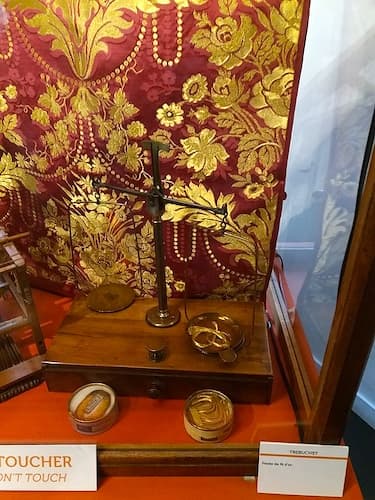
Photos via Wikimedia Commons: Header by Otourly CC BY-SA 3.0 – Trebuchet for weighing gold wires by Romainbehar CC0 – Photos1-2-4 are copyrighted to SheldonMcBride


