
Baie d’Audierne coastline
The Baie d’Audierne stretches from Pointe du Raz in the north to Pointe de Penmarch in the south, opening onto the Atlantic Ocean. Prized for its rugged and often deserted shores, the bay is a wild and unspoiled natural area.

Picturesque fishing villages dot its coastline, and important ports such as Audierne, Poulgoazec, and Saint-Guénolé, near Penmarch, lie on the banks of the Goyen River. Two-thirds of the coastline, from Pointe de la Torche to Plozévet, is a long pebble beach, remnants of the Quaternary glacial retreat.
Beyond this come ancient granite formations, steep cliffs plunging into the sea and sculpted by millennia, such as Pointe de la Torche, Pointe de Penmarc’h, and Pointe du Raz.
Over the centuries, countless ships have sunk on the beaches of the Baie d’Audierne.

Legend has it that the inhabitants of this isolated shore, nicknamed “the marsh people,” were formidable wreckers. Always on the lookout for ships in distress, they were ready to exploit them, plundering their cargoes and robbing their passengers…
The story of the “Droits de l’Homme” , a ship that ran aground on the shores of Plozévet during the French Revolution, also remains etched in memory. The 650 people who perished were hastily buried in the dunes. A thousand-year-old megalith, erected in front of the shipwreck site, was engraved with a dedication to the victims.
Baie d’Audierne – The hinterland
The hinterland of Baie d’Audierne is a landscape of dunes and ponds, locally referred to as “palus.” These formations are the remnants of former salt marshes, creating a network of lagoons protected from the sea by natural barriers of pebbles. Over time, natural erosion, the construction of coastal infrastructure, and centuries of pebble extraction have weakened this natural defence, exposing the hinterland to the risk of flooding.
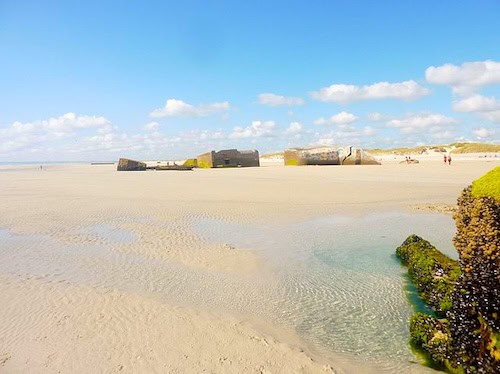
To preserve this fragile ecosystem, pebble extraction was banned in the municipality of Plovan in March 1934, when erosion was particularly severe. However, this decree did not prevent the Germans from reopening the quarries during the Second World War to fortify their Atlantic Wall with bunkers, further compromising the stability of the coastline.
The vulnerability of the Baie d’Audierne coastline has only increased over time, exacerbated by rising sea levels. This phenomenon is particularly visible in Tréguennec, where the bunkers once perched on the dunes are now submerged by the ocean. Despite efforts to mitigate the impacts, the hinterland remains subject to regular flooding during severe storms and high tides, often triggering ecological crises. Furthermore, ongoing siltation is transforming parts of the hinterland, isolating some ponds from the sea and profoundly altering their ecosystems. This ecological upheaval has far-reaching consequences, disrupting the fragile balance of the flora and fauna that once thrived in this unique coastal landscape.
Flora and fauna
The marshes of the Baie d’Audierne are rich habitats, primarily populated by willows and common reeds, locally known as roselières, which were once harvested for thatching. While the demand for thatched roofs declined over time, the local industry experienced a resurgence in the late 1980s, reviving this tradition.

These marshes also teem with diverse wildlife, including waterfowl, and less welcome inhabitants, such as mosquitoes!
The shallow seabed off the bay provides an ideal environment for cage farming of crustaceans, particularly lobsters. Shrimp, prawns, and wild crabs also thrive, and if you’re lucky, you might even spot dolphins. The fishing industry is flourishing, although strictly regulated to prevent over-fishing and marine pollution.
Unfortunately, the region is not immune to environmental disasters, such as oil spills. Faced with these challenges, the municipalities of Penmarc’h, Plomeur, Saint-Jean-Trolimon, and Tréguennec joined forces in 2000 to create the Syndicat Intercommunal à Vocation Unique (SIVU) – Single-Purpose Intermunicipal Syndicate (SIVU). This organization manages and protects 600 hectares of coastal dunes and marshes, which were placed under the management of the Conservatoire du Littoral in 1984.

The Coastal Conservancy guarantees the ongoing protection of threatened natural areas, particularly those located along lake shores and coastal zones. Access to the beaches of the Baie d’Audierne and local road infrastructure is now subject to rigorous monitoring in order to preserve the natural shingle barriers that provide essential protection against coastal erosion.
Recognised for its biodiversity and unique landscapes, the Baie d’Audierne received the Site of Intérêt Européen – Site of European Interest label and has also been integrated into the Natura 2000 network.
Department of Finistère
Coordinates: Lat 47.964495 – Long -4.446266
Photos via Wikimedia Commons: Header CC BY-SA 4.0 and Brook and reeds Photo1 and Blockhaus at Treguennec CC BY-SA 4.0 and Roselières near Plovan and Pebble beach by Moreau.henri CC BY-SA 3.0 – Reeds in bay by Ji-Elle CC BY-SA 3.0


