
La Madeleine inhabited for 17,000 years
Located on the north bank of the Vézère, opposite the village of Tursac, La Madeleine is a remarkable site that boasts three distinct levels of occupation!

At the river level is the prehistoric rock shelter, halfway up the cliff stands the medieval troglodytic village, and at the top of the cliff, the medieval castle.
What makes La Madeleine truly exceptional is its uninterrupted occupation over an astonishing 17,000 years, a feature without equal in Périgord.
This remarkable continuity, combined with the importance and style of the artefacts unearthed during various excavations, has led archaeologists to attribute to it a phase of the Upper Palaeolithic: the Magdalenian.
Formation of La Madeleine rock shelter
Millions of years ago, southwestern France was submerged by a vast sea that gradually receded.

In its wake, the rivers carved their rocks into the limestone plateaus, sculpting valleys and meanders, and digging galleries and shelters in the cliffs.
For our distant ancestors, these rivers offered natural protection, while the rock shelters provided a safe refuge from predators and inclement weather.
The fertile alluvial plains attracted game, while the forests provided abundant timber resources.
And thanks to rivers teeming with fish and unlimited water, life flourished in this ancestral landscape.
First colonization, 17,000 years ago
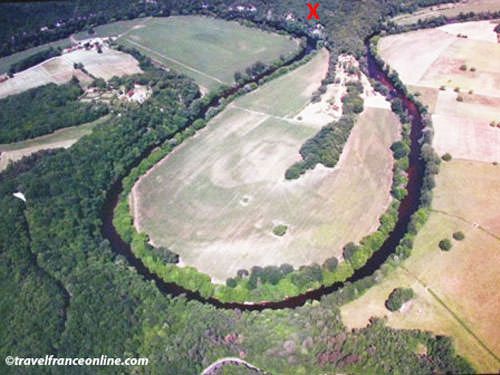
The first humans arrived and settled in the region approximately 17,000 years ago. Some chose to settle in a natural rock shelter nestled in the south-facing cliff of a looping meander of the Vézère River.
Accessible only by river, La Madeleine offered an incomparable natural defence against predators and potential intruders; the surrounding land’s fertility, unlimited access to water, fish, and game provided an ideal environment for the establishment and prosperity of Magdenenian populations over millennia.
As the temperatures rose and mammoths moved northward, they adapted their hunting techniques and weaponry, surviving and evolving.
This is how the legacy of Magdalenian culture extends far beyond the region’s boundaries, throughout all of Western Europe.
The first superficial excavations carried out at La Madeleine in 1868 revealed a great wealth of objects, suggesting the site’s importance. Further explorations the following year confirmed their suspicions.
The ancient inhabitants of La Madeleine were not only masters in the art of parietal painting and engraving. They also mastered the manufacture of tools, weapons, and ornaments from materials such as ivory, horn, and bone, often finely decorated or engraved!
The Age of the Reindeer
The abundant presence of reindeer in cave paintings has led archaeologists to nickname the Magdalenian “the Age of the Reindeer“.
However, subsequent excavations have revealed that the Magdalenians had a more diverse hunting repertoire. Besides reindeer, they also hunted red deer, horses, and even larger mammals.
These ancient artists displayed remarkable realism in colours and forms in their animal representations. They ingeniously used the natural contours of the cave walls, integrating them into their compositions with finesse and creativity. Such sophistication testifies to their expertise and their deep knowledge of their environment.
A major discovery that highlighted the importance of the La Madeleine site was the unearthing of five fragments of an ivory blade bearing an extraordinary engraving depicting a mammoth. Its sophistication and realism of the engraving suggests that the artist was very familiar with the animal, which undoubtedly places it in the same period.
This discovery has so far provided valuable information about the engravings and the cave’s age, and the time when the mammoths disappeared from southwestern France.
Magdalenian settlements
The transition from cave dwellings to tent dwellings among the Magdalenians marks a major turning point in their way of life.

In 1926, excavations unearthed a major discovery: the skeleton of a 3-year-old child adorned with shell jewellery, dating to approximately 10,000 years. The high quality of the jewellery suggests that the child may have been the son of a prominent member of the tribe.
As at La Laugerie Haute rock shelter, the presence of ochre pigments indicates that the Child of La Madeleine was painted before his burial. Many objects unearthed at La Madeleine, including the remains of the Child of La Madeleine, are exhibited at the National Museum of Prehistory in Les Eyzies-de-Tayac-Sireuil and at the National Antiquities Museum in Saint-Germain-en-Laye, near Paris.
Although the prehistoric shelter of La Madeleine remains closed to the public, the troglodytic village is open, and the ruins of the castle are visible from its surrounding walls.
La Madeleine troglodytic village
The origins of the village of La Madeleine date back to Saracen and Viking raids of the 8th and 9th centuries.
This troglodytic village was deliberately built like a fortress, strategically positioned to withstand possible attacks. Its steep access path, allowing only one person to pass at a time, constituted a natural defence, thwarting group assaults.
A fortified guard post, connected by a suspended walkway to a wooden platform, protected the village’s entrance. This platform, cleverly inclined towards the river, offered the guard a tactical advantage, allowing him to repel any intruder.
The village’s “main street”, a narrow alley lined with a protective parapet, ran (and still does!) between the edge of the cliff and the houses. Within the village, an area was reserved for artisans and their families, and remnants of their equipment are still visible in the ground or embedded in the rock.
Troglodytic dwellings
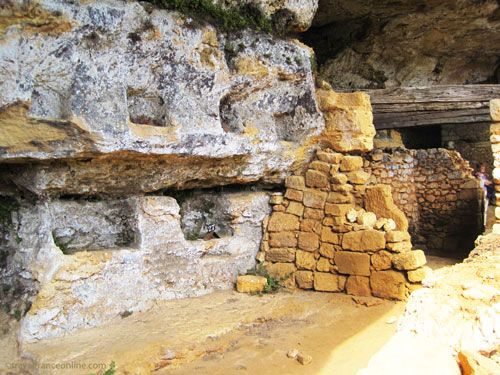
Natural rock shelters have proven to be ideal dwellings, requiring only an exterior wall to complete their structure. The surrounding forests provided the beams needed for the framework, while the cliff itself offered an inexhaustible source of stone. Today, the remains of these beams are marked by small cavities aligned in the rock face.
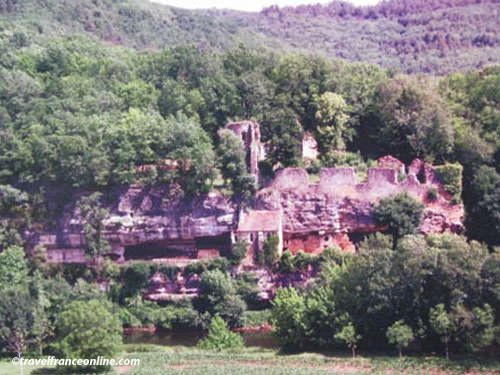
The interior walls were built with a mixture of mud, straw and wood commonly called cob or rammed earth. The cave dwellings generally had two levels, their layout dictated by the rock’s relief. Stables on the ground floor housed livestock such as goats, sheep, pigs and poultry, with the heat given off by these animals rising to the upper level, where the families resided.
Some houses have retained their walls, offering a glimpse into these long-gone installations, with telltale traces of smoke on the ceiling indicating the location of hearths. The villagers also adapted the cliff face to their needs, carving niches, cupboards and beds into it, often equipped with wooden doors.
Rainwater was collected in tanks carved into the rock, while gutters carried excess water and waste away from the houses. Finally, the villagers had created a communal vegetable garden at the top of the cliff, in the fortified enclosure.
One can easily imagine chickens, pigs, goats and other animals roaming freely in the narrow village street!
The importance of the river
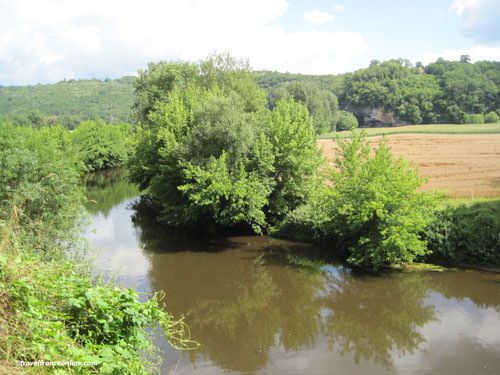
The villagers had ingeniously carved steps into the cliff to facilitate their movement between the village and the river below. River traffic was heavy, as the troglodyte villages depended on boats for their supplies. Essential goods such as wood, hemp, food, drinking water and weapons arrived by flat-bottomed boats called gabares, then were hauled up the cliff using a pulley system. Smaller boats and rafts made it possible to cross the river without a bridge.
Chapel of Sainte Madeleine
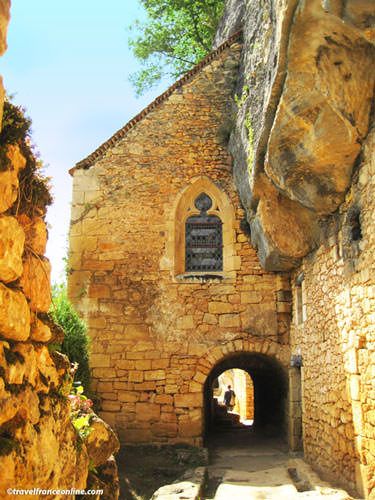
The Sainte-Madeleine chapel, a jewel of the village, was built by Lord Beynac in 1354, on the remains of an older chapel. Despite the passage of time, it retains its remarkable Gothic arches and its two Romanesque altars. Unfortunately, the vibrant frescoes that once adorned its walls have disappeared, leaving behind only a mysterious interior sundial whose function remains a subject of curiosity.
The watchman hole
Each troglodyte village along the Vézère and Dordogne rivers featured a unique feature known as a watchman hole or cluzeau. These small cavities, accessible only by ladder or rope, were strategically positioned at regular intervals along the river.
Their purpose was to serve as guard posts, enabling watchmen to communicate with each other using horns or visual signals. These signals served as warnings, prompting farmers to gather their grazing animals from the valley and seek refuge in the safety of the shelters.
Château fort du Petit-Marzac
Le Petit Marzac was built during the Saracen and Vikings raids of 8th and 9th centuries, and served as a protective bastion for the inhabitants of the valley. Some remains of the dry moats that defended it are still visible.
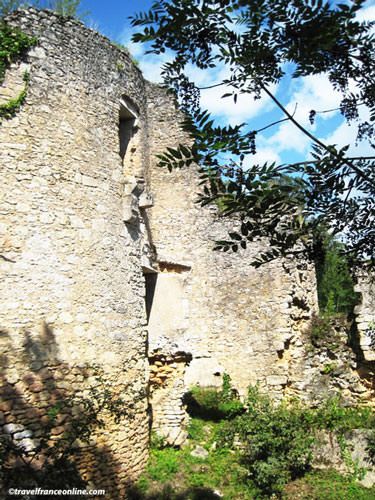
The fortress was reinforced by the Sireuil family in the 13th century. However, the English seized it, along with Tursac, in 1335 (Hundred Years’ War), and used both sites as strategic bases for their raids.
Lord Beynac recaptured Le Petit Marzac and Tursac in 1354, and both estates remained in his family until the 17th century.
Unfortunately, the fortress was destroyed by fire in 1620, was never rebuilt, and was later used as a quarry. Today, only ruins remain, including the ramparts and the Tour Saint-Martin (tower).
The once-flourishing troglodytic village of La Madeleine gradually declined after the fire.
Today, La Madeleine is no longer inhabited and is open to the public, and it is a UNESCO World Heritage Site.
Department of Dordogne – Tursac
Coordinates: Lat 44.96185 – Long 1.041255


