
Châtel in Val d’Abondance
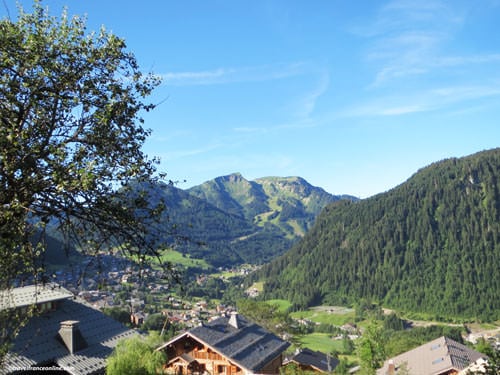
Châtel, an idyllic alpine village nestled at an altitude of 1,200 metres in the heart of the Val d’Abondance (Valley), lies in the heart of the Chablais region.

This picturesque area shares its border with the Swiss canton of Valais, allowing Châtel to be part of the prestigious Portes du Soleil ski area, a renowned network of 12 resorts. A quintessential mid-mountain resort, Châtel attracts not only skiing enthusiasts but also experienced hikers during the summer.
The village indeed boasts an extensive network of hiking trails, many of which cross the Franco-Swiss border, offering breathtaking panoramic views.
The picturesque Val d’Abondance stretches 25 kilometres from Chevenoz to Châtel, and was created by the winding Dranse d’Abondance River, which has sculpted the landscape over the millennia.
This valley was once part of the canton of Abondance, in the historic Duchy of Savoy. Two theories exist to explain the origin of the name, Abondance. Some attribute it to the “abundance” of its lush meadows, ideal for raising dairy cows whose rich milk is used to make Fourme d’Abondance cheese, which was awarded the prestigious AOC designation in 1990.
Others suggest that a Burgundian tribe settled there in the 5th century to escape the Hun hordes who were ravaging everything in their path. Indeed, Burgundian influence is evident in numerous place names and cultural traditions, lending credence to this theory.
As for the village of Châtel, its name derives from the Old French word for castel – castle, suggesting thatit stated as a stronhold. However, no ruins or documents have been found to corroborate this hypothesis.
The Abbey fo Abondance stands in the heart of the Abondance Valley.
Originally founded as a priory by monks from the Abbey of Saint-Maurice d’Agaune (in the Valais Canton) in 1108, it was quickly elevated to the prestigious status of an abbey.
Remarkably, the abbey has survived the centuries almost intact, preserving its original church, cloister, and convent buildings, and it became the first abbey in Savoy to be listed as a historical monument in 1875.
In 2003, the Ministry of Culture and Communication also awarded the valley the prestigious “Land of Art and History” label.
A spa town
Châtel remained under the jurisdiction of the Duchy of Savoy until 1860, when, like the rest of the region, it was annexed by France.
Until then, the village had prospered thanks to traditional forestry and agriculture, which provided a steady livelihood for its inhabitants.
However, the fortuitous discovery of a sulfurous spring a few years later heralded the arrival of hydrotherapy in the region, boosting the economic prosperity of Châtel.
The first hotel opened in 1880, laying the foundations for a flourishing industry: summer tourism. As the reputation of the therapeutic waters spread, Châtel became a popular destination, attracting visitors eager to enjoy the regenerative benefits of hydrotherapy in a pristine Alpine setting.
The smugglers of Châtel
Châtel’s proximity to Switzerland naturally gave rise to a clandestine but lucrative activity in the first half of the 20th century: smuggling!
Indeed, faced with hardship and a lack of jobs, particularly in the aftermath of the disastrous First World War, the villagers had no choice but to turnd to this illicit trade to support their families. Living in an isolated village, especially during the long winters, they indeed struggled against the harsh realities of their environment.
Thus, having few other options, they began smuggling tobacco across the border. Under the cover of night, the smugglers would take perilous mountain paths, laden with heavy contraband. Once in Switzerland, they would trade their illicit goods for basic necessities such as ham, bacon, and honey, foodstuffs that were scarce in their village. However, smuggling was a perilous trade.
Customs officers, intimately familiar with the terrain, often lay in wait for hours in the dense forest under cover of night. Despite the risks, many smugglers managed to evade capture thanks to their cunning and agility, allowing them to outwit their pursuers. The era of smuggling, characterised by this risky game of cat and mouse, lasted about thirty years, from 1920 to 1950. Although born of necessity, this clandestine trade left an indelible mark on the history and folklore of Châtel.
Châtel, one of 12 resorts in Portes du Soleil
In 1946, Châtel seized the opportunity presented by the rise of winter sports and invested heavily in the construction of the Vonnes ski lift.
Since this promising start, Châtel has continuously modernised and expanded its ski infrastructure. Over the next two decades, the village experienced intense growth, with the commissioning of the Super-Châtel and Morclan chairlifts, the Coq and Corbeau ski lifts, and the first Super-Châtel gondola. The construction of the Chalet-Neuf chairlift was a major milestone, establishing the first direct link between France and Switzerland and fostering cross-border collaboration in winter sports.
1975 was a pivotal year for the Châtel ski resort, as it was integrated into the prestigious Portes du Soleil ski area.
This expansion triggered the development of the Linga area, with the inauguration of its gondola lift and the commissioning of a network of chairlifts, notably Combes, Pré-la-Joux, and Rochassons, the latter providing a direct link between Châtel and Avoriaz.
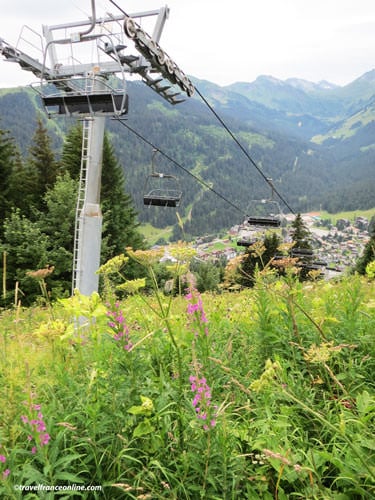
The momentum continued with the opening of the La Chaux des Rosées chairlift, followed by improvements to the Linga area, such as the installation of the Aity chairlift and the creation of a slalom stadium.
Other infrastructure improvements included the Cornebois chairlift and the Pied and Clos chairlifts. Meanwhile, the Super-Châtel ski area expanded, welcoming the Crêt and Conches chairlifts, as well as the Morclan chairlift, facilitating quick access to Switzerland and Torgon.
The relentless pursuit of improvement continued, culminating in the commissioning of the state-of-the-art Super-Châtel and Linga 10-seater gondolas, Plaine-Dranse, Barbossines, and Pierre Longue chairlifts.
Not resting on its laurels, the resort continues to evolve with new projects, such as the La Chaux des Rosées chairlift.
In 2015, another significant milestone was reached with the creation of links between the Linga and Super Châtel ski areas, thanks to the Gabelou and Portes du Soleil lifts. During the summer, many of these perfectly groomed ski slopes are transformed into hiking and mountain biking trails.

The Portes du Soleilski area boasts a network of 12 resorts, including 8 French resorts (Avoriaz, Morzine, Montriond, Les Gets, Saint-Jean-d’Aulps, Abondance, and La Chapelle) and 4 Swiss resorts (Champéry, Torgon, Morgins, and Crossets-Val d’Illiez-Champoussin).
The Châtel ski area extends from an altitude of 1,100 m to 2,200 m and is served by an extensive network of over 60 ski lifts, providing easy access to its varied slopes.
Travellers arriving by train will easily access Châtel from the train stations of Thonon-les-Bains (France) and Aigle (Switzerland), both served by the TGV high-speed train. Furthermore, Aigle train station has a direct connection to Geneva-Cointrin International Airport, making travel easier for visitors arriving by plane.
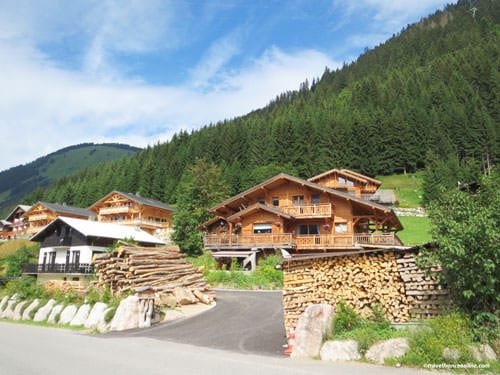
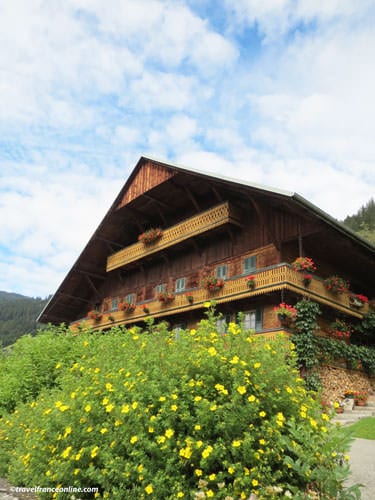
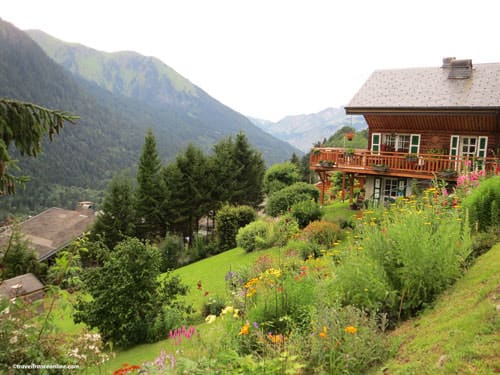
Finally, Châtel is renowned as a family-friendly resort that prioritises preserving its traditional Alpine charm with its picturesque wooden chalets, a contrast to the concrete towers that dominate some ski resorts.
Department of Haute-Savoie
Coordinates: Lat 46.267395 – Long 6.841152


