Rodez, the former capital of Rouergue
Rodez was the capital of historical Rouergue, and today is the capital of the Aveyron department.
Between the 6th and 8th centuries BC, the Celtic tribe of the Ruteni established their oppidum atop the Butte de Rodez. The 120-meter high hill commanded the Aveyron River.
This fortress later became the Roman city of Segodunum, capital of the Pagus Rutenicus, or Land of the Ruteni, a name which over time evolved into Rouergue.
Segodunum benefited from an optimal location on a local road leading to Millau-Gaufresenque, and was connected to the major Roman road to Spain.
It was thus an important crossroads for trade and cultural exchange with the entire region and beyond.
A dual city
Medieval Rodez was a city divided into two distinct quarters: the Cité and the Bourg, each administered independently.
The Cité, governed by the bishops of Rodez, was centred around the cathedral and its main square, the Place de la Cité, and the episcopal palace. This district was protected by high ramparts as well as thirty defensive towers.
The Bourg, the town under the jurisdiction of the counts of Rodez, was organised around its main square, the Place du Bourg. A conflict between the counts and the bishops led to the construction of a rampart separating the two quarters.
This rampart was dismantled at the beginning of the 16th century, when the County of Rodez was incorporated into the French Crown.
However, the layout of Rodez today still reflects this dual heritage, with two distinct quarters organised around their respective squares and each with its own distinct character and layout.
The medieval city
Boulevard Estourmel and Boulevard Belle-Isle were built on the site of the rampart that once divided Rodez.
Of the original thirty towers, only three remain on Boulevard Estourmel: the Tour Corbières and the Tour Raynald, while the Tour Maje has been incorporated into a hotel located on Place du Maréchal Foch.
The 17th-century episcopal palace still overlooks the Place d’Armes, and boasts a magnificent wrought-iron horseshoe staircase, reminiscent of the one at the Château of Fontainebleau.
The historic district of Rodez is a labyrinth of medieval alleyways lined with half-timbered houses and private mansions with corbelled facades and mullioned windows.
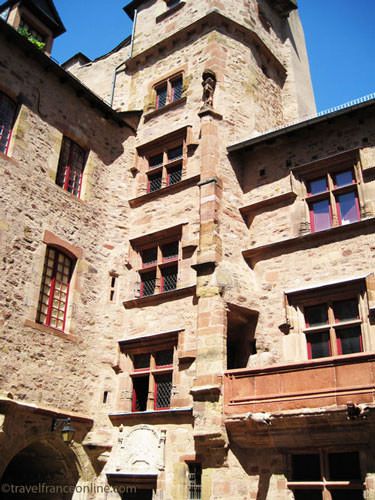
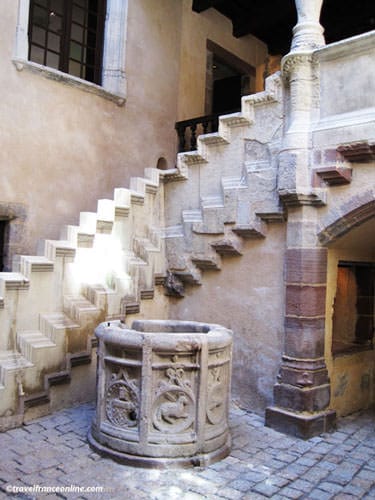
Among these architectural gems is the Maison de Benoît, on Place d’Estaing. This private mansion, built in the 15th century, is one of the oldest in Rodez. It boasts a magnificent Flamboyant Gothic gallery overlooking the inner courtyard.
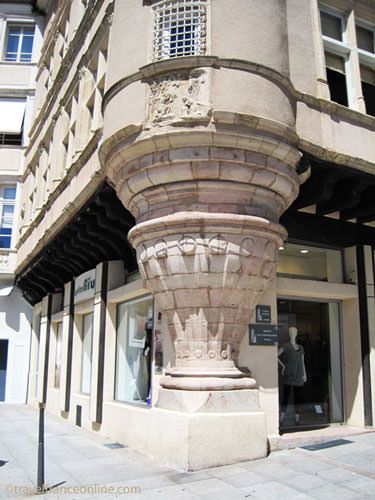
The nearbyTour des Anglais (English Tower) has a tower built in the 14th century and adorned with mullioned windows.
It is also known as the Maison Guitard, as it was built for the Guitard family of bankers and bears their coat of arms.
The Place du Bourg, the main square in the Counts of Rodez district, boasts numerous medieval and Renaissance buildings.
The 16th-century Maison d’Armagnac, on Place Olmet, is adorned with medallions depicting the Counts of Rodez.
It stands not far from the Church of Saint-Amans, which is dedicated to the first bishop of Rodez. Although the current building was rebuilt in the 18th century, it retains stones from the original 12th-century structure.
You can discover the many artifacts uncovered in Rouergue in the Musée Fenaille. Rodez has another museum dedicated to modern art – Musée Denys Puech.
Cathedral of Rodez
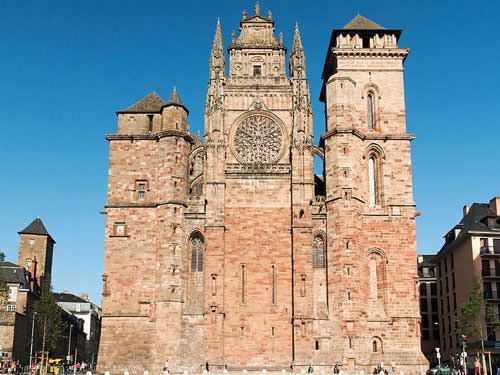
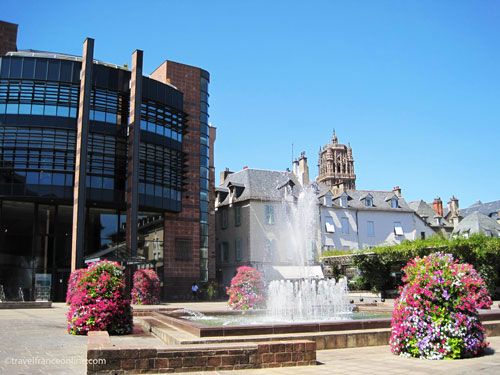
The cathedral, built of pink sandstone, is an iconic symbol of the city’s architectural heritage.
Its construction began in 1277 and completed in the 16th century, with additions and modifications continued into the 17th century, resulting in a remarkable fusion of architectural styles, from Gothic to Renaissance and Classicism.
Two imposing towers dominate the west facade, overlooking the Place d’Armes and framing the entrance to the cathedral.
Originally integrated into the fortifications, this facade was raised in the 17th century, blending Renaissance and Classical elements such as a monumental rose window, a crenellated gallery, and a Renaissance gable.
A 14th-century defensive tower was later raised and transformed into a bell tower, illustrating the transition from Flamboyant Gothic to Renaissance style.
Although the cathedral’s main architecture is predominantly Gothic, as evidenced by its impressive dimensions (107 metres long, 36 metres wide, and 30 metres high) and magnificent flying buttresses, classical influences are also evident.
The interior is distinguished by its high vaults and vast windows, which allow abundant natural light to flood the chancel and nave. The ambulatory is flanked by 27 side chapels, housing the tombs of the bishops of Rodez.
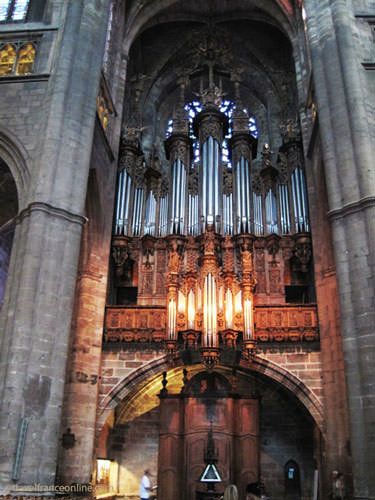
While the interior decoration remains generally understated, it showcases the richly ornamented choir stalls dating to 1468, the 16th-century gallery, the 17th-century organ housed in a finely carved wooden case, as well as numerous statues and sculptures.
Aveyron department
Coordinates Rodez:Lat 44.349389 – Long 2.575986
Photo via Wikimedia Commons: Cathedrale Notre Dame by Daniel VILLAFRUELA CC BY-SA 3.0