
Fontevraud Abbey, under the patronage of the Kings of England and France
Robert d’Arbrissel founded Fontevraud Abbey in 1101. However, Fontevraud was not an abbey like any other!
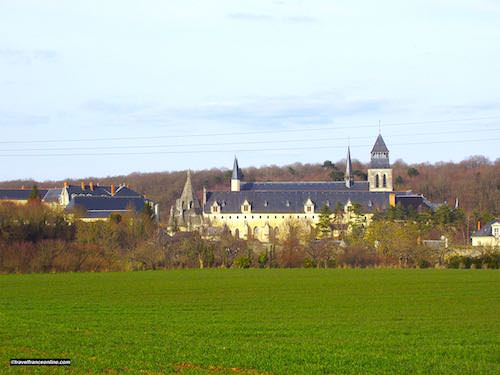
Unlike traditional monastic establishments, Fontevraud Abbey indeed brought together a community of lay brothers and sisters, each residing in a separate enclosure within the same estate!
This innovative approach to religious community life made it one of the largest monastic sites in Western Europe.
Fontevraud Abbey indeed covered 14 hectares and comprised four distinct monasteries, each with its own church, cloister, chapter house, kitchen, and living quarters.
Despite their individuality, the four monasteries were under the authority of a single abbess elected from among the community. Many abbesses came from royal or noble families, thus bringing with them considerable wealth and influence.
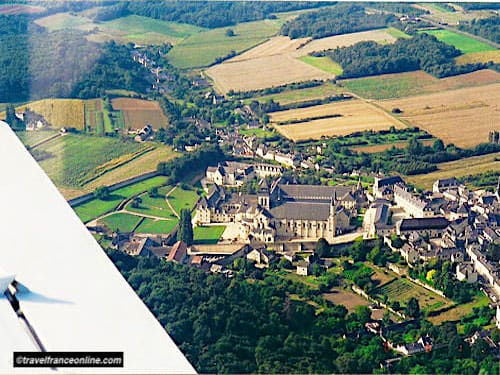
Fontevraud Abbey flourished as a centre of spirituality and learning under the leadership of Abbess Jeanne-Baptiste de Bourbon, sister of King Henry IV, and later Gabrielle de Rochechouart de Mortemart, sister of Madame de Montespan, mistress of Louis XIV.
Under Gabrielle’s leadership, the abbey transformed into a prestigious religious institution, renowned for its intellectual and cultural contributions. King Louis XIV entrusted the education of his four daughters to Fontevraud.
Fontevraud Abbey thus enjoyed the patronage of French and English monarchs for centuries.
Fifteen members of the Plantagenêt dynasty are buried in Fontevraud. The Dôme Church houses the recumbent statues of Henry II, King of England, his wife Eleanor of Aquitaine, who died in the abbey in 1204, their eldest son and successor, the legendary Richard the Lionheart, and Isabelle of Angoulême, wife of John Lackland, their youngest son. However, John Lackland’s recumbent statue contains only his heart.

Today, Fontevraud Abbey is a historical monument, renowned not only for its architectural splendour, including its perfectly preserved Romanesque kitchens, but also for its cultural and religious impact.
Unfortunately, the Huguenots sacked Fontevraud Abbey in 1561 during the War of Religions. However, the abbey recovered and regained its status as a leading religious institution at the beginning of the 18th century. At its peak, it owned more than 100 properties and 75 priories!
Unfortunately, the Fontevraud Abbey was declared national property during the French Revolution, and most of the monastic buildings were demolished, with the remaining buildings being converted into a prison.
Dome Church – Fontevraud Abbey
The main entrance to Fontevraud Abbey is on the Place des Plantagenêts.
It opens onto a vast courtyard surrounded by the 19th-century barracks built to accommodate the prison garrison, the 18th-century stables known as La Fannerie, and the late 17th-century Maison des Abbesses (Abbess’s House).
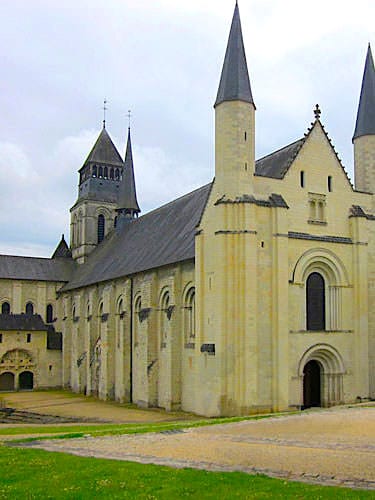
Once through the ticket office, you’ll arrive at the impressive Eglise du Dôme (Church), which was consecrated in 1119. This magnificent building boasts sculpted capitals and a four-cupola nave and is considered a masterpiece of Romanesque architecture.
Unfortunately, it served as a prison from 1804 to 1963 and still retains traces of the beams that supported a second floor. The church has thus undergone extensive restoration, allowing it to regain its original layout and beauty.
The Dôme Church stands on the north side of the Monastère du Grand Moustiers (Monastery).
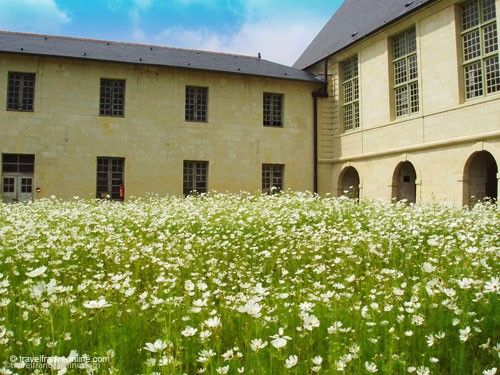
The Gothic and Renaissance Cloister gives access to the remarkable 16th-century Chapter House, which is adorned with portraits of the abbesses.
It also leads to the 12th-century Chapelle Saint-Benoît and the adjacent hospital.
The magnificent 40-metre-long Monks’ Refectory has retained its original Romanesque walls, but the original timber frame roof was replaced in the 16th century with a Gothic vault.
Finally, the cloister provides access to the Monks’ Dormitories and the famous Romanesque Kitchens.
Medieval kitchens – Tour Evraud
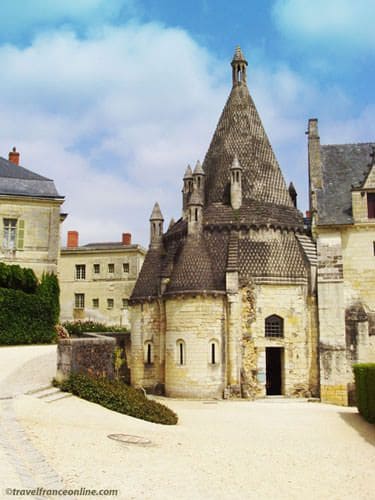
Fontevraud Abbey is renowned for having the only Romanesque kitchens still existing in France!
This imposing building, which housed the abbey’s kitchens, is also known as the Tour Evraud, an octagonal tower with a distinctive conical roof covered with interlocking tile slabs.
Eight round chapels initially surrounded this kitchen tower, but three were demolished in the 16th century to connect the kitchen to the adjacent refectory.
The architect Viollet-le-Duc carried out significant restoration work in the 19th century.
However, the large chimneys, which are now an integral part of the kitchens’ image, were not installed until 1904.
Fontevraud Abbey, Centre Culurel de l’Ouest
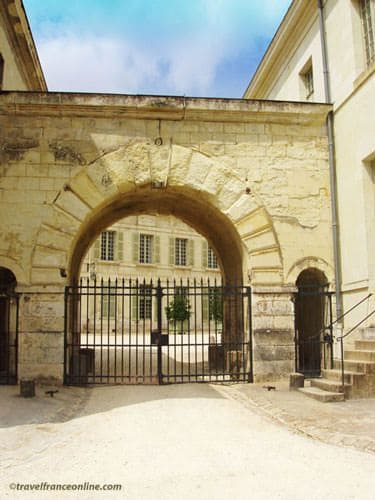
Fontevraud Abbey was restored in 1975 and became the Centre Culturel de l’Ouest (Western Cultural Centre).
The restoration work, carried out under the direction of the French National Trust for Heritage, ensures the preservation of this historic gem.
The buildings now host a variety of events, such as temporary exhibitions, seminars, conferences, and concerts, breathing new life into this ancient abbey.
Finally, the Prieuré Saint-Lazare, a former leper hospital, has been converted into a hotel.
Department of Maine-et-Loire – Fontevraud – Place des Plantagenêts
Coordinates: Lat 47.181821 – Long 0.050211


