
Rouen, an affluent Norman city
Rouen has exerted a great influence since ancient times.
The city was originally the capital of the Veliocasses, a Celtic tribe whose territory stretched along the Seine Valley before Roman colonisation.
The Romans developed the fortified settlement and transformed it into a prosperous city, the second most important in the Gallia Lugdunensis province after Lugdunum (Lyon).
In the early Middle Ages, the city became the capital of the Frankish kingdom of Neustria and the seat of a bishopric.
In 911, the King of France created the Duchy of Normandy and granted the Viking leader Rollo I, the first Duke of Normandy, the title of Count of Rouen, thus consolidating the city’s position as a regional centre of power.
In 1150, Rouen obtained its own charter, granting it autonomy and therefore broad sovereignty. Its flourishing economy was based on river transport, trade, and the import of wool from Flanders.
In 1204, King Philip II annexed the Duchy of Normandy to the Kingdom of France. Rouen remained under French authority until 1411, when the English seized it during the Hundred Years’ War.
It was at this time that Rouen became inextricably linked to Joan of Arc, the emblematic figure of the Hundred Years’ War, who was burned at the stake in the city square in 1431. Rouen definitively returned to the French Crown in 1449, at the end of the conflict.
The Renaissance was a period of economic and industrial growth for Rouen, with the textile industry, metallurgy, and river traffic playing a vital role in its prosperity. The city also gained renown for its artistic and cultural patronage, supported by influential bishops.
The Wars of Religion in the 16th century divided the population, and Rouen briefly fell to the English in 1562 before being recaptured by the French the following month.
Nearly half of Rouen was destroyed during the Second World War, but the city has since been rebuilt and has regained its former grandeur. Today, Rouen is a vibrant and dynamic urban centre, situated on the banks of the Seine and is the capital of Upper Normandy.
Rouen’s major landmarks
With such a long and rich history, Rouen naturally boasts a wealth of iconic monuments.
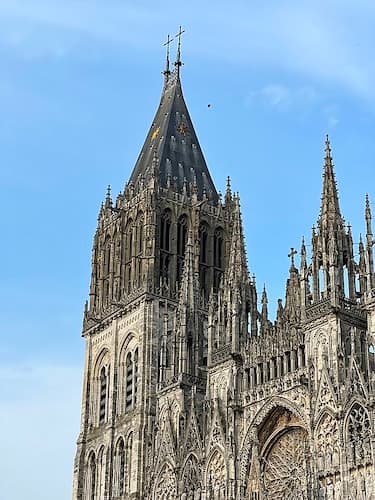
Notre-Dame Cathedral is a superb example of Gothic architecture and obviously one of Rouen’s most prominent landmarks.
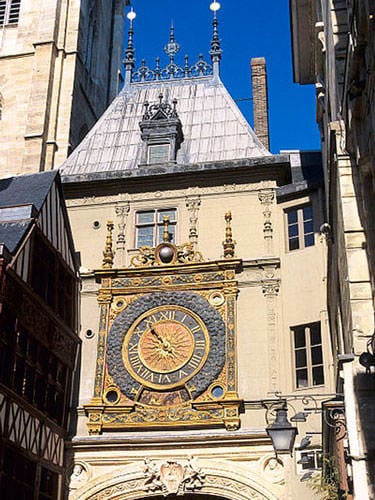
The Gros-Horloge (Great Clock) is an astronomical clock dating from the 16th century. Renowned for its magnificent Renaissance architecture, it houses a mechanism dating back to 1389. It is located in a 14th-century bell tower that also contains the city’s bells.
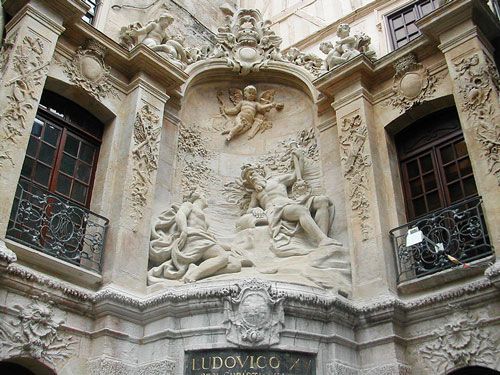
The magnificent Gros-Horloge Fountain adorns the west facade of the Gros-Horloge. Built in 1743, it is decorated with allegorical sculptural groups and was listed as a historical monument in 1889.
The Tour Jeanne d’Arc is the name given to the keep of long gone Rouen Castle. It was in this keep that Joan of Arc was interrogated during her trial in 1430-1431. The castle and the Tour de la Pucelle, the tower where Joan of Arc was imprisoned, were demolished in 1591. Only the Tour Jeanne d’Arc remains.
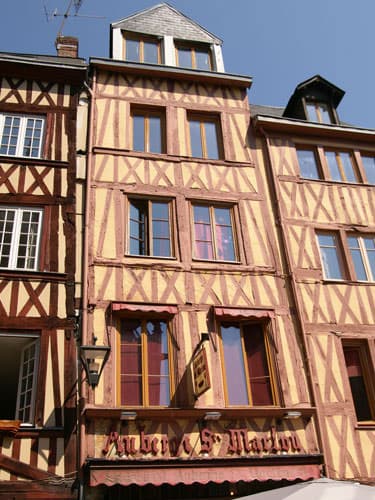
Joan of Arc was burned at the stake in the Place du Vieux Marché (Old Market Square). Most of the half-timbered houses surrounding this square were rebuilt after the Second World War.
An ambitious restoration program nevertheless uncovered the foundations of the pillory and the firebreak wall of the pyre. These historical remains stood in front of the Church of Saint-Sauveur, which was destroyed during the French Revolution and has since been replaced by the Eglise Sainte Jeanne d’Arc. This church, with its distinctly contemporary style, was inaugurated in 1979 and has been listed as a historical monument since 2002.
Another iconic monument of Rouen is the Palace of Justice, which housed the Parliament of Normandy.
Finally, the city is also world-renowned for its maritime and river event, L’Armada, which takes place every four years and brings together the most prestigious yachts and warships. This extraordinary flotilla sails up the Seine and docks at the quays of Rouen, attracting millions of visitors from all over the world!
Department of Seine-Maritime
Coordinates: Lat 49.443232 – Long 1.099971
Photos via Wikimedia Commons: Header Gros Horloge by Urban CC BY-SA 3.0 – Gros Horloge by Ytierny CC BY-SA 3.0 – Fontaine du Gros Horloge by Jean-Pierre Defrance Public domain – House Rue de Martinville by Pymouss CC BY-SA 3.0 – Cathedral by Chabe01 CC BY-SA 4.0


