
Le Tréport on the Alabaster Coast
Le Tréport is a fishing port and seaside resort at the northern end of the Alabaster Coast.
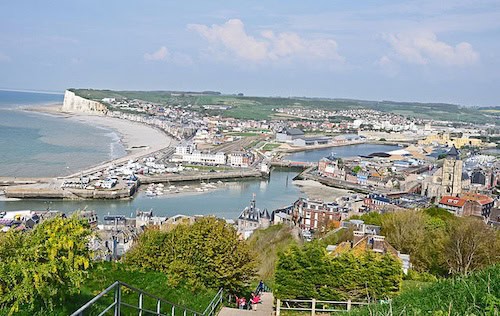
Situated at the mouth of the Bresle, one of the region’s three coastal rivers, it is renowned for its natural beauty, and for its pebble beach that stretches at the foot of the highest cliffs on the Côte d’Albâtre (Alabaster Coast).
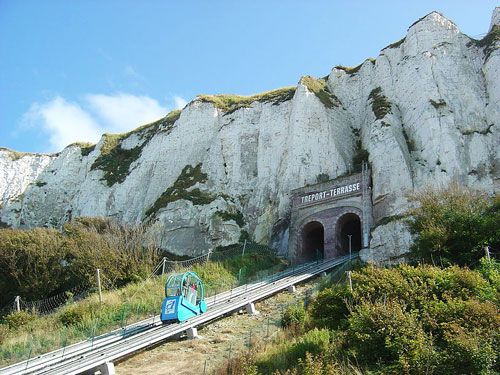
The town’s funicular, inaugurated in 2006, takes you to the top of the cliffs, which boasts an unobstructed view of the sea, of course, but also of Le Tréport, Eu, and Mers-les-Bains, a group of seaside resorts known as Les Trois Villes Soeurs – Three Sister Cities.
Eu and Le Tréport are located on the south bank of the Bresle, in Normandy, while Mers-les-Bains is situated on the north bank, in Picardy.
Le Tréport is also the place where the Vikings landed on our shores in the 10th century, and where Rollo, ancestor of the Dukes of Normandy, died around 930.
Le Tréport, a thriving fishing port
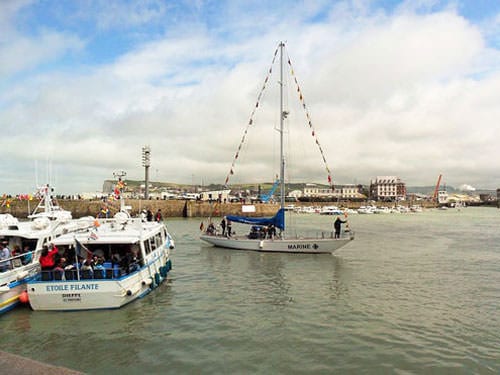
The opening of the maritime canal in the 15th century triggered the growth of the fishing port, facilitating the rapid transport of fresh fish to Paris. This growth intensified after the French Revolution.
Le Tréport Halle aux poissons (fish market), a testament to this flourishing trade, remains a must-see.
Maritime and river traffic improved over the years with the widening and modernisation of the canal’s infrastructure, reinforcing Le Tréport’s status not only as an active fishing port and hub for coastal shipping (cabotage), but also as a key centre for maritime rescue operations since the 1880s.
A trendy seaside resort
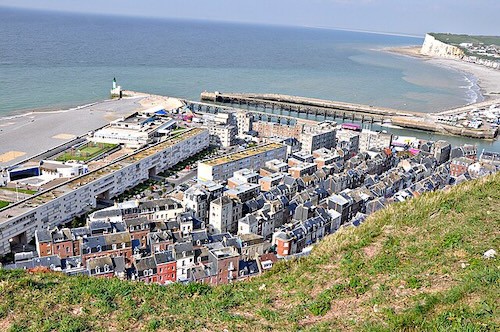
Le Tréport transformed into an upscale seaside resort in the mid-1840s, when King Louis-Philippe had a luxurious villa built in Eu to host the Queen of England. This, of course, attracted the wealthy Parisian bourgeoisie, who, in turn, built splendid villas along the seafront.
The Germans occupied the town during the Second World War, and many buildings were destroyed. The tunnels they dug into the cliffs to improve their defences are open to the public. A visit to the Musée du Vieux Tréport (Museum of Old Tréport) is also a must; it offers a glimpse into the lives of the fishermen and local traditions, some of which are threatened with extinction.
During your visit to Le Tréport, you will discover the ruins of the 11th-century Saint-Michel Abbey and destroyed during the French Revolution.
The Church of Saint-Jacques in Le Tréport was built on the site of the former parish church, which collapsed during the storm in 1360. Restored in 1699, it is now a listed historical monument.
As you explore the surrounding area, you will also find several World War II military cemeteries (Commonwealth, German, Belgian, and South African), as well as numerous crosses (calvaires,) erected to ward off epidemics and protect fishermen at sea.
Department of Seine-Maritime
Coordinates: Lat 50.059170 – Long 1.382472
Photos via Wikimedia Commons: Photo2 and Les 3 sister-towns by Philippe Alès CC BY-SA 3.0 – Header and Funiculaire by Roloff CC0 – Harbour by grassrootsgroundswell CC BY 2.0


