
Pierre aux Neuf Gradins on Puy Maria
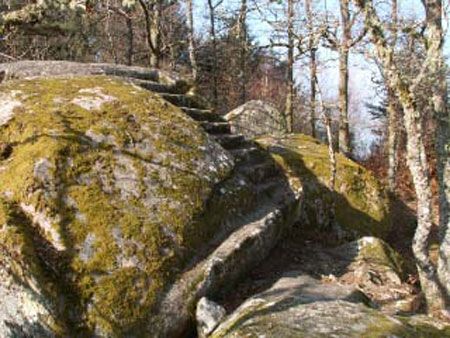
The Pierre aux Neuf Gradins (Nine Steps Stone) is a cluster of monumental granite boulders located at the summit of the wooded Puy Maria hill, or as locals call it, La peira daus nòu esbalets.
Puy Maria is nestled between two verdant valleys and offers superb panoramic views, especially in autumn when the leaves turn golden, and in winter when the landscape is laid bare, revealing the rugged beauty of the surrounding countryside
Natural erosion shaped this impressive collection of erratic granite boulders over millennia.

These blocks of hard rock indeed resisted erosion, unlike the fragile terrain on which they stood.
They attracted the attention of ancient peoples, as evidenced by an imposing 4-metre-high boulder that conceals three smaller carved rocks.
The first of these boulders, 1.5 metres high, was roughly hewn with three rudimentary steps leading to the centrepiece: the Pierre aux Neuf Gradins. This imposing 2.5-metre-high block has nine steps, each one metre wide and 10 centimetres high.
A drainage channel runs down from its summit, then passes under the highest step and flows towards the back of the block. The boulder’s summit is perfectly flat and leads to the third granite block, which was carved into an elongated trapezoidal platform, with two interconnected basins.
Witches’ cauldrons
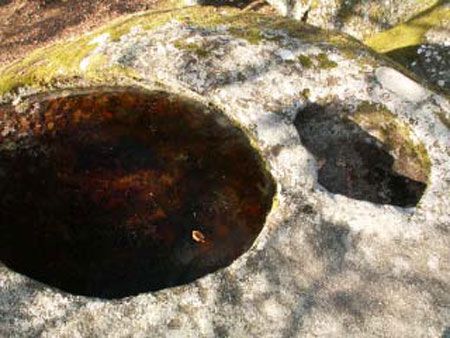
These natural basins, locally known as marmites de sorcières (witches’ cauldrons), are the result of natural erosion.
Over time, rainwater accumulated in these depressions, triggering chemical reactions with feldspars, minerals present in granite. The feldspars contain clay, which dissolved during these reactions, causing the basins to expand, some reaching a diameter of 40 centimetres.
The accumulation of plant debris in these water-filled basins then led to increased acidity. As the acidic water overflowed, it carved channels into the rock, which gradually widened to form what we see today as “gutters.”
The legends
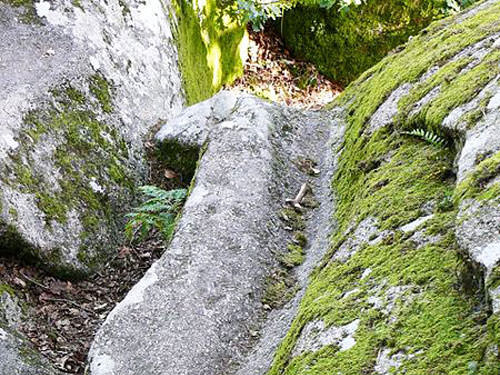
The Pierre aux Neuf Gradins is recognised as an archaeological enigma due to its unusual features and unknown origins, yet it is neither listed nor protected!
Although we know that the witches’ cauldrons formed naturally over time and that the nine steps were man-carved, we do not know the identity of these ancient stonemasons, nor the purpose of these carved blocks.
However, the Pierre aux Neuf Gradins shares similarities with other known sites in Western Europe, suggesting that it may have served as a place of worship as early as the Palaeolithic era, and was later used by the Druids for ceremonies and sacrifices.
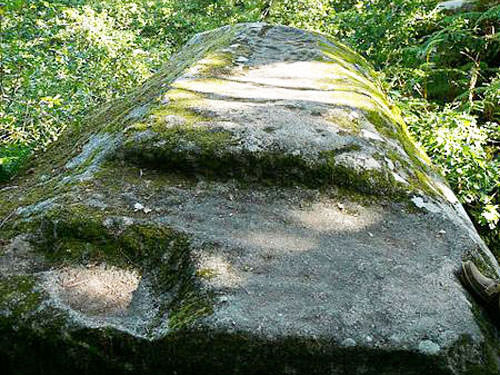
The mystery surrounding these boulders has thus given rise to numerous local legends. According to tradition, the water in the basins was thus renowned for its healing properties. Some claimed it could cure scalp rashes and fever, provided a coin was dropped in before drinking it. Women also believed in the magical properties of witches’ cauldrons and would dip a hairpin into the water before drinking it to ensure their husbands’ fidelity!
For those eager to discover these mysterious stones: A steep, marked path leads from the D60 road north of Pontarion to the site.
Department of Creuse – Soubrebost – Limousin region
Coordinates: Lat 46.012567 – Long 1.862338
Photos via Wikimedia Creative Commons: Header – Photo1 Photo2 – Photo3 – Photo4 – Photo5 by Philippe Hirou CC BY-SA 3.0


