
Argentoratum became Strateburgum
La Petite France is the historic district of Strasbourg; it is located at the western tip of the Grande Île, an island formed by the Ill and Rhine rivers. Situated on the Franco-German border, Strasbourg is home to the European Parliament and celebrated its 2000th anniversary in 1988.

La Petite France is located at the western tip of the Grande Île. This fertile area has been inhabited since the Palaeolithic era, and the first written records of it date back to 12 BC when the Romans transformed the Celtic oppidum of Argantorati into a military outpost, which they renamed Argentoratum.
The 5th century had a significant impact on the city, which was invaded by the Huns and the Alemannic tribes. Then, at the end of the 5th century, Clovis, King of the Franks, conquered the North of the country and created the Frankish kingdom (France), becoming its first king.
Clovis rebuilt the city and renamed it Strateburgum, after the fortress (Burg) located along the main road (Strasse). From 362 AD to 1262, Strasbourg was an important bishopric, that stood out from other cities in the region. It was indeed incorporated into the Holy Roman Empire in the 10th century, and granted the prestigious status of Imperial Free City.
La Petite France, the tanners’ district

The three Ponts Couverts
Since Celtic times, the enclave that became La Petite France district had been protected by ramparts, which were rebuilt in the 13th century to better control access to the river.
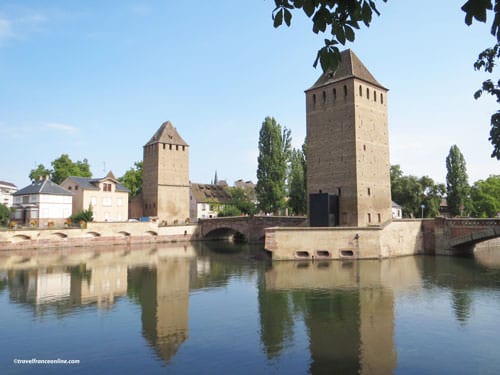
These ramparts included three covered bridges (Ponts Couverts), initially roofed with wood, which supported five fortified towers. Their old wooden pillars were replaced in the 14th century with masonry pillars, and in the 16th century, iron grilles were installed under the arches to prevent any attack by the river.
The wooden roofs were dismantled in the 18th century, and the bridges were replaced by the current stone structures at the end of the 19th century.
Today, only four fortified towers remain: Tour du Bourreau, Tour de l’Eclusier (also known as Tour Henri), Tour Jean de Altheim, and Tour des Français. The Tour Malzenturn, next to the Tour du Bourreau, was destroyed by fire in 1869, and its remains were demolished.
Barrage Vauban
Engineer Tarade built the Barrage Vauban at the end of the 17th century, based on plans by Marshal Vauban.
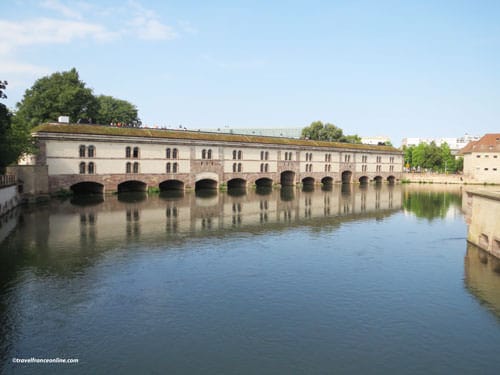
This imposing fortified dam spans the Ill River, replacing three covered bridges that had become obsolete due to advancements in firefighting and modern artillery.
Known as the Grande Écluse (Great Lock), this dam was equipped with sluice gates that allowed its arches to be sealed in case of enemy incursions. Its purpose was to slow the river’s flow, thus flooding the surrounding fields and transforming them into impassable marshes.
In 1966, the city of Strasbourg set up a panoramic terrace, the Terrasse Vauban, at the top of the dam. Designated a historical monument in 1971, the Vauban Dam is considered a feast of 17th-century French engineering.
Canal du Faux-Rempart – Fossé du Faux-Rempart
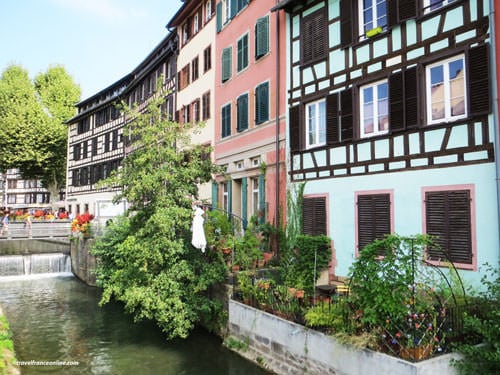
The Barrage Vauban protected the Canal du Faux-Rempart, also known as the Fossé du Faux-Rempart (ditch).
This canal was originally a small stream, a tributary of the Ill River, which marked the northern boundary of Grande Île.
Its name comes from the auxiliary fortifications built along it in the 13th century to strengthen the island’s defences.
This Faux Rempart was dismantled in 1840 and replaced with a navigable canal to facilitate the transport of goods in the region.
The industrious medieval district
The historic district of La Petite France was fiercely protected over the centuries by successive ramparts, but it wasn’t always a privileged neighborhood! Indeed, La Petite France, the former tanners’ quarter, was a pestilential enclave for the tanners washed their animal hides in the Ill River, turning it into a veritable sewer!

They ceased their activities long ago, but their houses, with their pointed roofs, narrow dormer windows, and open attics where the hides were dried, still stand and today constitute the rich architectural heritage of this district.
In addition to these superb medieval houses, the district also boasts watermills. In the 19th century, dams were built on three of the four canals to harness the hydraulic power of the Ill. The river powered the mill wheels, which produced the blocks of ice essential for preserving fresh produce and brewing local beer!
This once industrial district has now become the epicenter of tourism and also of Alsatian gastronomy, the former workshops now housing a multitude of restaurants that welcome a diverse clientele
La Petite France, a Unesco World Heritage
Despite the devastation of World War II, La Petite France has managed to preserve much of its traditional Alsatian charm, with its picturesque half-timbered houses and flower-filled balconies.
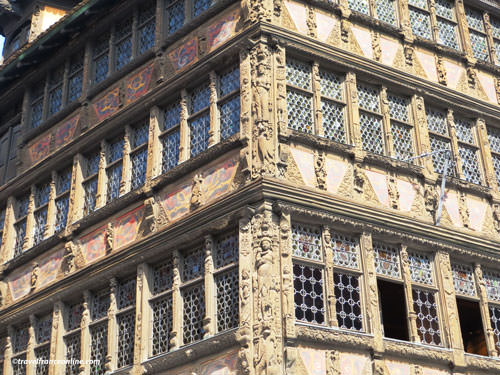
The Maison des Tanneurs, the former headquarters of the tanners’ guild, bears witness to the neighbourhood’s rich history and has been a listed historical monument since 1927.
Several narrow streets radiate from Place Benjamin-Zix. They lead to the Pont Couverts and the Lutheran Church of Saint-Thomas-et-Saint-Pierre-le-Vieux, a unique dual church that serves both Catholics and Protestants.
La Petite France was designated a UNESCO World Heritage Site in 1988, making Strasbourg one of the must-see destinations for tourists in Alsace.
Department of Bas-Rhin – Alsace region
Coordinates: Lat 48.579498 – Long 7.739519


