
Where is the Beaujolais Vineyard ?
The Beaujolais vineyard, one of France’s sixteen most prestigious wine regions, stretches across 19,000 hectares along the Saône River, straddling the Auvergne-Rhône-Alpes and Bourgogne-Franche-Comté regions. With altitudes ranging from 200 to 500 metres, this territory covers 55 km in length and 20 km in width, encompassing the towns of Chasselas and Mâcons as far as Lyon, in the Saône-et-Loire and Rhône departments.
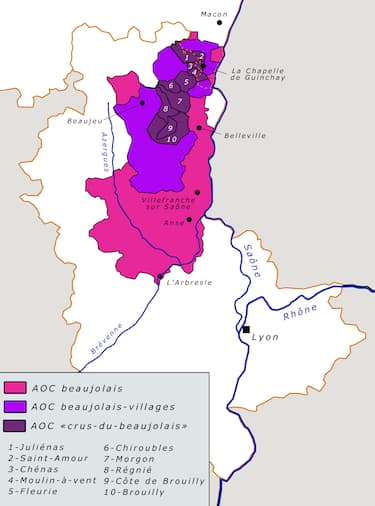
The region thus benefits from a great diversity of terroirs, clay, sand, silt, granite, limestone, and schist, offering unique growing conditions for its vines. In the north, the vines draw their nutrients from the granite, more specifically from the “granite de Fleurie – Fleurie granite.” In the centre, they thrive on the limestone slopes known as “pierres dorées – golden stones.” In the south, they grow on the schist of the Azergues Valley.
The Beaujolais vineyard benefits from a temperate continental climate, characterised by cold winters that extend into spring and hot summers due to their proximity to the Mediterranean. The region is influenced by strong westerly winds, creating a foehn effect. These winds warm and dry the air as they descend from the Massif Central. This temperature increase compensates for the low temperatures typical of a continental climate, which is beneficial for the grapes to ripen.
The Beaujolais vineyard produces approximately one million hectolitres per year. Ninety-five per cent of the total production is red wine, primarily made from Gamay Noir, also known as goye, a grape variety resulting from a cross between Pinot Noir and Gouais Blanc. Gamay N is known for its productivity and robustness, as well as its resistance to powdery mildew and Botrytis cinerea, or noble rot. It consistently produces high-quality wines, while white wines are predominantly made from Chardonnay.
Beaujolais Vineyard – 12 AOC
The Beaujolais Vineyard consists of 12AOC:
Beaujolais, Beaujolais Villages, Brouilly, Chénas, Chiroubles, Côte de Brouilly, Fleurie, Juliénas, Morgon, Moulin-à-Vent, Régnié, Saint-Amour.
It also has 2 IGP: Comtés Rhodaniens and Saône-et-Loire.
The Beaujolais Nouveau is not an AOC.
It is a primeur wine, exclusively produced in the AOC Beaujolais and Beaujolais-Villages areas.
Beaujolais Vineyard, one of the oldest in France
The Beaujolais vineyards were planted by the Romans 2,000 years ago. The local grape variety, Allobrogica, cultivated by the Gallic tribe of the Allobroges on the slopes of the Saône River north of Lyon, was already renowned.

In the Middle Ages, monasteries and abbeys, such as the prestigious abbeys of Cluny and Belleville, contributed to the development of Beaujolais production in the Morgon and Brouilly regions. The 17th century marked a turning point with the abolition of taxes in the Duchy of Burgundy, which fostered the recognition and expansion of the Beaujolais vineyards. Lyon wine merchants found new opportunities to export Beaujolais to Paris, facilitated by the opening of the Canal de Briare in 1662, which provided a vital transport route to the Loire River.
However, despite the excellence of the wines produced in the northern regions such as Brouilly, Fleurie and Chénas, those from the southern regions, near Lyon, were nevertheless often perceived as being of inferior quality compared to the wines of Bordeaux.
Beaujolais, a name recognized
Beaujolais wines began to gain recognition in the 18th century, and by the early 19th century, the modern Beaujolais vineyard was well established. However, the entire French vineyard was decimated by the European grapevine moth, followed at the end of the 19th century by attacks of powdery mildew, downy mildew, and phylloxerae. Thus, disease-resistant grafts were imported from America to recreate the vineyard. Despite these setbacks, Beaujolais wines remained popular, and the launch of Beaujolais Nouveau in 1951, spearheaded by Georges Duboeuf, brought them international renown. This commercial success not only made Beaujolais Nouveau known worldwide but also drew attention to the entire Beaujolais wine region.
Administratively, Beaujolais is part of the Bourgogne (Burgundy) region.
Coordinates for Beaujeu – Beaujolais Vineyard: Lat 46.158237 – Long 4.580456
Please remember to drink responsibly www.drinkaware.co.uk – L’abus d’alcool est dangereux pour la santé, à consommer avec modération – Photos via Wikimedia Commons: Map by Cyril5555 CC BY-SA 3.0 – Gamay grape by Viking59 Public Domain


